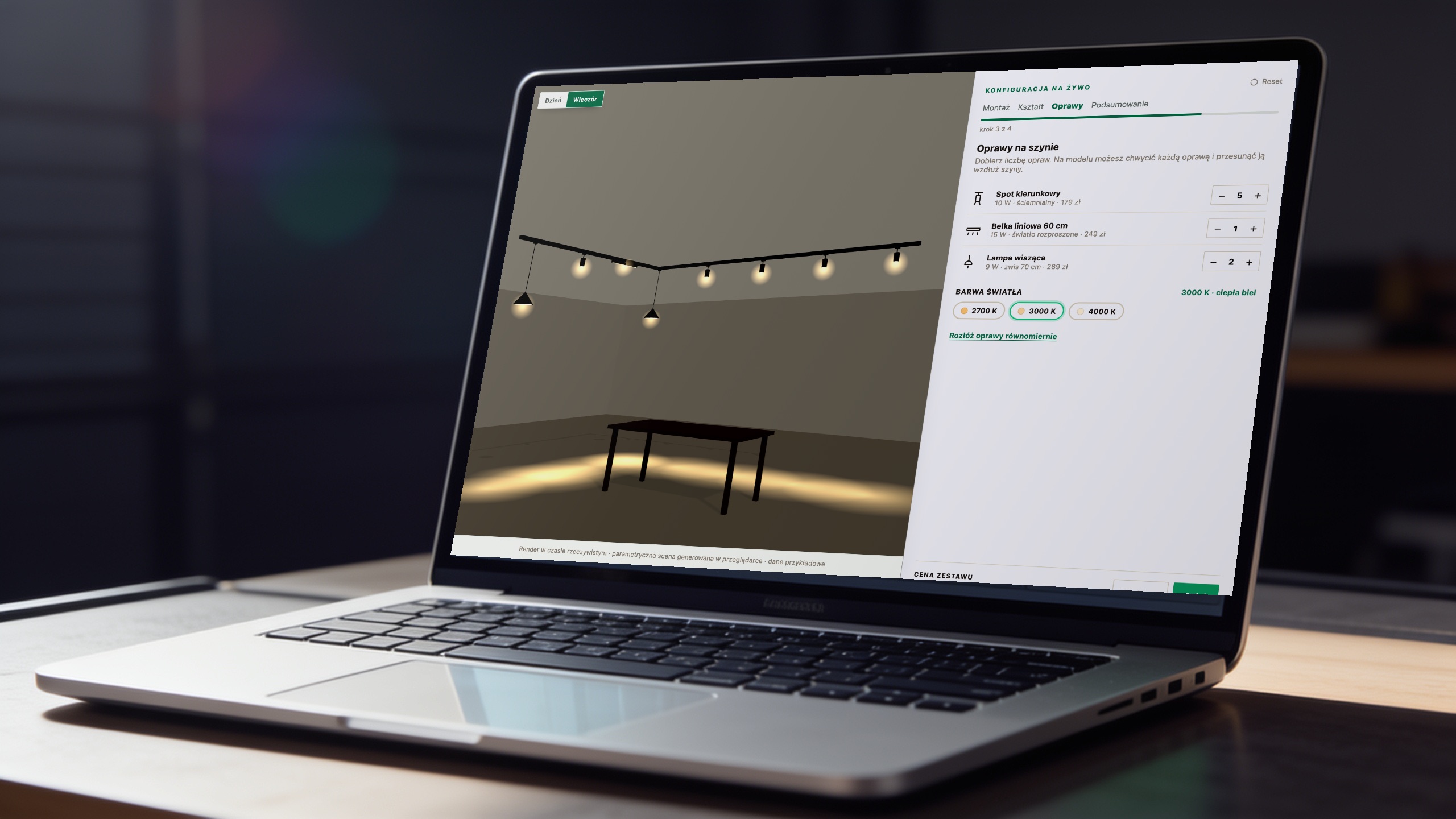
without installing an app
original / camo / carbon / Cerakote
base model, accessories, finish
desktop and mobile, no app required
What the 3D configurator solves—and what it can't replace
Here’s the honest truth before we quote you on a project: 3D visuals have a real impact on sales, but they aren’t a silver bullet. Below is what they actually do—and what you shouldn’t expect from them.
A customer is buying a technical product and wants to see how the kit is put together before making an inquiry
The choice of accessories affects the appearance, not just the price—magazine, red dot sight, body finish
You sell internationally and don't always have a sales representative on-site at the customer's location
Do you want to track which ad variations actually result in a search query, rather than just a click on the ad?
A lead with specific details (model + options) is more valuable than a lead from a "request a quote" form
Your competitors are showing static PDFs, and you want to take your first impression to the next level
3D firearms configurator: who it's for, how to plan it, and how to plug it into sales
A 3D firearms configurator is useful for manufacturers, importers, gunsmiths, and shooting accessory companies that sell kits made up of many components. This guide answers the questions that come up before a project starts: where to begin with the catalog, how to describe accessory compatibility, and what happens to the configuration when the customer clicks “send inquiry.”
Who uses a firearms and accessories configurator
In this industry, customers rarely buy a “bare” firearm. They choose a base model and then add optics, a red dot sight, a grip, magazines, a suppressor, or a receiver finish. Each of these decisions changes the look, weight, and price of the build.
Different types of companies can use the configurator:
- manufacturers and importers who want to show their full line of models and accessories in one place,
- gunsmith shops and coating companies for which the finish is the main product,
- accessory manufacturers who want to show how their rail, stock, or optics look on popular platforms,
- hunting and shooting stores that sell ready-made kits, e.g. for hunting or the shooting range,
- airsoft replica manufacturers, where personalization is a big part of the purchase.
There is one common denominator: the product consists of many components, and the customer wants to see the result before asking about the price. If your offering consists of individual items without dependencies, a regular catalog with photos is enough.
Inquiry instead of cart
Firearm sales are subject to regulations and verification of the buyer's license, which is why a configurator in this industry usually ends with an inquiry rather than an online payment. That's not a drawback, just a different business model. The customer comes to the sales rep with a ready build, and the rep handles the paperwork, timing, and terms.
In the demo above, the flow covers three types of decisions: base model, accessories, and finish. At the end, it's worth collecting not only contact details but also information needed for follow-up, e.g. the preferred pickup store or whether the customer already has a permit. That way, the sales rep's first call is about a specific setup, not about what the customer is looking for.
A separate decision is how to show the price. You can display the full price of the kit, a “starting at” price for the base model, or hide prices and provide them only in the quote. If you sell to both individual customers and retailers, the configurator can show different price lists depending on who is logged in. It's worth making this choice early, because it affects the data structure.
How to describe accessory compatibility
The most work in a 3D firearm configurator isn't the model but the data on what fits what. Compatibility knowledge is often scattered: some in the manufacturer's catalog, some in salespeople's heads, some in service notes. Before the project starts, it's worth gathering it in a single spreadsheet.
A simple structure works well: each component has a mounting type, and the base model has a list of available slots.
| Element | What needs to be documented | Example rule |
|---|---|---|
| Optics and red dot sights | Rail type, mounting height | Red dot sight available only with a mounting rail |
| Magazines | Model, caliber, capacity | Extended magazine only for a selected model |
| Grips and stocks | Platform, length, adjustment | A folding stock excludes a specific grip |
| Finishes | Available coatings, market, lead time | Coating available only in selected markets |
That spreadsheet later becomes the data source for the rules engine and the CMS panel. A new accessory with the same mount type is then added in the panel, without rebuilding the logic.
Finishes and materials: the most visible part
The demo shows four receiver finishes on a single model: original, camo, carbon, and Cerakote. For the customer, it's the most emotional decision, because they see the effect immediately. For the team, it's a decision about how many materials to prepare and how faithfully they should reproduce the actual coating.
It’s worth deciding whether you show a closed palette of finishes or also custom patterns. A closed palette gives predictable costs and a realistic preview. Custom patterns are better handled as a “custom finish” option with a field for a description and a photo, because every new pattern in 3D means work for a graphic artist.
For finishes, lead time information is also useful. A made-to-order coating extends the delivery time, so the customer should see it in the summary before sending the inquiry. This saves the sales rep conversations about why the build won't be ready next week.
How a 3D firearms configurator supports the sales team
A configuration saved in the system is more than a lead. After a few months, you can see which base models customers choose most often, which accessories they add to the cart, and at which step they drop off. That's data you can't get from a “request a quote” form.
This information is useful beyond the configurator itself. It helps plan inventory before the season, put together ready-made bundles, e.g. a hunting kit with optics, and prepare campaigns around specific configurations. If you work with a network of stores, the inquiry can go to the nearest partner along with the full configuration.
Where to start so you don't overpay
You don't need to model the whole catalog right away. A sensible first phase is one or two of the most popular base models with the accessories customers choose most often. The remaining models can be handled through a 2D path with photos and added to 3D gradually.
Before talking to a vendor, check what 3D files you have in-house or from your suppliers. Accessory manufacturers often share models with trade partners, which can shorten preparation. You can check an approximate price range for your scope in the estimator, and the quote depends mainly on the number of base models, accessories, and finishes.
Also decide in advance who in the company will own the catalog in the configurator. Prices, accessory availability, and new models change several times a year. If no one is responsible for updating the data in the panel, the configurator will soon start showing kits that are no longer offered.
You can check the price range for your project in configurator cost estimator. A different 3D mechanic is shown in 3D car configurator, and we describe the scope of our implementations on the page online configurators and presentations.