The “wow” faCTOr boosts engagement, not conversion. Three real-world spricerios where a 3D product configurator turns a cost into an investment, and three situations where you’re throwing money away. Plus: how much it actually costs and when it pays off.

A customer visits your product page. Four studio photos, a “specifications” tab. They spend 43 seconds there and leave. Out of a hundred such customers, only two come back. The rest look at the Same thing on your competitors’ sites—because your competitors also have four studio photos—or go to a brick-and-mortar store. In the latter case, you lose your profit margin.
Three.js It's not for making your page look fancy. Three.js is for stopping the client from asking „how will this look on my end?” and starting to click „buy.”.
Too Long; Didn't Read · 30 SECONDS
- Three applications that justify the cost of 3D: 1) product configurator (kitchens, furniture, cars); 2) B2B product tour (machinery, heavy equipment); 3) immersive storytelling for premium brands (perfumes, watches, alcohol).
- The "wow" faCTOr boosts engagement, not conversion. 3D focuses on conversion not on the landing page, but further down the funnel, where the customer asks, “What will this look like for me?”
- When NOT to use 3D: You sell commodities (screws, cables), have fewer than 5,000 unique users per month, and don't have an IT team to maintain the system.
- Cost: 3D configurator MVP: from PLN 30,000 (basic product) to PLN 90,000 (advanced version with ERP integration). Timeline: 8-week MVP; fixed price; initial consultation after 1 week.
Three.js It is a JavaScript library for rendering 3D graphics in the browser. No plugins, no apps—it runs on WebGL, which is supported by every phone and laptop from the past eight years. Three.js powers Apple’s websites, Nike’s campaigns, and BMW’s configurators. In a B2B context, it is mainly used for: product configurators, product tours, and immersive storytelling for premium brands.
Three.js to biblIoTeka JavaScript, which allows tworzyć i wyświetlać animowane, interaktywne grafiki 3D withoutpośrednio in a browser internetowej. Używa WebGL do renderowania grafiki, umożliwiając tworzeNo złożonych wizualizacji i gier without potrzeby wtyczek.
Check if the configurator makes sense on your end
Survey 15 questions (3 min). After filling it out, we'll both know if there's anything to talk about.
A JavaScript library that renders 3D graphics in the browser. No plugins, no apps, no downloads—it runs on WebGL, which is supported by every phone and laptop from the past eight years. Customers can rotate a product with their finger, change its color, select a size, and see the result instantly. This is not experimental technology. Three.js powers Apple’s websites, Nike’s campaigns, and BMW’s configurators.
Challenger: The „wow” effect is a trap
A typical brief at a marketing agency starts with the word „wow.”. „We want the website to be impressive”. The agency delivers: a rotating logo, parallax scrolling, particles floating in the background, and a product model in the center. It looks nice. The effect lasts 15 seconds. Then comes the moment of the purchase decision, and the customer still has to click “learn more” or call a sales representative to ask about the configuration.
The „wow” effect increases engagement. It does not increase conversions.
This is where 3D starts working to boost your profit margin—not on the landing page, but further down the funnel. Baymard Institute Research show that the biggest conversion losses in e-commerce occur on the product page and in the shopping cart—precisely where customers ask, “What will this look like in my home?”
When should you use 3D (Three.js) on a product page?
Product Configurator
You produce kitchens. A client comes with room dimensions and color preferences. Thisday, they are talking with a salesperson who draws it for them in CAD, sends a render after three days, and the client says „No, I prefer white.”. Two more days. A week has passed, the client is already talking to two other kitchen designers.
3D product configurator in Three.js shortens this loop to minutes instead of days. The customer chooses the cabinet fronts, countertops, and handles themselves, sees the result immediately, and saves the configuration via a link. The salesperson receives a finished design with a quote once the customer is already emotionally invested in the choice, since they made it themselves.
2. Product tour
You sell machinery or expensive B2B equipment. The page has icons and bullet points. „high performance”, „modular design”. The client doesn't know what that means in practice. They schedule a demo. The demo lasts a month from inquiry to visit. During this time, the competition is already talking.
Product tour with Three.js demo without a salesperson. The customer scrolls through the machine, clicks on a module, and gets a contextual explanation. They open the service panel and see that the filter can be accessed without removing the housing. When they finally schedule a live demo, they come with specific questions. Your sales representative doesn’t explain what the machine does; instead, they answer the questions of a committed customer.
3. Immersive storytelling for premium brands
Case 3: Products whose value isn’t listed in the specifications. Perfumes, watches, premium alcohol, designer furniture. Here, 3D doesn’t just showcase features—it tells a story. As the customer scrolls through the page, they’re guided by the narrative: a shot of the workshop, a close-up of the material, a 360-degree view of the product.
This is the only situation where the "wow" faCTOr makes business sense. Because your competition isn't another furniture company—it's the customer's mindset. „can spend that 30,000 differently”. In this decision, emotion wins over logsc. 3D builds emotion better than four studio pictures.

When does 3D on a website NOT make sense?
More important than „when to do” is „when not to do.” Three situations where you're throwing money away:
You're selling a commodity. Screws, cables, office paper. The customer doesn't need to rotate the product. They need to know if you have it in stock and for how much. 3D won't add anything here, and slow down the page, which, when it comes to commodity purchases, directly translates into lost orders.
You have fewer than 5,000 unique monthly users. Custom configurator MVP starts at 30,00PLN 0For it to pay off, you need enough traffic so that even a few percentage points of improved conversion translates into actual orders. Below that traffic threshold, you’re just paying for aesthetics, not sales.
You have no one to keep the site. Three.js is not a WordPress plugin. The configurator requires maintenance, new variants, catalog integration, and model updates. If your IT team consists of just one person handling Office 365, and the agency disappears after implementation, you’re better off sticking with stock photos and investing in professional product photography.
How do we do this in JSON Crew
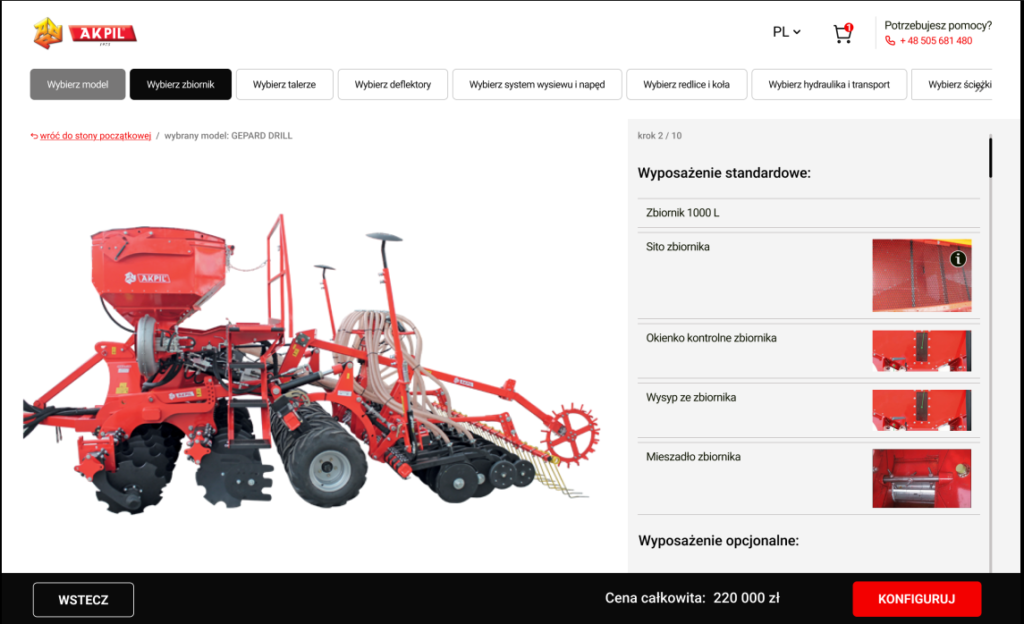
Product configurators are our core. Last year, we implemented three: Akpil (agricultural machinery) with the configuration of hundreds of parameters per model, Hunting rifle with the configuration of the model, stock, wood, caliber, and accessories, plus one construction industry project. Ten manufacturing compaNos use our platform. JSON Hub, which turns a configuration into a ready-to-sign proposal—no PDFs, no back-and-forth eemails.
Three.js is in our core stack along with Next.js and Nest.js, we don't include it in the project; instead, we build on it starting from the first sprint. This allows us to deliver the configurator's MVP in 8 weeks. Not 8 months.
The most common thing we hear from clients after implementation: “I thought the graphics were the most important thing. It turned out that business logsc was the most important—who can buy what, at what discount, and in what order.”. 3D for 30% of the project. The rest is understanding how you actually sell.
The questions we hear most often
„How much does it cost?”
MVP of the configurator from 30,000 zlotys (a simple product, a few parameters, integration with a single data source). Complex projects with hundreds of parameters and ERP integration – up to 90 thousand. Everything is a fixed price; we have an initial consultation after one week, with no price ranges or change requests along the way. You receive the budget after 7 days, not after a 45-minute call.
„How long does it yese?”
MVP 8 weeks from signing the contract to production. The first working configurator in your hands after 3 weeks, a 40% version, but you can already show it to customers and gather feedback. We break down the path to the MVP into two-week sprints, each of which ends with a demo, not a slide presentation.
„Does my product fit in 3D?”
It’s a good fit if the customer decides on the configuration (size, material, color, features) and your website gets over 5,000 unique visitors per month. It’s not a good fit if you sell 15 variations of the Same product and the customer just wants to see the price. During our first conversation, we’ll tell you straight up which group you fall into; sometimes the recommendation is „Don't build the configurator, yese better pictures and a price calculator.”.
What to do if you're interested
Schedule a 30-minute diagnostic consultation. It’s free. We’ll come prepared—show us your product and sales processs, and we’ll tell you whether 3D makes sense and at what stage of the sales funnel. If it doesn’t make sense, we’ll tell you straight up where your real opportunities lie.
See our product configurators →
P.S. Three things you won’t see on a typical Three.js agency website, but which determine whether a project will succeed: real-world load times on the client’s phone (not the developer’s laptop), integration with your PIM and ERP before you see the first render, and testing with a real-world client before you launch it into production. Without these three elements, you have a nice mockup, not a sales tool.
Frequently Asked Questions
What is Three.js?
Three.js is a JavaScript library for rendering 3D graphics in the browser. It runs on WebGL, which is supported by all phones and laptops from the past 8 years. No plugins, no app installation required. Three.js powers, among other things, BMW configurators, Nike campaigns, and Apple’s interactive websites. In the B2B seCTOr, it is mainly used for product configurators, product tours, and immersive storytelling for premium brands.
When should you use 3D on a product page?
Three situations where 3D truly pays for itself: 1) product configurator (the customer selects variants, colors, and sizes themselves and sees the result—kitchens, furniture, cars); 2) B2B product tours (exploring a machine or expensive equipment before scheduling a demo with a sales representative); 3) immersive storytelling for premium brands (perfumes, watches, designer furniture—where emotion drives the purchase). Everywhere else, 3D usually equals a waste of money.
How much does the 3D configurator in Three.js cost?
The price for a 3D configurator MVP ranges from 30,00PLN 0 (simple product, a few parameters, integration with one data source) to 90,00PLN 0 (complex projects with hundreds of parameters and ERP integration). At JSON Crew, we provide a fixed-price quote after a one-week initial consultation, with no “price ranges” or change requests during the project. Implementation yeses 8 weeks, with the first working version available after 3 weeks. Post-launch maintenance costs ~5,000–15,00PLN 0/year.
Three.js vs WebGL vs Babylon.js: Which One Should You Choose?
WebGL is a low-level, raw graphics API for browsers. Three.js and Babylon.js are WebGL libraries that make development easier. Three.js has the largest community and the most tutorials; it’s best suited for simple configurators and storytelling. Babylon.js offers more out-of-the-box capabilities for complex 3D scenes and better developer tools; it’s used for games and simulations. For 95% of B2B projects (configurators, product tours), Three.js is sufficient and wins out in terms of implementation speed.
Does 3D content on a website boost sales?
Yes, but not in every context. 3D increases conversion rates on product pages (the Baymard Institute shows that this is where the biggest conversion losses occur in e-commerce—“what will this look like in my home?”). A 3D configurator shortens the sales cycle for kitchens or furniture from days to minutes. But 3D does NOT increase sales when: you’re selling a commodity (screws), the customer doesn’t need to rotate the product, or the page yeses 8 seconds to load (in which case, 3D = lost orders).
What are the technical requirements for Three.js?
Client-side requirements: any phone or laptop from the last 8 years (WebGL is natively supported in Chrome, Safari, Firefox, and Edge). Project-side requirements: hosting with a good CDN for 3D models (typically 1–10 MB per model), integration with a product management system (PIM, ERP), and an IT team for maintenance (frontend developer + DevOps). Three.js is NOT a WordPress plugin; it requires a developer. If your team consists of just one person using Office 365, you’re better off choosing a template instead of custom 3D.
About the author
Jędrzej SiewierskiCEO and co-founder JSON CrewSince 2024, he has been building product configurators for B2B compaNos (manufacturers of agricultural machinery, hunting weapons, modular homes, and IoT electronics) as well as JSON Hub, his own SaaS platform that integrates Customer Relationship Management, carmated quoting, and project management. Co-author of a digital sales transformation methodology: shortening the path from interest to purchase through a configurator + carmated quoting + Customer Relationship Management. Stack Next.js, Three.js, Nest.js, React Native. Contact: contact@jsoncrew.com · LinkedIn.