How much does a product configurator cost, and how to prepare for a quote
Almost every manufacturer asks “how much does a configurator cost” before talking to a vendor. This guide doesn't repeat the list of EASY, MID, and HARD tiers. It shows what to prepare before the conversation, how to compare quotes from different companies, and what costs only show up after launch.
Why two quotes for the same configurator differ several times over
A manufacturer sends the same brief to three vendors and gets three quotes that are hard to compare. Usually this isn't due to different rates, but to a different understanding of the scope. One company quoted just the interface with hard-coded prices, the second a rules engine with an editing panel, and the third added CRM integration and a PDF generator.
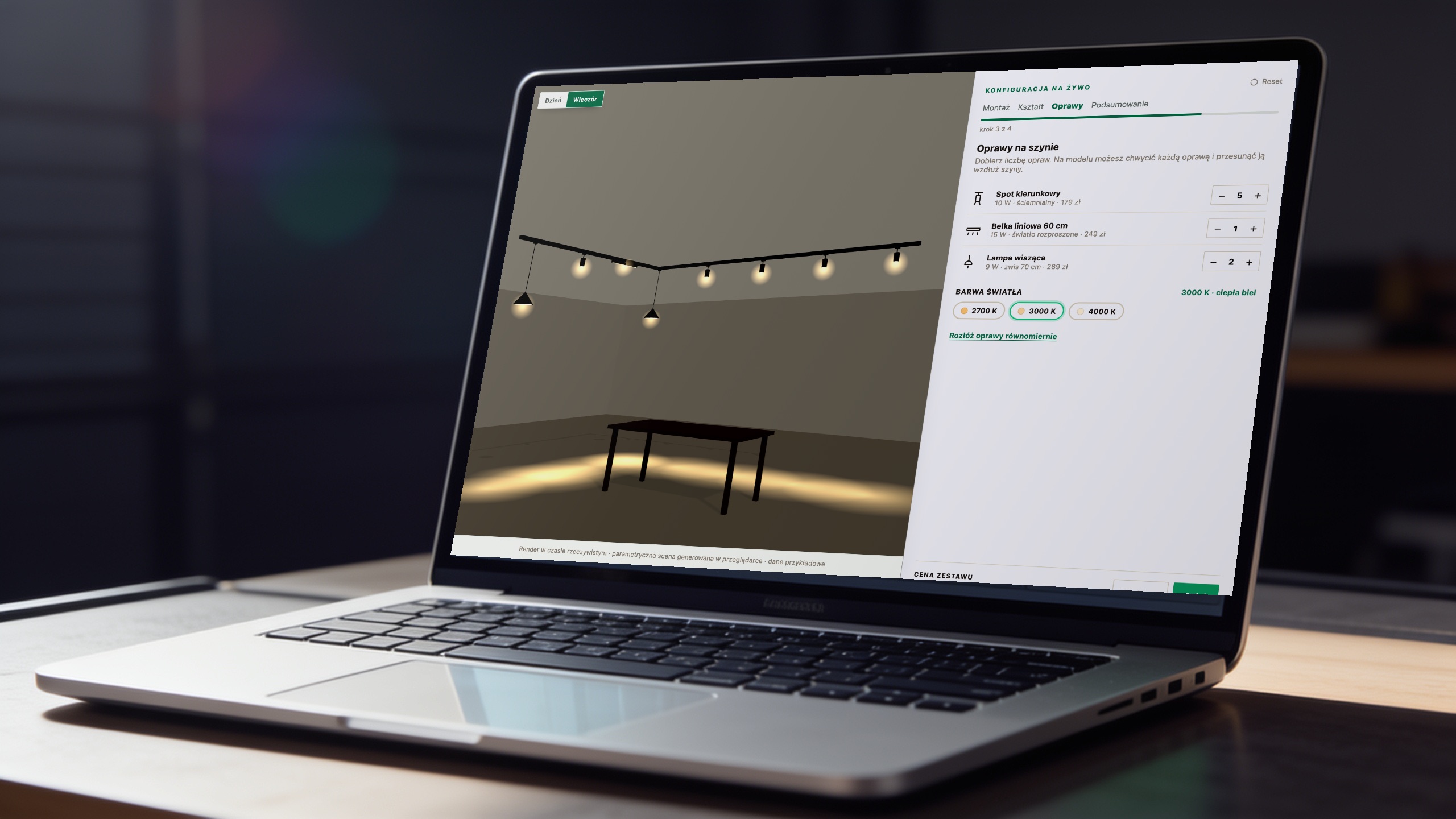
That’s why, before you compare prices, make sure you’re comparing the same thing. In the demo above, the estimator asks about exactly the elements that most often make quotes diverge: the number of options and rules, the visual layer, the quote document, and integrations. The same list works as a template of questions for any vendor.
What to prepare before the pricing conversation
The more specifics you bring to the first call, the narrower the range and the shorter the discovery. You don't need a finished specification. It's enough to gather what your sales team works with every day:
- your current price list or catalog, even if it's a PDF or a spreadsheet,
- a list of exceptions your sales reps know “by heart”: what excludes what, what requires a surcharge, what is available only in selected markets,
- information on who will update prices and options after launch,
- systems the configuration should go to: CRM, ERP, email inbox,
- photos, renders, or 3D models, if they exist,
- two or three typical quotes a sales rep prepared manually in the past month.
The last point is the most underrated. A real quote shows the actual pricing logic better than a process description, because it reveals discounts, bundles, and line items nobody thought of when writing the brief.
The starting point doesn't have to be a well-organized database. In the project for agricultural machinery manufacturer Akpil, the source material was a 136-page PDF price list, which became a single configurator covering 57 machine types. Cleaning up the data is part of the work, but it needs to be factored into the schedule.
Decisions that have the biggest impact on configurator cost
Some decisions are made deliberately, others “along the way” during conversations. It’s worth knowing which of them have the biggest impact on the budget before someone says “while we’re at it, let’s add this.”
| Decision | Cheaper option | More expensive option |
|---|
| Product presentation | Photos or 2D graphics that switch as options are selected | 3D model with material and accessory variants |
| Price | Estimated or final price after configuration | Price recalculated with every click, separate price lists for dealers and end customers |
| Configuration output | Email or form with a summary | PDF quote with a number, terms, and versioning |
| Languages | One version | Multiple versions with separate price lists and currencies |
| Product data | Entered in the CMS panel | Two-way sync with ERP or PIM |
None of these decisions is inherently better. The more expensive option makes sense when it solves a problem that is already costing you sales reps' time or lost inquiries.
How much a configurator costs after launch, and what to ask right away
The implementation price is only part of the bill. The configurator runs on a server, uses libraries that receive security updates, and the product catalog changes every season. Before signing the contract, ask the vendor a few things directly.
- Who pays for hosting and where the application runs: on your side, with the vendor, or in the cloud.
- What you can change yourself in the panel and what requires a developer. Changing a price without a change request is standard, but adding a new dependency rule may not be.
- How fixes and further development are billed: a block of hours, per-change orders, or a subscription.
- Whether you get the code and documentation, or are locked in to a single vendor.
The answers to these questions often change how the quotes rank. A cheaper implementation without a price editing panel can cost more within a year than a pricier one where the sales team updates the catalog themselves.
Off-the-shelf SaaS tool or a custom-built configurator
There are platforms on the market where a configurator is assembled from ready-made building blocks for a monthly fee. They work well for simple products with a few options and linear pricing. Problems start with rules the builder didn’t anticipate, an unusual dealer price list, or integration with the company’s ERP.
A configurator built for your company costs more up front, but it mirrors your process rather than the other way around. A good test is to write down the three hardest rules in your product range and ask an off-the-shelf tool vendor how they'll handle them. If the answer is “we'll work around it with a form,” you have your answer.
How to reduce the budget without compromising the project
The safest approach is to cut breadth, not depth. It's better to launch a configurator for one product line with complete rules than for the entire catalog with simplified logic that lets through configurations that can't be manufactured. An incorrect quote sent to a customer costs more than a missing product line.
The second thing you can postpone is the visual layer. A 3D model, an elaborate PDF, or a dealer portal can be added in a later phase, once your analytics show which steps customers abandon. The rules engine and data structure, however, are not worth simplifying at the start, because rebuilding the foundation is the most expensive change in the entire project.
Finally, go back to the estimator result and treat it as a starting point for the conversation, not a final price. The range tells you which complexity category your project falls into. The answer to how much a configurator costs for your company only emerges after the rules are mapped during discovery.
You'll find more about implementation scope on the page online configurators and presentations, and how the configurator connects with quoting is covered in the description of digital quoting and pricing. A production example is described in agricultural machinery manufacturer case study.
That's a pretty high bar. Is there a way to start with something smaller?
Yes. Most of our projects are broken down into phases. Phase 1 typically consists of the configurator itself, without a 3D layer, without deep integrations, and without a dealer dashboard. You add the rest once the configurator is generating revenue and you have the data to determine what’s actually needed.
We have a complex pricing algorithm. Is it even possible to build something like that?
This is the most common question. In practice, most algorithms can be expressed as a set of rules and relationships: if A and B, then X; if A and not B, then Y. Before providing a quote, we conduct a brief discovery phase, map out these rules, and use that information to provide a realistic scope for the project.
What exactly happens after I submit the result from the estimator?
We'll receive your submission with your answers and budget range. Within one business day, we'll schedule a 30-minute discovery call. No sales pressure: you describe your needs, and we'll outline the realistic scope, phases, and pricing for your specific situation.
How are you different from an agency that also offers configurators?
Most agencies provide an interface. We build a rules engine, integrations with CRM and ERP systems, an admin panel for your team, and—optionally—our own quoting system (JSON Hub). Once the system is up and running, your sales department manages the configurator on its own—without having to pay us for every price change in the catalog.
How long does implementation take, and can I count on a fixed deadline?
Yes, you can count on a fixed timeline—we establish the schedule and milestones during the specification phase following the discovery phase, based on the actual scope and business priorities.
Can I see the configurator in action before I make a decision?
Yes—this is our Showroom: in the /showroom/ section, you'll find, among other things, a 3D weapon configurator (WebGL, variants, pricing), a 3D car configurator (GLB, cost estimate), a house configurator (steps, construction options, dynamic pricing), and a cost estimator. All of them demonstrate our production workflow—the same code and the same patterns that we use for our clients. During the discovery phase, we can also show you a live demo from the Akpil project.