A product configurator is a tool that allows your customer to build an offer themselves – choose variants, see the live price, and send a request ready for order. Instead of waiting two days for a quote from a salesperson, the customer gets it in three minutes. In this article: full definition, five types of configurators, who it's profitable for, how implementation works, and how much it costs.
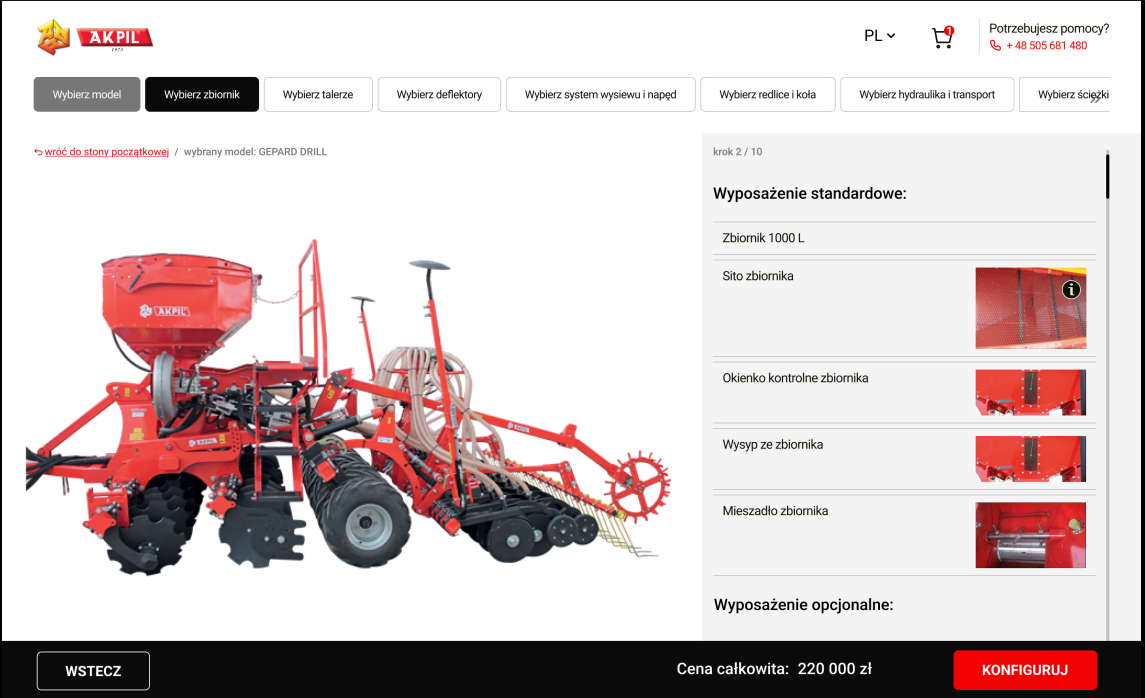
If you've ever tried to buy a customizable product online – custom furniture, an agricultural machine with options, a laptop with on-demand parameters – and seen the „configure” button that led you through selecting options and showed you a live price: you were just a user of a product configurator.
On the one hand, it's convenient for the buyer. For the selling company, it's a tool that shortens the time from inquiry to quote from days to minutes, eliminates errors in quotes, allows the customer to make a purchase decision without calling a salesperson, and relieves the sales team of repetitive work.
According to Forrester Research studies cited by Polish implementation companies, 74% B2B clients expect the ability to configure products online themselves, a 68% twierdzi, że takie narzędzie znacząco wpływa na ich decyzje zakupowe. W rezultacie dzisiaj konfigurator produktowy nie jest już przewagą konkurencyjną – jest standardem, którego brak Cię kosztuje.
A configurator isn't a feature. It's a way to get a customer to buy before they call the competition.
You already know you need a configurator? Schedule a call – we'll tell you which bracket you'll land in and how long it will take. | Arrange a call |
Product configurator definition: what is a product configurator
Check if the configurator makes sense on your end
Survey 15 questions (3 min). After filling it out, we'll both know if there's anything to talk about.
Product configurator an interactive tool that allows the customer to independently select product variants, options, and accessories, and then see the price, specifications, and visualization in real time configured order.
First of all, in its simplest form, it's a form with dropdown lists where each option change immediately recalculates the price. On the other hand, in a more advanced version, it's an interactive 3D visualization of the product that changes with the selection, plus business logic (exclusion rules, dependencies, discounts, promotions), plus integration with CRM, ERP, and a PDF quote generator.
Configurator is not:
- PDF catalog – The catalog shows all products, the configurator guides you through the selection and calculates the price for a specific configuration
- Price calculator - the calculator works, but doesn't show the product, doesn't enforce dependencies, doesn't generate an offer
- Inquiry form – the form collects data, the configurator builds the product
- E-commerce with a shopping cart e-commerce sells ready-made products, a configurator builds a product for the customer
- Configure-Price-Quote CPQ is primarily a tool for salespeople during the quoting stage. A configurator is a tool for the customer before they contact a salesperson. They can work together.
Five types of product configurators
In other words, under the common name „configurator” lie five different categories of tools. The difference between them is the difference between a Fiat 126p and a Tesla – they are all cars, but we are talking about a different class of solutions.
TYPE 1 · BASIC
Parametric Configurator
Dropdown list with variants (color, size, material), price field. Customer selects, price updates. Good for simple products: t-shirts, mugs, catalog furniture. Implementation: 1-2 weeks. Cost: 5,000-15,000 PLN.
TYPE 2 · B2B INDUSTRIAL
Logic-based configurator with rules
Dozens of parameters with exclusion rules and dependencies. Example: an agricultural machinery configurator – choosing shafts, widths, hydraulic options, where each option has limitations („tire shaft requires a transport drawbar”). The customer cannot configure something that cannot be produced. Implementation: 8-12 weeks. Cost: 60,000-150,000 PLN.
TYPE 3 · 3D VISUAL
3D configurator in the browser
Product shown in 3D, customer rotates it with their finger, changes upholstery color, sees the effect immediately. Technology: Three.js in the browser, without downloading the app. Kitchens, designer furniture, luxury goods. Implementation: 12-16 weeks. Cost: 90,000-200,000 PLN.
TYP 4 · E-COMMERCE + CART
Configurator with instant purchase
Configurator integrated with a shopping cart – the client configures, adds to the cart, and pays. You sell customizable B2C or B2B SMB products without talking to a salesperson. Implementation: 10-14 weeks. Cost: 70,000-180,000 PLN.
TYP 5 - ENTERPRISE CPQ
Configure-Price-Quote for Large Organizations
Configurator + CRM + quote generator + dealer portal in one. For enterprises with 50+ salespeople. Tools like Epicor CPQ, Tacton, Configure One. Ready SaaS, per-user subscription. Implementation: 2-4 months. Cost: 80,000-400,000 PLN setup + $75-200/user/month. Detailed comparison here.
How the configurator works — four layers
In practice, every configurator, regardless of type, operates on four logical layers. When you look at a quote from a software house, each of these layers costs money, and each one can go wrong.
Layer 1: Product Model
Product data – variants, options, base prices, dependencies. The source of truth is usually ERP or PIM (Product Information Management). Without good data, a configurator shows nonsense. That is Problem number one with implementation - Rules live in the salesperson's head, not in the system.
Layer 2: Rules Engine
Business logic - what excludes what, what requires an additional component, how is discount calculated for customer X on orders above amount Y. In simple configurators, this is a few conditions in JS, in advanced ones - a dedicated engine supporting hundreds of rules and thousands of combinations.
Layer 3: User Interface
What the client sees and clicks. Here are the biggest UX decisions: how many steps, whether to use a progress bar, when to show the price, and how to visualize unavailable options. EDISONDA writes directly: Designing a B2B configurator is about designing decisions, not pretty forms.
Layer 4: Integrations
CRM (save lead), ERP (current price list and stock levels), PDF generator (company-branded quote), email/SMS (notifications), marketing automation (retargeting customers who abandoned configuration).
Who benefits — 5 criteria
First and foremost, a product configurator is not a one-size-fits-all solution. For some companies, it's a key investment that pays for itself in 6 months. For others, it's an expensive toy. Five criteria can help assess this.
| Criterion | The configurator makes sense | The configurator doesn't make sense |
| Number of product variants | Over 10 combinations | 1-5 variations |
| Average offer value | Above 15,000 PLN | Below 5,000 PLN |
| Monthly offer | Above 10 | Below 5 |
| Number of traders | 3+ active sellers | Lack of a salesperson or a „temporary” team” |
| Sales process | Client is asking about options/pricing before purchase. | 90% of repeatable sales without setup |
As a result, if you hit four out of five positive criteria – the configurator will almost certainly pay for itself in the first year. However, if you hit two or fewer – improve your sales process foundation before investing. A configurator won't fix a lack of salespeople or a lack of proactive selling.
Benefits — from real numbers
What's more, these are not hypothetical promises. Below is data from real-world implementations (ours + published case studies from Polish companies).
74%
B2B clients expect self-service online configuration (Forrester)
+198%
Increased conversion for Pneumat after implementing the configurator (Delante case study)
30 minutes
instead of 2 days for valuation (typical result of manufacturing companies after implementation)
+10-20 pp
win-rate growth after CPQ implementation (Gartner, Nucleus Research)
In addition, there are additional effects that are not immediately visible in the spreadsheet:
- Error reduction in valuations the salesperson won't make a mistake in the calculator because the system enforces the rules
- Shorter sales cycle – the client comes to the meeting with a ready-made configuration, not starting with „how much does it cost”
- Better data for analytics – you know what configurations customers are trying to build that aren't offered, where they get lost
- Self-service for small orders - The salesperson only handles large deals; small ones are self-service.
- Retargeting effect – A client who configured a product and left without purchasing is a hot lead for marketing campaigns
Configurator vs. other sales tools
Another common objection is: „We already have a CRM / quote generator / calculator – why do we need a configurator?”. Answer: these are different tools for different stages of the sales process. Namely: a configurator does not replace a CRM – it works with it.
| Tool | Funnel stage | Who uses | What does it give |
| PDF Catalog | Interest | Client | It shows an offer, no interaction |
| Pricing calculator | Evaluation | Client | It counts the price, it doesn't show the product |
| Configurator | Evaluation + Decision | Client | Build + price + inquiry |
| Customer Relationship Management | Lead Management | Salesperson | Lead tracking, follow-up, history |
| Configure, Price, Quote | Bidding | Salesperson | Generating a quote after speaking with a client |
| E-commerce | Purchase | Client | Cart + payment |
In practice, in a well-organized process, these tools work together. The client configures the product (configurator) → leads go to CRM → the salesperson uses CPQ for the formal offer → the client pays in e-commerce. For medium-sized companies, we can combine four of these layers into one tool – JSON Hub, our platform that replaces a separate configurator + CRM + quote generator + dealer portal.
Implementation — what does the process look like
In summary: implementing a configurator is not „buying an off-the-shelf product.” It's a project that requires your team's involvement – especially sales representatives and designers who know the sales rules. The typical process is outlined below.
Week 0-1
Discovery
A software house meets with your salespeople to extract pricing rules. Business document, 15-40 pages.
WEEK 1-6
Build
Two-week sprints. After each one, a working piece for testing. Your salesperson comments on the prototype.
WEEKS 6-10
Implementation + testing
Configurator on the website, testing with salespeople on real configurations. Fixes, training.
Purchase Order Launch
Maintenance
~20% value of the project annually. New variants, price list updates, integrations.
We have detailed 5 most common implementation problems – mandatory reading before signing any agreement with a software house.
How much does the configurator cost?
Bottom line:
- Simple configurator (Parametric, one product line): 35,000-60,000 PLN implementation, 6-12,000 PLN/year maintenance
- Advanced configurator (several lines, rules, integrations): 87,000-150,000 PLN implementation, ~PLN 18,000/year
- Advanced Configurator (hundreds of variants, 3D, ERP, multi-tenant): 175,000–300,000 PLN implementation, 18,000+ PLN/year
Full pricing matrix, three ROI models, and a response to the question „when is it not worth it?” in a separate article about configurator prices.
Configurator in Poland — Our Case Studies
On the other hand, theory is one thing, and real-world implementations are another. Below are examples from our portfolio.
Akpil - agricultural machinery
57 machine types, 136-page price list, hundreds of parameters per model, exclusions between options („tire roller requires a transport drawbar”). Before the configurator: the client opened a PDF, calculated in Excel, called the salesperson, and waited two days for a quote. Now: they configure online, see the price, and send a request ready for order. Details in the case study.
Hunting weapon
Model configuration + stocks + wood + caliber + magazine + sights + accessories. Hundreds of combinations, each with a different price, weight, and licensing requirements. The customer configures it themselves, seeing the total in real-time. Online store + distribution through a network of branches. Case study here.
Construction Company - Project under NDA
500 product variations, 10 salespeople. Before: quoting took 2 days. After: 30 minutes. Three out of ten inquiries previously got lost because the offer was too slow. After implementation – deals closed faster, before the client checks the competition.
Frequently Asked Questions
Does the configurator replace the salesperson?
No. It relieves him of repetitive work (calculating options, generating offers) so he can focus on talking to a customer ready to buy. The salesperson still negotiates terms, builds relationships, and closes the deal – they simply enter the conversation at a better stage.
How long does implementation take?
From 1-2 weeks (simple parametric) to 16 weeks (advanced 3D with integrations). MVP of an extended configurator – 8-12 weeks.
Does the configurator only work for physical products?
No. It works equally well for services with variants (architectural design, insurance policy, recruitment package), configurable software (licenses, modules), and subscriptions (plans with add-ons).
Can I build a configurator myself?
For a simple parametric product configurator – yes, a WordPress plugin or low-code solution will handle most cases. For an advanced one with rules, integrations, and 3D – no. That requires a development team specializing in rules engines, UX, and integrations.
How to choose a software house for implementation?
Five checkpoints: real IoT/configurator in the portfolio, in-house development team (not a „network of partners”), showcasing code and architecture of specific projects, Fixed Price for MVP, maintenance plan in the main agreement. We broke this down separately.
What's next if you're considering implementing
Order a diagnostic call 30 minutes, free. Come with three answers: 1. What product do you sell and how many variations does it have? 2. How many proposals do your salespeople make per month? 3. What is the average offer value? | Fill out the form |
As a result, we’ll state it plainly: does a configurator make sense for you, in what type (parametric, logic-based, 3D, enterprise), in what price range will it land, and is it worth starting now—or should you first organize the foundations of your sales process.
P.S. The most common reaction after our diagnostic conversation is: „I didn't realize we had enough variations for this to be profitable.” The configurator isn't for everyone, but when it fits, it pays for itself in 6-18 months – mainly through sales representative time savings and a higher win rate thanks to faster customer responses. The rest (3D, visualization, retargeting) are the cherries on top. First, the cake: the sales rep stops calculating in Excel, and the client gets an offer in minutes.