15 firms on the shortlist. Each promises a „tailor-made solution.” The production director has to choose one. This article is not another „5 things to look out for” list. It's a practical filter that leaves you with three real candidates. Maybe two.
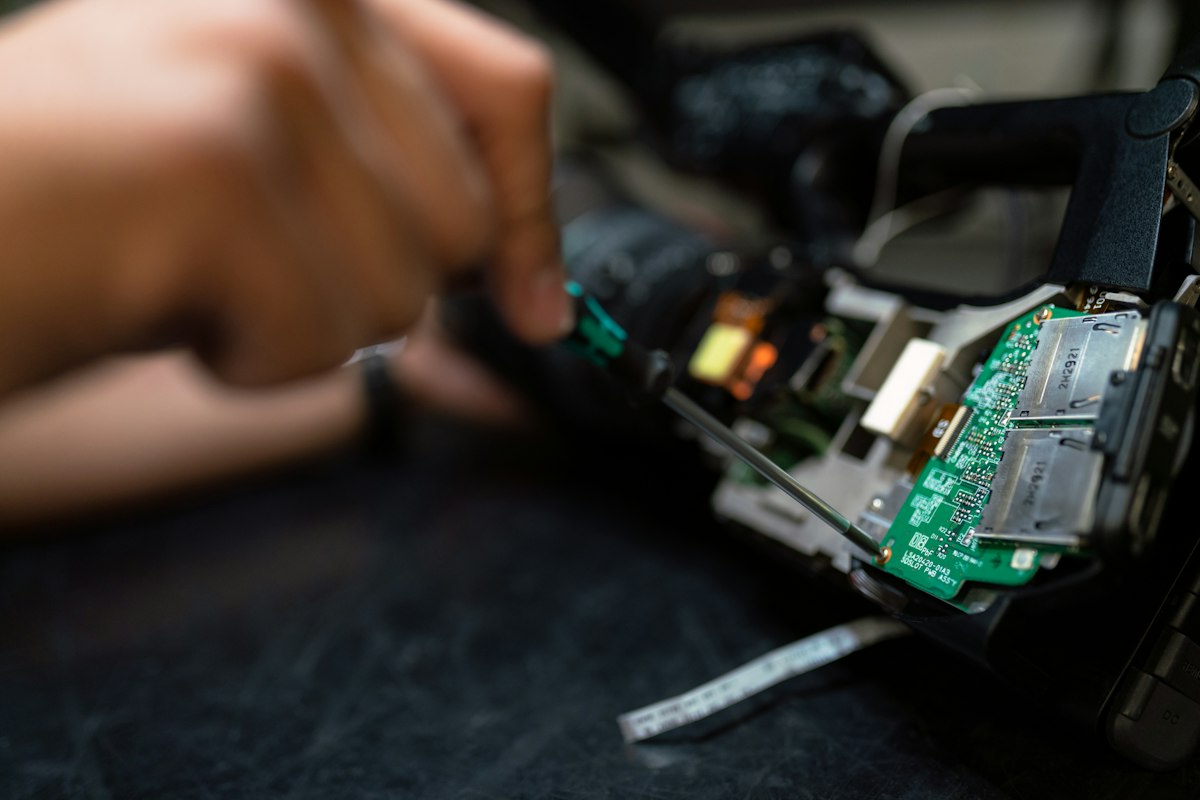
The third breakdown this quarter. The line is down for forty minutes, then another twenty for diagnostics. In a typical medium-sized factory, an hour of line downtime costs tens of thousands of zlotys. Multiply that by three breakdowns a quarter. The production director gets a call from management: „Why didn't we know sooner?”. The answer is simple and frustrating - because The sensor data sits in ten different systems, and no one looks at it in one place..
If this sounds familiar, you're probably at the point where management said „we're buying an IoT dashboard.” And now you're sitting in front of a list of fifteen companies, each promising a „tailor-made solution for your needs.” And you don't know which one to choose.
This article isn't another „5 things to look out for” list. It's a practical filter that you'll apply to this list of fifteen companies, and you'll be left with three. Maybe two.
A bad answer to a good problem
One email with a concrete point each week.
AI, B2B sales, and implementations. No spam, unsubscribe with one click.
Before you go any further, I need to challenge one assumption.
Most companies that come to us asking „build us an IoT dashboard” start the conversation with: „We first checked ready-made SaaS solutions, but none of them fit.”. The problem is they checked SaaS products that cost 500 PLN per user per month, with an interface designed for a generic client. They skipped two levels too far.
SaaS dashboards make sense. For small businesses. Up to three product lines. Without ERP integration.
The problem starts when you have:
- More than one bet
- Old PLC and new PLC from the same manufacturer, which do not communicate with each other via OPC UA
- Historical data in SAP/MES, real-time data in InfluxDB, quality data in QMS
- Regulator that requires data to remain within your infrastructure
At this point, every SaaS either limits you or costs as much as a custom solution. And in three years, when you want to connect a fifth plant and add a predictive model, you'll be dependent on the roadmap of a vendor who has 400 other clients.
A custom IoT dashboard is not a cost. It's A strategic option for the data you have today, but do not yet understand.
The good news is that distinguishing a good tech partner from a contender isn't just a gut feeling. It's six questions to ask in a 45-minute conversation. Companies that understand this choose a partner differently than companies that simply buy software. Below are those questions.
Six criteria that will realistically differentiate companies
Forget „industry experience” and „strong team.” They mean nothing. Here is a list you can run every company on your shortlist through.
1. Do they have a real IoT in their portfolio, or just „dashboards”?”
The difference is fundamental. A company that built three dashboards for CRM and now calls itself an „IoT company” doesn't know what to do when OPC UA The packets are being lost every 200 ms, and the Siemens driver says it's online but doesn't respond to reads.
Control question: „How many real-time data sources have you supported in your largest project? What protocols? What throughput?”. If the answer is „we integrated with an API” – that's not IoT, that's SaaS integration. Leave.
2. Do they understand your edge layer, or just the cloud?
Most errors in IoT dashboards don't happen in the cloud. They happen between the controller and the IoT gateway. A company that only knows AWS IoT Core In Azure IoT Hub, you order hardware from a „friendly integrator” – and when something breaks, you'll be calling two companies that will point fingers at each other.
Control question: „What does your sensor-to-dashboard stack look like? Who is responsible for the edge layer?”. If the answer is vague, you have a problem.
3. What do their operational dashboards look like, as opposed to their presentation dashboards?
It's subtle but important. Many IoT portfolios consist of nice animations, gradients, and 3D renders of machines. Those are dashboards. for a presentation to the board. You need a dashboard for the operator, who looks at it eight hours a day.
Control question: „Show the dashboard that the operator looks at during production. Not the version for management.”. A company that doesn't have such a dashboard in its portfolio has likely never worked with a real end-user.
4. Can they work with your IT, or do they want to build an enclave?
A worse version of the same story: a company builds you a beautiful dashboard, but hosts it on their server, with their own authorization system, disconnected from your AD. In six months, you have IT enclave – a system that cannot be audited. A year later, this lands on the CISO's radar and the project dies.
Control question: „What does integration with SSO and our identity system look like? Where is the data located? Who has access to it?”. Companies that respond with „our admin panel” instead of „your Active Directory” disqualify themselves.
5. What do they do after implementation
An IoT dashboard is not a project that ends. Drivers are updated, production lines are expanded, regulators change requirements. A company that treats implementation as „fixed scope, fixed price, goodbye” will leave you with a system that will be dead in two years.
Control question: „What do your maintenance contracts look like? What is the SLA for production incidents? How many people on your team will genuinely know our project after a year?”. If they respond with generalities – then executor, not partner. The executor will do exactly what you wrote in the brief, and then disappear.
6. Can they say „no”?”
This is a final test. A company that agrees to everything you say during the first interview is either desperate or not listening. A good company will come for a second interview and say: „Half of what you want doesn't make sense because of X. But it's worth doing Y, which you haven't thought of.”.
Control question: „What in our brief do you think doesn't make sense?”. The executor will reply, „Everything is great, we'll build it.” The partner will reply, „That's wrong, don't do that.” You hear the difference.
If you’ve run your shortlist through these six criteria, you probably have two or three candidates left. Now, here’s the list of red flags that will weed out the rest.
Four red flags

They don't have their own programmers, only a „network of partners.”. This means they'll outsource your work to someone you don't know, in a place you can't see. For IoT, where debugging requires deep domain knowledge, this won't work. The executor will pass it on. The partner works with their own team.
They don't show the code or architecture. They ask you to sign an NDA, then they show slides with AWS and Azure icons. If after two meetings you haven't seen an architecture diagram of a specific project they built – they haven't built anything.
They count work hours in Excel, not in sprints. IoT projects have many unknowns. A fixed-price quote for 18 months without milestones isn't a quote, it's a lottery. Either they'll add change requests, or they'll deliver something that works, but doesn't meet your actual needs.
They promise „AI-powered predictive maintenance” in the initial offering. Before you have the basic data in one place, talking about AI is marketing. A company that starts with AI doesn't understand that 80% of the value of an IoT dashboard is the availability and cleanliness of the data. Gartner in the definition of IoT platforms clearly prioritizes data management and integration over analytics – and it's right. AI is the cherry on top. But first, the cake.
How do we do this in JSON Crew
Honestly, we are not a company that has built thirty IoT dashboards. We are a software house that I build product and SaaS configurators for manufacturers. The last year saw three implemented configurators (Akpil – agricultural machinery, Knieja – hunting rifles, plus one from the construction industry) and ten manufacturing companies on our platform. JSON Hub. This year we also built APP Smart Control – Heating control system for private, industrial, and public facilities. It is the only dedicated IoT system we have in our portfolio.
And that's exactly why this article makes sense. Because in the product configurator for a machine factory and in the IoT dashboard for a production line, it appears the same class of problemsreal-time data from multiple sources, operator UX, ERP integration, the question „who will maintain this in a year.” We see the same pitfalls from both sides.
When we talk to a client considering a custom dashboard, the first meeting usually looks the same. We come in, sit down, and the production manager says: „We want a dashboard where all lines, all alerts, and all KPIs are visible, and in real-time.”. We answer: „Show us what your morning looks like today, when your shift begins.”. And instead of estimating, please grant us access to the boiler room.
This is the difference between a partner and an executor. The executor values the brief. The partner values reality.
When we take on a project, we start with a week discovery, in which we sit with your operations team – not management, not IT – and look at the data you already have. From this week, there's a document that says: „Of the three things you want to monitor, two make sense right away, the third requires tidying up at the edge layer first.”. This is the point where many projects with other companies wouldn't even get started. For us, this is the first deliverable.
Then we work in two-week sprints, with a demonstration of a working piece every sprint. Your operator sits in front of a working view in the third week, not in the sixth month. We make changes when they are inexpensive, not at the end when they are expensive.
Stack Next.js, Nest.js, Three.js for 3D visualizations AWS or on-premise, depending on your regulator's requirements. This is the same stack we've built configurators for Akpil and Knieja, as well as APP Smart Control. If you want to see how it works with a real customer, check out Case Study: APP Smart Control, where the application controls heating in facilities ranging from houses to industrial halls.
If your problem isn't the dashboard, but rather Automated pricing and product configuration – this is our core and there we deliver the MVP in 8 weeks. Check it our product configurators It often turns out that a client who is thinking about an IoT dashboard actually needs a configurator first, because that's what will unlock the data that will then be displayed on the dashboard.
The questions we hear most often
„And wouldn't it be better to build this in-house?”
We hear this on every other project. The answer is nuanced because it depends on three things.
If your IT department already has developers experienced in IoT, MQTT, and OPC UA, and you see this as a long-term internal competency, then in-house is a good choice. We understand; we'd do the same in your shoes.
If your IT team consists of SAP, Office 365, and user support specialists, building IoT in-house means 18 months of learning at your expense before the first real dashboard goes into production. A better model: we build, and your team takes over maintenance after twelve months. Knowledge transfer is contractually guaranteed.
„We already have a dashboard that doesn't work. What now?”
The most common scenario: someone built this for you before the pandemic, today it serves two people, and no one knows how to maintain it. The audit takes two days, costs zero. Result: either „It can be saved. Here's a list of changes and costs.”, or „It's better to plow it under, here's why”. We don't push a sale if it realistically can't be salvaged. Sometimes a better recommendation is „hire an integrator who already knows your stack.”.
„How long does it take and how much does it cost?”
An MVP dashboard with basic integrations takes 8 weeks for us – the same timeframe as a product configurator. A full dashboard with ERP integrations, an edge layer, and a controller takes 12 to 16 weeks. The budget depends on the number of data sources, regulatory requirements, and the edge layer. You'll receive a quote after a week of discovery, not after a 45-minute call. Because a 45-minute call makes a quote a guess, and we don't want to mislead you.
Specific test before the next interview with the company
In the next conversation with a potential supplier, ask three questions in this order:
- „Show me an operational dashboard from the last 6 months that can be logged into and show what it actually looks like.”
- „Who specifically, by name, will be the architect for this project and what is their availability in the first 3 months?”
- „What would you change in our brief if you were in my shoes?”
The first question screens out companies that only have nice mockups. The second screens out companies that will delegate the work to someone unreliable. The third screens out executors, leaving partners.
If a company can pass these three questions with answers that convince you – it's worth further discussion. If it fails even one, don't waste your time on a full RFP.
Looking for a partner, not an executor? Order a 30-minute diagnostic call. Free of charge, no strings attached. We'll come prepared – just tell us what you're monitoring today and where the data lies. In half an hour, you'll get an honest assessment of whether a custom dashboard makes sense for you, or if an off-the-shelf SaaS will suffice. If the answer is „SaaS,” we'll tell you directly.
P.S. If you already have an IoT dashboard, but aren't using it as planned, contact us. In most cases, the problem isn't with the tool itself, but rather that it was built without an operational team. The audit takes one day, costs nothing, and will show you whether it's worth rebuilding or scrapping.