 Maciej Ramus

Most industrial IoT projects start with an off-the-shelf platform. That makes sense: fast start, ready-made connectors, dashboards in a few days. The problem usually appears after 12-18 months, when the platform starts limiting you instead of helping. The dashboards are close, but not quite right. Integrations work, but only with the systems the vendor supports. The data is there, but locked in a structure you can't fully control.
This article is a list of five specific signals that your company has outgrown and is ready for an off-the-shelf solution custom IoT applications built around a real production environment.
What do we waste our time on with a ready-made platform?
% of project time consumed by workarounds and sticky tape
1. The platform handles 80% of your process—and that 20% costs more than the entire project
Ready-made IoT platforms are designed for a median of cases. If your production line, machine type, or data model falls outside this median, engineering time goes to workarounds. A parser here, a middleware script there, a cron that no one fully understands. After 18 months, the "ready-made box" has a layer of brittle custom code on it that the vendor doesn't support and the team didn't design.
Custom IoT applications start from your process definition, not from a vendor template. The data model, the alert thresholds, the dashboard structure—all designed around how the line really works.
2. ERP or MES integration requires an external connector
SAP, Comarch, Microsoft Dynamics, an in-house MES: off-the-shelf IoT platforms connect to popular systems through official APIs or marketplace connectors. If your system isn't on the supported list, or if you need two-way synchronization instead of a read-only export, you're facing a connector project that often costs as much as building a native integration from scratch.
In a built-to-order solution, integration with ERP or MES is a first-class architectural citizen from day one. Authentication, field mapping, sync frequency, conflict resolution - all defined in advance, not patched after implementation.
Ready-made platform vs. custom IoT applications
3. People export data to Excel instead of operating from a dashboard
A typical pattern: the platform has a dashboard, but production managers export to Excel every morning because the visualization does not correspond to how they think about the process. Or QA needs a report in a format that the platform doesn't natively generate, so someone runs a scheduled export and pastes it into a template.
This is a signal that the platform's UX model does not match the team's mental model. Bespoke IoT applications can be built with role-specific views: what a maintenance technician needs on a tablet next to a machine is significantly different from what a plant manager needs on a desktop to review shift results.
4. Scaling to more devices changes costs dramatically
Most IoT SaaS platforms are priced per device, data volume, or both. With 50 sensors this is acceptable. At 500, the monthly payment often increases faster than the operating value—especially if you don't use most of the platform's features.
Own IoT applications running on their own infrastructure or private cloud scale at the expense of computing power, not the vendor's growth ambitions. For manufacturers planning multi-plant implementations, this difference becomes significant within 2-3 years.
5. You need real-time action, not after-the-fact reporting
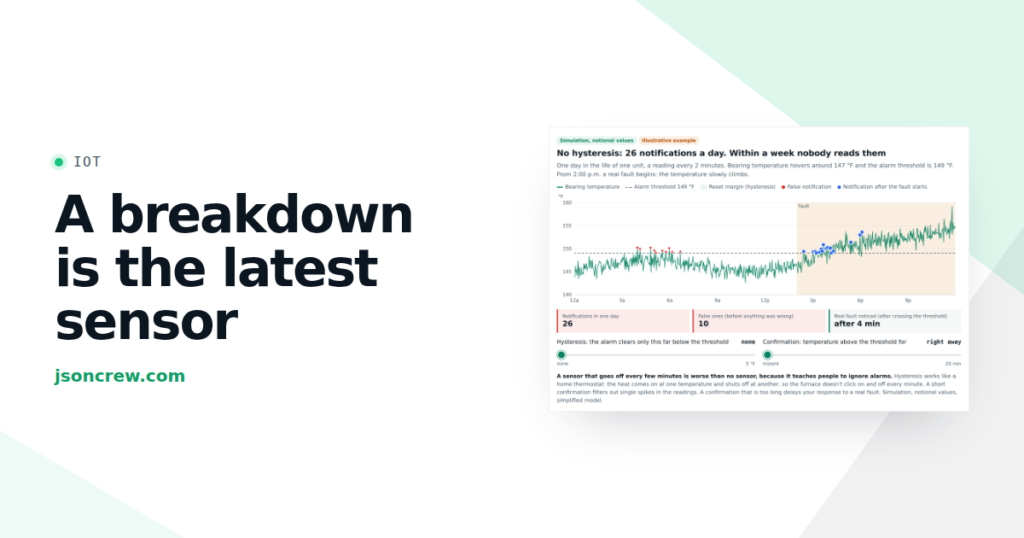
Ready-made platforms are often optimized for historical data analysis and reporting. Real-time alerts exist, but usually through a limited rules engine: "if value exceeds threshold, send email." Complex event processing—detecting a pattern across multiple sensors in a time window, triggering automatic action in another system, escalating only when certain conditions occur together—typically requires an enterprise tier or a separate streaming layer.
Your own IoT applications can be designed from the beginning around an event-driven backbone. Real-time alerts tailored to the actual physics of devices, not the limitations of the vendor's rules engine.
Mark the signals that apply to your project
What does a custom IoT application actually include?
A production-ready, custom IoT solution typically includes three layers:
- Backend: device management, message broker (MQTT/AMQP), data management pipeline, storage layer, business logic and integration with ERP/MES/CRM
- Aplikacja mobilna: app for technicians to maintain, inspect and report on the machine—works offline, syncs when connected
- Dashboard: Role-specific web views—for plant managers, quality teams, and management reporting
The timeline for the first production release is typically 12-20 weeks, depending on the number of device types and integrations required. A detailed breakdown of the five implementation phases, along with a realistic 30/30/30/10 division, can be found on the website custom IoT applications.
When ready, the platform is still a good choice
Not every manufacturer needs custom. If you are doing proof-of-concept with fewer than 30 devices, if your process fits into the standard monitoring and alerting model, or if the team does not yet have a clear picture of what decisions the system should support—start with a ready-made platform and verify the use case.
Custom IoT application development makes sense when the operating environment is specific enough that an off-the-shelf solution will always be a compromise, and when the scale is large enough that the compromise has a measurable cost.
Next step
If at least three of the five signals above apply to your situation, it is worth scheduling a technical call. We are building custom IoT applications for manufacturers in Poland, Germany and the UK—connecting to existing production infrastructure without interrupting ongoing operations.