 Jędrzej Siewierski
By Jędrzej Siewierski, CEO and co-founder of JSON Crew.
It is 7:40 on a Sunday evening in January, and a customer calls: your unit is down. The nearest technician can get there Monday afternoon, and the part arrives Thursday. The unit had been warning them for three weeks, with bearing vibration creeping up and the temperature rising about a degree a week. Nobody saw it, because nobody was looking.
(Illustrative example. The customer and the timeline are made up, but if you make equipment that runs at your customers’ sites, you have had this phone call.)
That is what predictive maintenance is about: hearing the equipment before it stops. It is also about something that rarely gets written down. The same data tells you who needs a part, when to offer a service visit, and who will be shopping for a new unit next year.
In short:
- There are three ways to look after equipment: fix it when it breaks, replace parts on a fixed schedule, or replace them when the equipment itself shows they are wearing out. The third one is predictive maintenance.
- A breakdown is the worst sensor you can have, because it reports the problem after the fact. Vibration or temperature usually start rising days or weeks earlier.
- An equipment manufacturer has something no plant has: thousands of its own units at customer sites, a ready source of service work, parts orders and the next sale. Start with one good signal, and leave the machine learning for last.
The tow truck, the oil change sticker and the warning light
Think about your car. You can look after it in three ways.
One: you drive it until it stops. Then come the tow truck, a week without a car and a bill you didn't expect. Until that day it feels like you are saving money.
Two: the sticker on the windshield. You change the oil every 3,000 or 5,000 miles and replace filters and brake pads by the schedule. The car breaks down less often, but you also replace parts that would have lasted another six months. And if something wears out faster than the book says, you still end up on the shoulder.
Three: the warning light. The brake pad sensor says there are a few millimeters left, and the oil life monitor says the oil wears out early after a winter in stop-and-go traffic. You go to the shop when the car tells you to, not when the calendar does.
Every machine, compressor and boiler at your customers’ sites works the same way, except you don't have one car. You have hundreds or thousands of units, each wearing out at its own pace.
Move the service slider. Service every 8 weeks means almost no breakdowns, but you throw away parts with the most of their life left, and it costs the most of all three. Service once a year lets breakdowns beat the technician again. Replacing on signal avoids both problems, although some failures come with no warning, and no sensor will catch them.
What is predictive maintenance?
Definition
Predictive maintenance (also called condition-based maintenance) is a way of looking after machines and equipment in which repairs and part replacements are scheduled from the equipment's actual condition, measured continuously (vibration, temperature, motor current, pressure, cycle count), instead of by the calendar or after a breakdown.
Three approaches side by side: reactive, you fix it after it breaks; preventive, you replace parts on a fixed schedule; predictive, you replace a part when the equipment itself shows it is wearing out.
Engineers call the three approaches reactive (the tow truck), preventive (the sticker) and predictive (the warning light). Condition-based maintenance means the same as the third. Condition monitoring is only the listening part: the warning light is condition monitoring, and booking the brake job because the light came on is predictive maintenance. Plenty of companies stop halfway, with readings on a screen and service still booked by the calendar.
The same car picture appears in a 2004 guide by the Pacific Northwest National Laboratory for the U.S. Department of Energy, the O&M Best Practices Guide, Release 2.0: most people change their oil every 3,000 to 5,000 miles without checking it, while someone who has it analyzed might go 10,000. Based on the studies it collects, preventive maintenance saves on average 12% to 18% compared with running to failure, and a well-run predictive program another 8% to 12% on top of that. Industrial surveys it cites go further: about ten times return on investment and 70% to 75% fewer breakdowns.
Treat these figures with care: they are two decades old and come from surveys the guide does not describe in detail, so they show an order of magnitude, not a promise.
None of this is new. In 1978, Stanley Nowlan and Howard Heap of United Airlines showed in a report for the U.S. Department of Defense (Reliability-Centered Maintenance) that many failures don't depend on a part's age, so replacing parts by the calendar doesn't always help.
Guides on predictive maintenance in manufacturing from companies like IBM, AWS and Siemens are a good way to learn how it works inside a plant that wants its own machines to stop less often. This article takes a different seat: the company that built the machine.
A breakdown shows up too late: dead time in maintenance
Back to the car. A warning light doesn't fix anything on its own. It comes on Monday, you notice it Wednesday, you call the shop Friday, and the first open slot is next week. All that time the car is driving around with the problem. Engineers call the delay between what is happening to a machine and the moment someone acts on it dead time. I wrote more about it in the article on feedback loops in business.
Between the first detectable sign of wear (vibration, heat, noise, a change in motor current) and the moment the unit stops, there is a warning window. For a bearing it can be weeks, for a seal days, and for an electronic board sometimes minutes or nothing at all. A signal that rises before the trouble arrives is what engineers call a leading indicator. If you have no such signal, the breakdown itself is your sensor, and dead time swallows the whole window.
Even with a signal, someone has to see it, decide to send a technician, find the part and an open slot. Every step eats into the window.
Notice the second switch. Many companies connect their units, and then the alert lands in an inbox someone checks on Fridays. Connecting the unit is half the job. The other half is the path from the alert to the person who acts on it, and that half is usually an automation or an integration with the service system you already use, not another dashboard.
Why is an alarm that goes off every few minutes worse than no alarm?
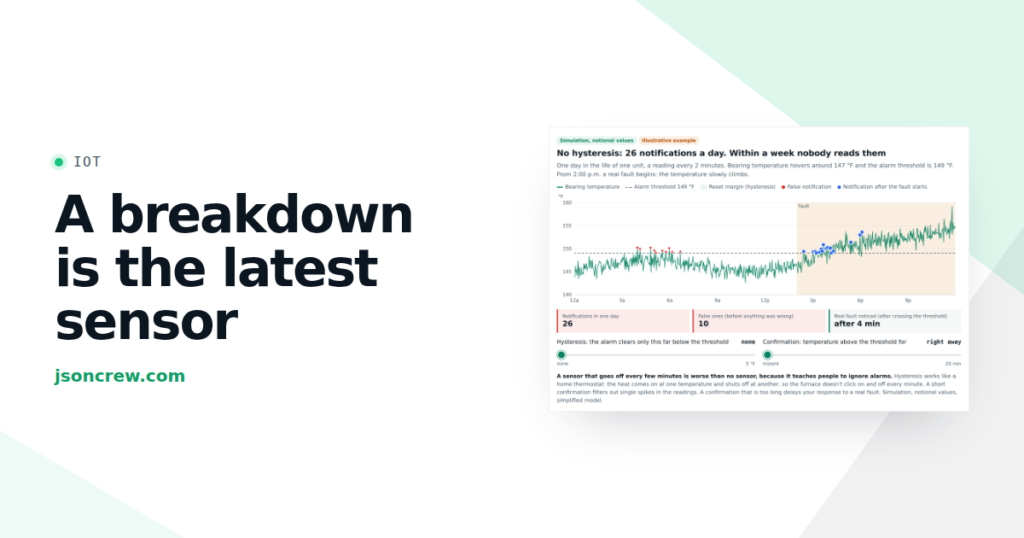
Picture a tire pressure light that comes on every time you hit a pothole. After a week you stop looking at it. And on the day you really get a flat, you won't look either.
This isn't a made-up problem. In 1994 the Texaco refinery in Milford Haven, Wales, had an explosion and fire. According to the UK Health and Safety Executive sheet Better alarm handling, in the last 11 minutes before the explosion two operators had to handle 275 alarms. Following guidance from EEMUA, a UK association of industrial equipment users, the HSE sets a target of, on average, no more than one alarm every ten minutes in normal operation.
For a manufacturer, the mechanism is the same. If ninety-five of a hundred daily notifications are a temperature that briefly jumped over the threshold, technicians stop reading them, and the real ones get lost too.
The first fix is under the hood. The radiator fan switches on when the coolant is hot and only switches off once it has clearly cooled down. If it switched on and off at the same temperature, it would click on and off every few seconds in traffic. Engineers call that gap between on and off hysteresis. An alarm can work the same way: it fires at the threshold and clears only well below it.
The second fix is confirmation. A well-designed tire pressure light ignores a single pothole and reacts only to pressure that stays low. In the same way, an alarm can only fire once the temperature has stayed above the threshold for a few minutes. The price: the longer you wait for confirmation, the later you see a real fault.
Set hysteresis to 3 °F and confirmation to 2 minutes. Out of 26 notifications a day, one is left, and it fires as soon as the temperature really crosses the threshold. Move confirmation to 16 minutes, and you see the same fault 48 minutes later. The right setting depends on how fast the problem grows in your equipment.
Remote monitoring: device data is a sensor for the whole company
The same signal that says „this bearing is wearing out” answers questions for five different people in your company, not just service. The warning light in your car doesn't only talk to the driver either. It tells the shop you'll be in next week, and if the carmaker could see it, they would know which models wear through brake pads fastest.
| Signal from the unit | Who needs it | What they decide |
|---|---|---|
| Rising vibration, temperature, motor current | service | a planned visit instead of an emergency call-out |
| Cycle count, running hours | Parts | order the part before the technician drives out, not after |
| Unit age, more frequent signs of wear | SALES | a conversation about replacement or an upgrade, before the customer starts shopping |
| How customers really use the unit, which faults keep repeating | engineering | the next model built on data instead of guesses |
| How many breakdowns were prevented, how many came without warning | leadership | whether service actually prevents breakdowns or just drives to them |
In most companies only service has a good sensor. Sales hears about a need when the customer calls, and engineering learns about a design flaw from warranty claims, months later. Remote monitoring gives each of those teams a signal before the result. The underlying technology is the industrial internet of things (IIoT): equipment that sends data about its own work to a central system.
What an equipment manufacturer can do that a plant can't
A plant has a few dozen machines. A manufacturer has an installed base: every unit it has ever sold that is still running. You can't get closer to the customer than that. The unit sits at their site every day, not just on the day the invoice is signed.
Once a manufacturer can see data from that base, maintenance stops being only a service cost.
Service that calls first. Instead of waiting for the call on Sunday night, the technician books Tuesday, because the data shows the bearing starting to wear. The customer remembers that you called before anything happened.
Parts you offer first. When a unit shows that a filter or a seal is wearing, you call with a ready quote before the customer looks for a generic replacement. With a large parts catalogue, this is where a Product configurator for parts or quote software pays off: the signal comes in, and the right part with the right price goes out the same day.
The next sale at the right moment. A twelve-year-old unit that signals wear more and more often belongs to a customer who will buy a new one next year. The only question is whether they buy it from you. With data you know a year ahead. Without it, you find out when a request for quote arrives, or never.
On ours sales system map, this is the growth stage: everything after the first sale, including retention, upsell and referrals. For an equipment manufacturer, that stage has a sensor built into the product.
Enter your own numbers. The result is not a revenue forecast. It is the number of conversations you could start first. For what happens on the service side once a unit reports a fault before the customer does, see the article on field service management.
What it looks like at KG Elektronik
KG Elektronik is a Polish manufacturer of gas boiler controllers, in business for 25 years. We built APP Smart Control for them: a phone app for end customers, a cloud platform that talks to the controllers, and a dashboard for the KG team. The full story is in the APP Smart Control case study.
Before the app, customers had to go down to the boiler room to check why the boiler went out, and they often learned about a failure on a cold Sunday evening. As of April 2026, about 12,000 devices are connected to the platform, and the app has more than 1,000 downloads on Google Play. Customers get a push notification when the temperature deviates from normal, with alarm thresholds they set themselves. The KG team sees every connected device in its dashboard, can diagnose problems remotely, and has the infrastructure in place for future remote firmware updates. At 12,000 devices, the way alarms behave decides whether people keep the app on their phone or delete it.
The most interesting business effect came from Grzegorz at KG Elektronik, in an interview in April 2026, six months after launch: „Customers and competitors were surprised by such a simple and cool app. And by the fact that the controllers didn’t get any more expensive, even though they have all these cool features. It’s only this month that we’re starting to see customers finally coming back to the store asking for our WiFi-enabled controller.”
One honest caveat: APP Smart Control is not a textbook predictive maintenance system. It is the first step toward one: data flows from the devices, and the alarms don’t go off every few minutes. Wear signals for service, parts offers and replacement conversations all build on that foundation. More about how we build software for equipment manufacturers: IoT applications.
CMMS or a connected product: where should you start?
Search for maintenance software and you will mostly find CMMS, programs for planning inspections and work orders. They are good tools for organizing who does what and when, but they only know what someone types in. A connected product app does the other half: it collects data from the units and tells you when something needs doing. A plant with a well-kept CMMS can add machine signals to it. A manufacturer with thousands of units in the field usually starts with data and alarms. If you are choosing a partner for that data layer, our guide to choosing an IoT development company lists the questions to ask.
Whichever end you start from, the order is almost always the same:
- One good signal. One reading that genuinely comes before your most common failure, checked against your failure history.
- A short path from alarm to person. The alarm opens a ticket with a named owner right away. This cuts dead time more than any algorithm.
- Only as many alarms as service can handle. With a two-week backlog, a hundred new tickets a day won’t speed anything up.
- Thresholds, hysteresis, confirmation. Every alarm should be rare and real.
- Shared goals. If service is measured by call-outs, nobody wants fewer breakdowns. Measure breakdowns prevented.
- Machine learning last. Prediction models need months of data and recorded failures. Before that, they mostly learn random spikes. A simple, well-set warning light beats the smartest onboard computer that has known your car for three months.
When predictive maintenance doesn’t pay off
It doesn’t always make sense. Sometimes a warning light would cost more than the car.
- Cheap units that are easy to swap. If a failure means a five-minute swap of a cheap part and nobody loses anything, the tow truck approach is fine.
- Failures with no warning. Some faults, especially in electronics, give no earlier signal. Spare parts in stock and fast service help there, not a sensor.
- Too few units. In the KG Elektronik case study we say it plainly: with a small number of devices (up to about 200) or hardware without connectivity, a simpler web dashboard or a configurator may be the cheaper route.
- No connectivity. If the unit can’t send data, the first step is a communication module, not analytics.
- Nobody to act. The best alarm is useless if no one has the time and the authority to send a technician.
Four questions for Monday
Before you buy sensors or commission an app, go through these with your team.
- How do you find out about a failure at a customer’s site today? If the answer is „the customer calls”, your sensor is the breakdown. Count the days from that first call to the repair.
- Which failure costs you the most, and does anything announce it? One, not all of them. Ask your most experienced technician how they can tell it’s coming.
- What happens to an alarm along the way? Draw the path: who receives it, who decides, where the part comes from. Every step takes days out of the warning window.
- Who outside service would use this data? Sales, parts, engineering. If nobody, start with service. If everyone, you have your reason to start now.
Frequently asked questions
What is the difference between predictive and preventive maintenance?
Preventive maintenance replaces parts on a schedule, regardless of their condition. Predictive maintenance measures the condition of the equipment continuously and schedules the replacement when the reading shows wear. According to the U.S. Department of Energy’s 2004 O&M Best Practices Guide, preventive maintenance saves on average 12% to 18% compared with running to failure, and predictive maintenance another 8% to 12% compared with preventive.
Is condition monitoring the same as predictive maintenance?
Condition monitoring is collecting and watching readings from equipment. Predictive maintenance uses those readings to decide when to service or replace a part. You need the first to do the second.
What data do I need to start?
One reading that comes before your most common and most expensive failure: usually bearing vibration or temperature, motor current, pressure or cycle count. More important than the number of sensors is whether the alarm reaches someone who can send a technician right away.
How do you avoid false alarms?
With hysteresis (the alarm clears only well below the threshold, like a car’s radiator fan), a short confirmation (the reading must stay above the threshold for a few minutes) and sensible thresholds. The UK Health and Safety Executive gives a target for industrial plants of, on average, no more than one alarm every ten minutes in normal operation.
Where is your company getting stuck?
Device data is only one of the places where a company can react too late. The test „Where is your company getting stuck?” shows in a few minutes at which stage of sales and customer service that happens in yours.
Thinking about an app for your device or your own service portal? Our app cost estimator shows in a few minutes what it would realistically cost and how long it takes, before you talk to anyone.
Where is your company getting stuck?
Eight statements about how your company reacts to its numbers. For each one, pick how often it happens to you. At the end you'll see what kind of controller your company is today, what it's missing and where to start.
None of the eight statements fits your company. Good sign: your decision loop is calm. Check it once a quarter, because the wobble usually starts when you grow or the market shifts.
I'll send you 10 questions to map one process, with tips for your result
✓ Sent
CEO of Ideo Solutions AS
How to cite this article: Jędrzej Siewierski, „Predictive Maintenance for Equipment Manufacturers: Your Installed Base Is Already Talking,” JSON Crew, jsoncrew.com, 2026.