 Jędrzej Siewierski
Author: Jędrzej Siewierski, CEO and co-founder of JSON Crew.
Monday, 9:00 a.m., weekly board meeting. On THE OKR screen per quarter: one goal, three key results. Two green, one red.
„All aboard,” says the CEO. Two people from the production and one from the service go to help with the offers. After a week, the result is green, so everyone returns to their work. After two more, it's red again.
OKR did his job here: he showed what was important and made us look at it every week. He just didn't say how strongly to react to the red color.
In short:
- OKR (goals and key results) is a method of setting goals: several goals per quarter, for each about three measurable results and a review in a constant rhythm.
- OKR shows that the result is red, but does not tell you how to react strongly. When the effect of the decision comes with a delay and the measurement jumps, the rule „red = alarm” swings with the result.
- Three things help: a zone of peace for minor fluctuations, a memory of arrears instead of panic, and patience tailored to the delay. Department goals can't work together to give your bottleneck more work than it takes.
Thermostat, or OKR you know from home
Think about heating your house in winter. You want it to be warm and the gas bill won't go up. That's your goal. To know if it's going well, you write down three numbers: 21 degrees in the living room, 19 degrees in the bedroom, and a January bill no higher than a year ago. These are the key results: measurable, with a deadline, without discussing whether it was successful.
You just wrote OKR.
The thermometer in the living room shows 22 degrees, because the sun came in, and after airing 19. The reading jumps, although nothing has changed at home. This is Noise.
For this, the radiator needs time. You unscrew the valve, and it gets warmer after half an hour, with underfloor heating after a few hours. delay.
And a furnace that has constant power. When you unscrew the valves in all rooms, it will not give more heat, it will only distribute the same to more radiators. This is congestion, i.e. a bottleneck.
The old thermostat knows only two states: it heats completely or not at all. Because heat comes late, radiators continue to heat long after the room has warmed up. Once it's too hot, once it's too cold.
The same thing happens in the company, only instead of a furnace, the people you move between departments work. I will come back to this thermostat.
Okay, what is it? Definition in two sentences
Definition. OKR (from English Objectives and Key Results, i.e. goals and key results) is a method of setting goals, in which the team selects several important goals for a period, usually a quarter, and adds several measurable key results (abbreviated as KR) to each. The goal tells us where we are going, and the key results tell us how we got there.
The method was created by Andy Grove at Intel. John Doerr learned it from him, he called it OKR, in 1999 he showed the founders Google (source: whatmatters.com, Doerra), and in 2018 he described it in a book Measure What Matters („measure what's important”).
The Google re:Work guide provides simple rules:
- Three to five goals for a period. It distracts the team more.
- Around three key results per target, each with a number.
- Rating from 0.0 to 1.0. With ambitious goals, a good result is around 60-70%. A score consistently close to 100% may indicate that the goals are too low.
Doerra's service also distinguishes between a committing goal (which must be achieved) and an ambitious goal (intentionally set higher than the team's current capacity). The response to the red status for each is different.
OKR goals vs. KPIs: what is the difference?
Gauges hang by the boiler: water pressure, system temperature. You monitor them constantly because they indicate whether everything is working properly. These are KPIs, or Key Performance Indicators. A seasonal goal is different: “The room should be 20 degrees at midnight, not 17.” That is an OKR. It has a direction and a deadline, and once achieved, you set the next one.
| KPIs (metrics) | OKRs (Objectives and Key Results) | |
|---|---|---|
| Question | is the company healthy? | where do we want to get to this quarter? |
| Lifespan | fixed, long-term | for a specific period, usually a quarter |
| Example | margin, inventory turnover, response time to inquiries | “Faster quotes”: 80% of quotes delivered within 48 hours by the end of March |
OKR examples for a manufacturing company
It's illustrative example: the company and figures are fictional, but the structure is typical for a manufacturer of custom products.
Manufacturer of storage racks, 60 employees. Every quote requires a technician's assessment: drawings, load capacity, component selection. Currently, 62% of quotes are issued within 48 hours. Customers increasingly report that they have already received a quote from a competitor.
| Goal | Key results by the end of the quarter |
|---|---|
| The client receives a quote before they forget about us | KR1: 80% of quotes sent within 48 hours (currently 62%) |
| KR2: 90% of inquiries include complete pricing data in the form | |
| KR3: Quote as a page with price and delivery time for 3 main product lines |
This is a good OKR: one goal understandable to everyone, three numbers, a deadline. The trouble begins only when KR1 turns red.
What happens when a key result turns red?
In many companies, the answer is: alarm. The red color triggers a rescue action, and green ends it. The colors themselves are fine (the Doerra service describes how many organizations use them to assess progress). The problem starts when the color alone dictates the reaction.
This is an old thermostat. Red means full heat. Green means the heater is off. It works well enough when heat arrives instantly and the thermometer doesn't jump. In a company, you rarely have both.
Delay
On Monday, you add two people to the quoting team. Before they are onboarded and start sending offers, two weeks pass. During that time, the result remains red, so you add a third person. Then everything kicks in at once, the result jumps above the target, and people go back to their previous roles. Two weeks later, the gap reappears.
It is the same with radiators: they keep heating even though the room is already warm. John Sterman at MIT demonstrated in 1989 through experiments that managers regularly overreact precisely when the consequences of their decisions arrive with a delay.
Noise
One large, atypical offer or a single person's vacation can lower the weekly result by a few points. This is not a trend; it is just the sun briefly warming the thermometer. Reacting to every such spike is a decision made in panic.
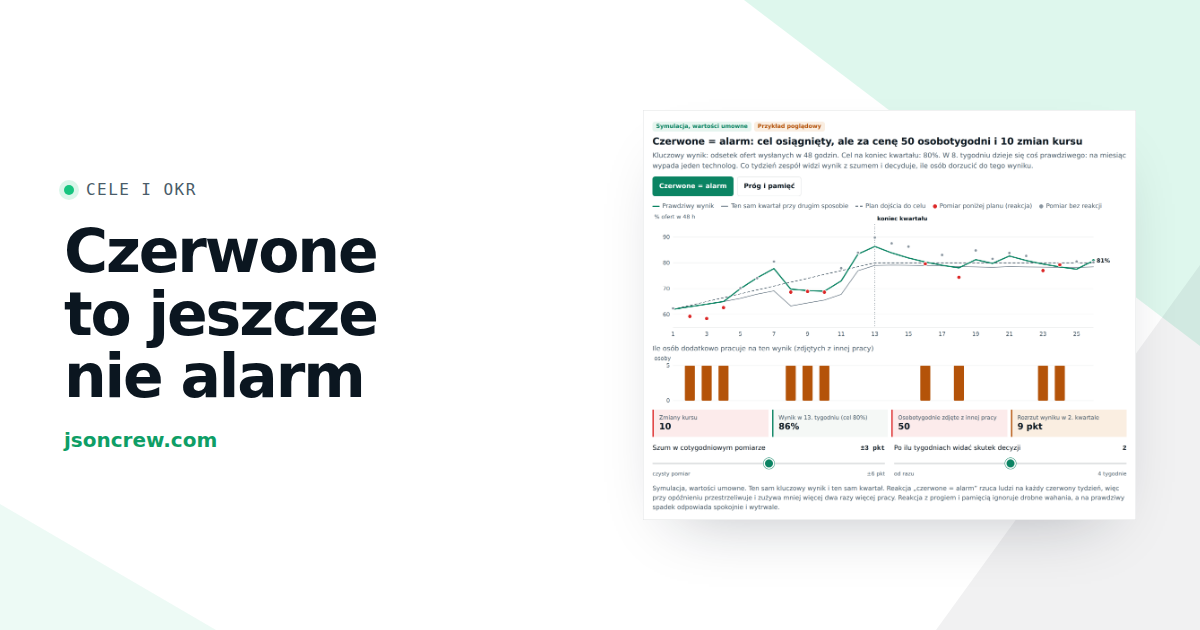
Check it yourself: the same key result, the same real dip in week 8, a different way of reacting.
In this simulation (using arbitrary values), with noise of ±3 points and a two-week delay, the 'red = alarm' response achieves the target. However, it costs about 50 weeks of human work diverted from other tasks and 10 course corrections in half a year. The response with a threshold and memory ends the quarter at approximately 79%, with one course correction and roughly half that workload. Set the delay to zero, and the alarm suddenly looks quite good. The catch is that in a company, the delay is almost never zero.
Threshold and memory: how strongly to react to a key result
A modern thermostat does three things that an old one cannot. The same can be done in a company:
- A zone of peace. A thermostat does not turn on the heater when the room is 20.8 degrees instead of 21. In a company: define in advance what deviation from the plan is noise (for example ±3 points), and do not change course within that zone.
- Backlog memory. If it has been a bit too cold since morning, the thermostat does not fire up the heater at full power; it heats up slightly more strongly until it catches up. In a company: the sum of the backlog over several weeks matters, not today's color. The correction is small but persistent, and it grows until the backlog disappears.
- Patience matched to the delay. With underfloor heating, the thermostat knows that the heat will arrive in a few hours, so it does not crank it up every five minutes. In a company: the longer you wait for the effect of a decision, the more gently you react.
Engineers call this type of thermostat a PI controller with a dead zone: it looks at today's deviation, remembers the accumulated error, and ignores minor fluctuations. I write more about this in the pillar of this series on process management in companies.
Here, the distinction between goal types comes back. An ambitious goal that ends at 70% is considered a good result by Google, so treating it like a fire to be put out is a reaction to noise. A committed goal that has been outside the comfort zone for three weeks requires correction, but a calm and persistent one.
Goal cascade: when every department has green OKRs, but the company has red ones
A good OKR also fails when you incorrectly break down the company goal into departments. Go back to the boiler. Every household member wants it warmer in their room and turns their valve to the maximum. Everyone did their part, but the bedroom at the end of the pipe still cools down because the boiler has no more power.
In the shelving example, management breaks down the goal of 'faster quotes' into departments. Marketing gets the key result of 'inquiries +30%'. Sales: 'every inquiry passed for quoting within 24 hours'. Technologists: '44 quotes per week'. Each goal individually is reasonable. Together, they push work into areas where there is already a bottleneck.
In the simulation (illustrative example, assumed values), with marketing increased by +40%, all three departments end the quarter in the green, and the company achieves 20% of quotes within 48 hours instead of 80%. The client waits more than 5 business days for a quote. The number of quotes per quarter is almost the same in both scenarios (572 and 553), because the capacity of the engineers is the limiting factor anyway.
When you set key results at the intersection of departments, the same quarter looks different:
- Marketing: qualified inquiries, capped at the weekly volume that engineers can process.
- Sales: offer in 48 hours or immediately a fair, further date.
- Technologists: quote queue of no more than 2 days.
Eliyahu Goldratt described this in the Theory of Constraints: the pace of the whole system is determined by the slowest point. This introduces one control question to OKR: do the key results of the departments, taken together, push more work into the bottleneck than it can process?
If the bottleneck can be widened, it usually pays off more than the next campaign. It is like replacing a boiler with a more powerful one. For quotes, this may mean that simpler quotes are calculated by the system: the client selects parameters, and the price is generated immediately, without waiting for an engineer. This is how digital quoting and calculations, i.e. the bidding stage on our sales map system.
OKR + Tuned Company Total
A Tuned Company is about viewing the firm as a control system: goal, measurement, deviation, and reaction. OKR answers part of the questions; the rest is worth adding.
| Question | Corresponds to OKR | What to add |
|---|---|---|
| How often do we review? | Fixed review cadence | Cadence aligned with outcome lag |
| Are we on track? | color or grade 0.0-1.0 | Zone of calm: distinguishing noise from signal |
| What do we do when results drift? | Team discussion and decision | reaction strength matched to lag, backlog memory |
| How does the company's goal cascade down to departments? | goal cascade | shared key results at the intersections, within the capacity limits of the bottleneck |
If you already have OKRs, you don't throw anything away. You simply add answers to five questions.
Starting Monday: five questions for your OKRs
- How much does this result jump on its own? Check the last 8–12 weeks. If the fluctuations are larger than the difference you are reacting to, you are reacting to noise.
- How many weeks does it take to see the effect of a decision? Measure this based on recent decisions, not from memory.
- Where is the bottleneck for this result? Are key results from other departments adding to its workload?
- Is this goal a commitment or an ambition? And does the entire team understand it the same way?
- What will we do when it turns red, before it happens? Write down the rule in advance: the comfort zone, the strength of the correction, and how many weeks we allow for a decision. Then, on Monday at 9:00, the decision is already made.
Questions 1 and 2 will be answered by the history of results, week by week. If you manage sales in a CRM, you have it at your fingertips. In our case, this role is fulfilled by JSON Hub, our own CRM with a quotation module.
When it doesn't work. The comfort zone is not an excuse for not reacting. If the result is outside the zone for the third week in a row, or if it drops sharply for a clear reason (a key client has left, the production line has stopped), react immediately. A calm response applies to fluctuations, not fires. Secondly, if the thermometer is hanging over a radiator, meaning you're measuring the wrong thing (for example, inquiries instead of accepted opportunities), no amount of adjusting your response will help. I describe what happens to the measurement when you attach a bonus to it in article on Goodhart's Law.
Where OKR sits on the sales map
On our map of the sales system, OKR and the goal-setting rhythm belong to the growth: stage, where the company defines what it will develop in the next quarter and how it will measure progress.
Frequently Asked Questions
Okay, what's in one sentence?
It is a goal-setting method: a few goals per quarter, each with about three measurable key results that indicate whether the goal has been achieved.
How does OKR differ from KPI?
KPIs are constant company health indicators that you monitor continuously, like gauges on a furnace. OKRs are period-specific goals. A good key result is often a KPI that you aim to shift during a specific quarter.
Should OKRs be linked to bonuses?
Doerra notes that OKRs were originally decoupled from compensation, and Google’s guide clarifies that they are not a performance review. When a key result determines a bonus, there is a temptation to set a low, safe target. If bonuses are used, they should rather reward outcomes at the intersection of departments.
What to do when a key result turns red?
Check if the deviation exceeds the established comfort zone. If so, apply a small, steady correction and allow it time equal to the effect's lag. If the result continues to drift, the correction must increase. The 'everyone on board' rule during a lag ends in oscillation.
Find out where your business is stuck
OKRs tell you where you are going. The 'Where is your company stuck?' test will show which key result is delayed, noisy, or blocked for you. It takes just a few minutes.
Where is your company blocking out?
Eight sentences about how your company responds to results. Next to each of them, indicate how often you do this. At the end, you will see what kind of regulator your company is today, what it lacks and where to start.
None of the eight sentences fit your business. This is a good sign: your decision loop is calm. Check it quarterly, because rocking usually begins when the company is growing or the market is changing.
I will send you 10 questions to list one process, with hints for your result
Sent
CEO of Ideo Solutions AS
How to Cite This Article: Jędrzej Siewierski, “OKRs: What They Are, How to Set Goals, and What to Do When a Key Result Turns Red,” JSON Crew, jsoncrew.com, 2026.