 Jędrzej Siewierski
By Jędrzej Siewierski, CEO and co-founder of JSON Crew.
Your distributor calls. Customers in the store walk past your product and ask for „the one with the app.” Your hardware has been good for years, but it has no app, no cloud, and no way to tell you when something goes wrong in a customer's home.
So you search for an IoT development company and get a page of agencies that all say „end to end.” Each one sends a presentation full of beautiful screens. Which one will still be there when device number 5,000 stops reporting on a cold Sunday night?
In short:
- An IoT development company builds the software side of a connected product: how the device communicates with the cloud, the cloud itself, the mobile app, the dashboard for your team, and the way you update devices after they’re sold.
- Most portfolios show the app. Most trouble sits underneath it: dropped connections, devices you can't update remotely, security, and costs that change at 10,000 devices.
- Ask eight questions before you sign. Four are must-haves: a live product you can download, a plan for remote updates, how each device is secured, and who owns the code at the end.
Choosing an IoT vendor is like hiring a builder for a house.
Picture two builders bidding on an addition to your house. The first one shows photos of gorgeous kitchens. The second one also shows a kitchen, then talks about foundations, drains and who signs off on the wiring. Which one would you trust?
A connected product is a house with several trades in it:
| In the house | In your connected product |
|---|---|
| Fundamenty. | The connection inside the device: Wi-Fi module and firmware that communicates with the cloud |
| Plumbing and wiring | The cloud backend that keeps thousands of devices connected and sends alerts. |
| THE KITCHEN | The mobile app and web dashboard that your customers and service team see |
| Repairs after you move in | Remote updates, monitoring, and support |
The kitchen is the part that everyone photographs. The foundations are where houses crack. And most problems happen where two trades meet, when the plumber blames the electrician and nobody owns up to the leak.
Every good IoT development company can show you a nice app. Find out whether they've built the foundations and plumbing too, and whether they'll be around for repairs. If you build your own hardware and firmware, draw the line between your team and theirs on day one.
How to choose an IoT development company: 8 questions
They fit into a 45-minute call, and good vendors like them because they get to show real work.
1. „Can I download or log in to something you built that real customers use today?”
Not a demo build, not a video. An app in the App Store or Google Play, or a login to a live dashboard. A product that has been in customers’ hands for months has survived bad Wi-Fi, power cuts, and users who press every button at once.
2. „Who owns each layer, and who do I call when a device shows online but doesn't respond?”
The plumber-versus-electrician question. Ask for a simple diagram of who builds what: device firmware, connection, cloud, app, dashboard. Then ask for one name responsible for the entire chain.
3. „What happens when a device loses Wi-Fi for an hour, a day or a week?”
Home Wi-Fi drops and routers are replaced. A good answer covers what the device does on its own, what the app shows in the meantime, and how the device catches up. Most teams use MQTT, a messaging standard built for „high-latency or unreliable networks,” but the design around it matters more.
4. „How will you update the firmware on devices that are already in customers’ homes?”
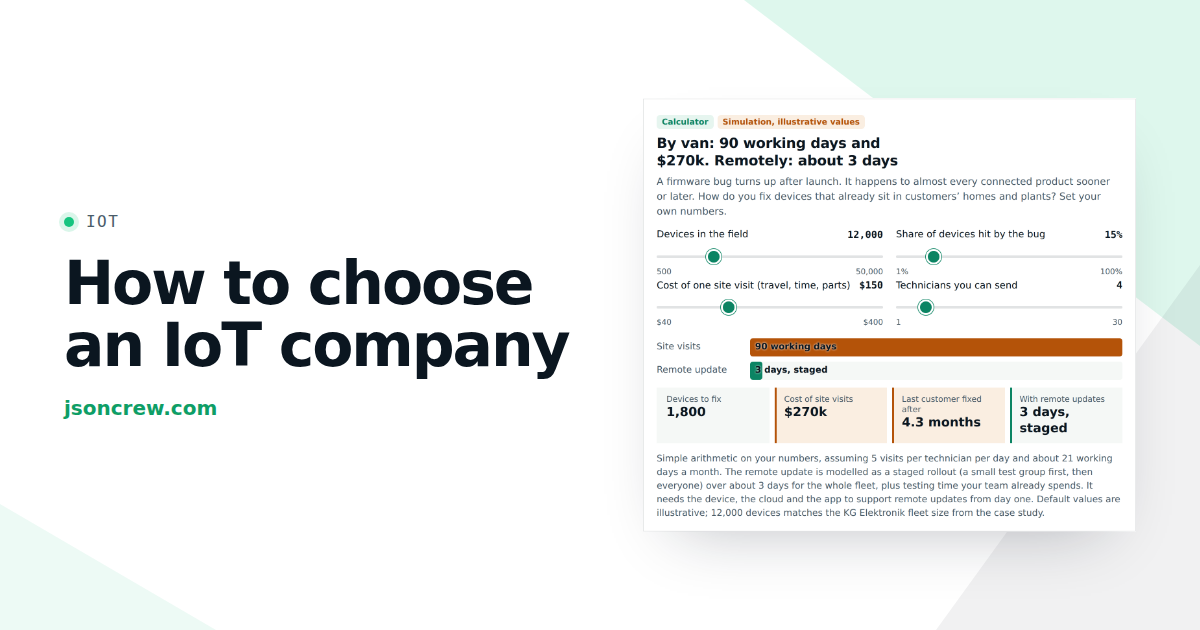
A must-have. Almost every connected product ships with firmware bugs. If the device cannot be updated remotely (engineers call it an over-the-air update, or OTA), every fix means a truck roll, a technician, and an apology. Ask how an update is rolled out in stages and how a failed one is rolled back.
What does a field fix cost without remote updates? Enter your own numbers.
5. „How is each device identified and secured?”
Also a must-have. A good answer is specific: each device has its own credentials or certificate, so one compromised device doesn't open the door to the rest. In the UK, it's the law for consumer products: the product safety regime, in effect since April 29, 2024, requires unique or user-set passwords, a published way to report security issues and a published minimum period for security updates. In the US, NIST’s IR 8259 lists security activities for device makers before launch.
6. „What changes at 1,000 and at 10,000 devices, including hosting cost?”
An app that works with ten devices on a test bench may not work with ten thousand. Ask what they’ll load-test, and ask for a hosting estimate at your three-year forecast. Choices made in month one decide your cloud bill in year three.
7. „When will we see something working, and how often after that?”
Ask for the date of the first clickable prototype and the demo schedule after it. It decides how much of your budget gets spent twice (more on that below).
8. „Who owns the code and the infrastructure at the end?”
The last must-have. Get code ownership and handover steps written into the contract: where the code lives, whose cloud account it runs in, what documentation you get and who can maintain it after launch. You don’t need your own team on day one, but you need the option to build one later.
Bonus question: „What in our brief would you change?” A vendor who agrees with everything hasn’t read the brief or doesn’t want to lose the deal. The builder who tells you the skylight will leak is the one you want.
Score up to three vendors
Use this after each call. It stays in your browser.
Why the demo schedule matters: The Tuned Company view
In the pillar article on feedback loops I describe every process in a company as a loop: set a goal, measure, see the gap, correct. In a software project, your measurement is working software on a real device. Without it, you’re judging the build from status reports, like judging an extension from the builder’s emails without visiting the site. Visit every two weeks and you catch the wall in the wrong place while it’s two rows of bricks. Visit at handover and you pay to tear it down.
In the simulation, a demo every two weeks wastes about one week of work in 24; one demo at the end wastes almost twelve. The numbers are illustrative, the shape isn’t. So pick the vendor who shows you working software soonest, on a real device, and keeps showing it on a fixed schedule. On our sales map this is the Needs discovery stage: find out what the problem really is before you pay for the solution.
Ready-made IoT platform or a custom build?
Both paths are good for the right company. Ready-made platforms get a standard connected product to market fast: Tuya offers an IoT cloud ecosystem for brands building and managing smart devices at scale, and Particle helps companies „power their connected machines, vehicles, and products.” For the cloud layer alone, AWS IoT Core and Azure IoT Hub are mature choices that many custom projects are built on.
A ready-made platform tends to fit a standard device type (a smart plug, a simple sensor) that has to launch quickly and doesn’t need to feed your ERP or service systems. A custom build tends to fit when your device speaks its own protocol, your brand must lead in the app, you plan for thousands of devices, or device data should flow into service, warranty or spare parts. Many projects mix both: a custom app on top of a managed cloud service. Ask each vendor what they’d buy, what they’d build, and why.
What does IoT app development cost? The factors, not a number
I won’t put a price here. Without your device, volumes and integrations, any number would mislead you. These move it:
- Layers in scope: app only, app plus cloud, or everything down to the firmware.
- Platforms: one codebase for iOS and Android costs less than two separate apps.
- The device side: whether your controller already connects, or needs a communication module.
- Integrations: ERP, service desk, warranty, distributor systems.
- Scale and hosting: 500 devices and 50,000 need different architecture and a different cloud bill.
- Security, compliance and support after launch.
Ask every vendor to price the same scope at the same device count. That’s the only way to compare like with like.
A real example: KG Elektronik’s Smart Control app
Here is the project I know best, because we built it. To be straight with you: it’s our first major IoT project, and our core business is Product configurators.
KG Elektronik is a Polish manufacturer of gas boiler controllers with 25 years in business. The hardware worked, but to change the temperature or find out why the boiler went out, customers had to go down to the boiler room. Competitors were starting to offer Wi-Fi. We built a mobile app for iOS and Android from one codebase, a cloud backend that connects each controller over MQTT and sends an alert when the temperature leaves the normal range, and a dashboard for KG’s team with a view of the whole fleet and the groundwork for remote firmware updates (full case study).
Each device has its own certificate. Running our own message broker instead of a managed service cut infrastructure costs by about 70% at more than 12,000 devices; with a few hundred devices the math can come out differently.
The results, from the case study: about 12,000 connected devices (April 2026), 1,000+ downloads on Google Play, and 3 months from brief to the app stores, at a fixed price. KG received the code and took the product over. Six months after launch, Grzegorz from KG Elektronik told us: „It’s only this month that we’re starting to see customers finally coming back to the store asking for our WiFi-enabled controller.”
What made the difference wasn’t the screens. It was the foundations, laid in the first month: architecture, the message broker, device security.
What to do before you call an IoT development company
- Write down your device count today and in three years. Every architecture and hosting answer depends on it.
- Draw the line. Which layers do you own (hardware, firmware), and which does the vendor build?
- Pick the scenario that scares you. A firmware bug in 2,000 homes. A Wi-Fi outage at a big customer. Ask every vendor to walk you through it.
When you may not need an IoT development company yet
If you have a few hundred devices or fewer, if your hardware has no connectivity yet, or if decisions in your company take longer than the project itself, a full IoT platform may not be the best first step. A web dashboard, a ready-made platform or a Product configurator can be a cheaper way to a similar result, and a good vendor will say so in the first call.
Frequently Asked Questions
How do I choose an IoT app development company?
Ask eight questions: a live product you can download, who owns each layer, offline behavior, remote updates, device security, what changes at 10,000 devices, how often you see working software, and who owns the code. No answer on any of the four must-haves is a red flag.
How much does IoT app development cost?
It depends on the layers in scope, platforms, whether your device already connects, integrations, scale, security and support. Ask every vendor to price the same scope at the same device count.
Should I use a ready-made IoT platform or a custom build?
A ready-made platform such as Tuya or Particle fits standard devices that need to launch quickly. A custom build fits a device with its own protocol, thousands of units, or data that should feed service and ERP systems. Many projects combine both.
What are OTA updates and why do they matter?
Over-the-air (OTA) updates let you fix or improve the firmware on devices already in customers’ homes, without a site visit. Without them, every firmware bug means sending a technician. Plan them from day one.
Where is your company getting stuck?
Eight statements about how your company reacts to its numbers. For each one, pick how often it happens to you. At the end you'll see what kind of controller your company is today, what it's missing and where to start.
None of the eight statements applies to your company. Good sign: your decision loop is calm. Check it once a quarter, because the wobble usually starts when you grow or the market shifts.
I'll send you 10 questions to map one process, with tips for your result
✓ Sent
CEO of Ideo Solutions AS
30-minute call
Thinking about an app for your device?
Bring your filled-in scorecard to the call. Email contact@jsoncrew.com with what your device does today and how many are out there, and we’ll set up a 30-minute call. I’ll tell you honestly whether you need a custom build, a ready-made platform or something simpler first. More about how we work: IoT applications.
How to cite this article: Jędrzej Siewierski, „How to Choose an IoT Development Company: 8 Questions to Ask Before You Sign,” JSON Crew, jsoncrew.com, 2026.