 Maciej Ramus

A customer fills in a “Price on request” form: a patio enclosure, roughly 4 by 3 metres, asking for a quote. A salesperson calls to ask about the details, a production engineer checks feasibility, and two days later a quote for PLN 38,000 goes out. The reply arrives a week later: “Thank you, I was expecting around 15”. Nobody was at fault. The customer had no way of knowing what price range the product was in, and the company had no way of knowing that the budget was different from the start. It paid for this with three hours of work by two people and one enquiry that never stood a chance.
This article is for manufacturers and companies that sell made-to-measure products or products in many variants: joinery, enclosures, fences and gates, pergolas, furniture, machinery and equipment, structures. We look at what research says about how customers buy today, when hiding the price makes sense and when it costs more than it brings, what ways of showing a price exist beyond the “all or nothing” choice, how to reconcile website prices with dealers and fluctuating material prices, and how to check the effect on your own numbers. Inside you will find a tool that matches a pricing model to your offer and calculates how much quotes with no chance of success cost you.
What research says about buyers
Business customers are less and less likely to start with a conversation with a salesperson. In a survey of 750 buyers involved in complex B2B purchases, Gartner calculated that meetings with suppliers account for only 17% of the time spent on the entire buying process. If three suppliers are being compared, each gets roughly 5 to 6%. Buyers spend the rest of their time researching on their own, holding internal discussions and comparing offers.
This trend is not reversing. In a Gartner survey published in March 2026, 67% of B2B buyers said they would prefer to complete a purchase without involving a sales rep. A year earlier the figure was 61%. In its 2024 report, based on a sample of 2,509 buyers, 6sense describes how buyers make first contact with a vendor when they are roughly 70% of the way through the buying process, and in more than 80% of cases it is the buyer who initiates that contact.
So what are buyers looking for in this self-directed part? TrustRadius has been asking business software buyers this question for years, and for years the answer has been the same. In the 2021 edition, 81% of buyers wanted to find pricing information on their own, and since 2023 transparent pricing has been at the top of the list of changes buyers expect from vendors.
In fairness, two things should be added. First, this research mainly concerns large markets and technology purchases, not a Polish manufacturer of windows or agricultural machinery. Second, the same Gartner shows that buyers who completed a purchase entirely digitally are more likely to regret their decision. So the conclusion is not “the salesperson is unnecessary”, but rather: customers want to enter a conversation with a salesperson already knowing whether your offer fits their budget. If they do not know, they often will not get in touch at all, or they will contact a competitor who told them.
Why companies hide prices and how much truth there is in it
“Price on request” rarely comes from laziness. There is usually one of six arguments behind it. Each of them has some truth in it, but almost every one can be solved in a way other than hiding the price completely.
| Argument | How much truth there is in it | What to do instead of hiding the price |
|---|---|---|
| “Every order is different, it is impossible to give a price” | A lot for bespoke projects, little for made-to-measure products priced according to fixed rules | With rules: a configurator or a “from” price for a named configuration. With projects: price ranges from similar completed jobs |
| “Competitors will see our prices” | Little. A competitor will get your quote anyway, all it takes is one enquiry from a fake customer | Show the price of the product, not your costs, discounts and margins. Your advantage is the speed and accuracy of your quote, not the secrecy of your price list |
| “The customer will drop out before we show the value” | Partly. For products priced above the market, the figure alone without context puts people off | Show the price together with what the customer pays for: materials, warranty, installation, service, a comparison with a cheaper alternative |
| “We want to collect contact details” | Partly. A contact without a budget has little value, while the cost of handling it is real | Give the price without registration and collect contact details when the configuration is saved, the quote is downloaded as a PDF or a site survey is booked |
| “We sell through dealers” | A lot, because the manufacturer’s price affects partners | The manufacturer’s recommended price and forwarding the enquiry to the nearest dealer, described below |
| “Material prices change every week” | A lot in the steel, aluminium and timber industries | An update date, a validity period and a price adjustment clause in the quote instead of no figure at all |
There is also a reason nobody says out loud: hiding the price lets the salesperson tailor the figure to the customer. In the short term this works. In the long term it ends with two customers from the same industry comparing quotes for the same product and seeing different prices, and the company losing control over how much its product really costs. If discounts are to exist, it is better for them to be written into rules rather than kept in the salesperson’s head.
Five ways to show a price
The choice is not black and white. Between a full price list and a “Price on request” form there are at least three intermediate solutions, and in many companies a combination of two of them works best, for example a “from” price on the product list and a configurator on the product page.
| Model | When it fits | Ryzyko | What it must include |
|---|---|---|---|
| Full price list | A catalogue product, the price depends on one or two parameters, prices change rarely | The need to keep it up to date. An outdated price list does more harm than no price list | Net or gross, what is included in the price, update date |
| “From” price | Variants with a moderate spread, the cheapest variant is actually bought | A “from” price calculated for a variant nobody buys is seen as a trick and destroys trust | A named configuration, the price of a typical order, the main surcharges |
| Ranges from completed jobs | Bespoke projects, engineering, public procurement | Ranges that are too wide say nothing | Three to five examples with scope and amount, minimum order value |
| Configurator with a quote | A made-to-measure product or a product with many options priced according to fixed rules | Wrong rules give wrong prices. They have to be set up with the production engineer, not just with the marketing department | A price calculated in real time, a clear distinction between an indicative price and a binding quote, the configuration saved in the enquiry |
| Enquiry with a budget question | When the price genuinely cannot be shown, for example for prototypes | The customer will enter an understated budget or none at all | Budget ranges to choose from instead of an empty field, deadline, scope |
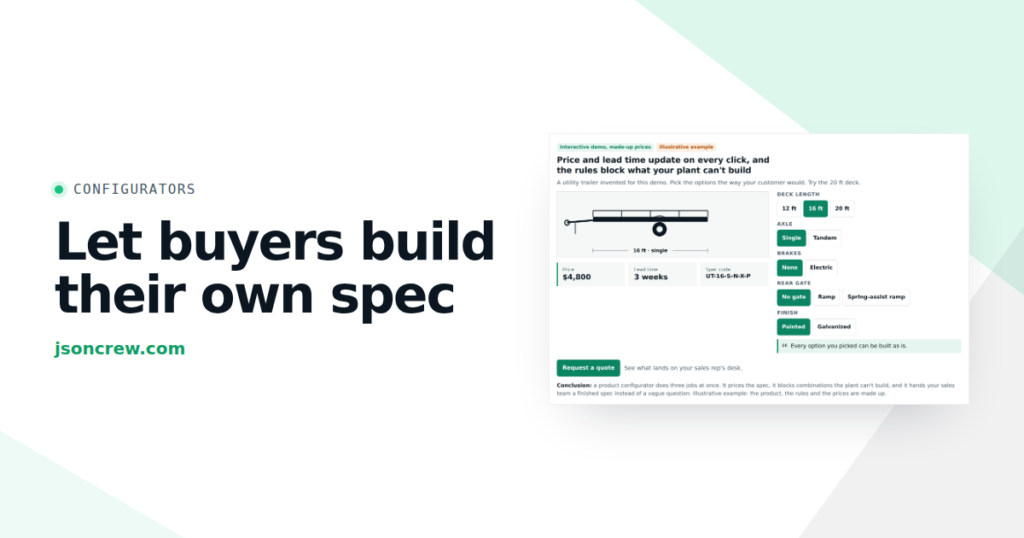
For manufacturers of made-to-measure products, the winner is usually a configurator with a quote, because it is the only option that shows the real price of a specific order rather than the price of a variant the customer does not want. If you are wondering how to calculate prices in such a configurator, we have described separately when it is enough to use a matrix price list or a formula.
What happens to enquiries once the price is shown
The first concern is always the same: there will be fewer enquiries. Most often there will, and that is the goal, not a side effect. The enquiries that drop out are mainly those that would have ended with “too expensive” after the quote had been prepared anyway. The customers who remain know the price range and get in touch because it suits them. The content of the conversation changes too: instead of “how much does it cost”, there are questions about lead time, installation, colour and payment terms, so the conversation is closer to an order.
There is no single honest figure for how much the number of enquiries will fall and how much their quality will rise. It depends on how far your price is from market expectations, how many enquiries drop out on price today and how you show the figure. That is why, instead of looking for a figure in other people’s research, it is better to measure it yourself. Where exactly in your sales funnel you lose customers only becomes visible when you count each stage separately.
How to run a test
- Measure your baseline for the last three months: the number of enquiries, the share of enquiries that received a quote, the share of quotes converted into orders, the average order value and the team’s time per quote.
- Record how many quotes were lost on price. If your CRM does not record this, add one mandatory loss reason: price, lead time, competition, no response, other.
- Show the price for part of your offer, for example for one product line or one region, and leave the rest unchanged as a control group.
- Measure for 8 to 12 weeks. For products with a long decision cycle, a shorter test will only show a drop in enquiries, not a change in the number of orders.
- Judge by orders and margin, not by enquiries. Fewer enquiries with the same number of orders means success. Fewer orders means the problem is the price level or the way it is shown.
How to show a “from” price honestly
The “from” price is the most commonly used compromise and the most commonly misused one. A customer who sees “from PLN 4,900” and then receives a quote for 11,000 will not think they chose an elaborate configuration. They will think they were misled. A good “from” price meets several conditions:
- it is calculated for a configuration customers actually buy, not for a variant that is technically possible but not worthwhile,
- it has a named configuration: dimensions, material, equipment, for example “sliding gate 4 m, galvanised, without automation”,
- it sits next to the price of a typical order or the range that covers most orders,
- it shows the three or four factors that change the price most, with an example surcharge,
- it states clearly whether it is net or gross and whether it includes transport, installation and a site survey,
- it has an update date if material prices change.
Website prices, dealers and installers
A manufacturer that sells through a partner network has a legitimate concern: the price on its website will become the price from which the customer starts negotiating with the dealer. The solution is the manufacturer’s recommended price, labelled as such, and forwarding the enquiry to the nearest partner together with the saved configuration. The customer gets a point of reference, and the dealer gets a ready enquiry from a customer who knows the price range.
The limit is a legal one. EU Regulation 2022/720 on vertical agreements allows a supplier to recommend a resale price or set a maximum price, but treats imposing a fixed or minimum price on distributors as the most serious restriction of competition. A recommended price on a website is permitted. The problem starts when it is accompanied by pressure: a threat to stop deliveries, loss of a discount or “talks” with a dealer who sells for less. UOKiK, the Polish competition authority, has already fined manufacturers and distributors for such practices. When setting rules for a partner network, it is worth consulting a competition law specialist.
Consumers, businesses and tenders
If consumers buy from you, show gross prices. The Polish Act on informing about prices of goods and services requires prices to be displayed in retail sales, and the Polish Consumer Rights Act requires the total price including taxes to be given before the contract is concluded. An additional rule applies to price reductions for consumers: next to the reduced price you must show the lowest price from the 30 days before the reduction. If you also sell to businesses, a net and gross toggle is better than two price lists, because you do not have to maintain two sets of figures.
Public procurement is a different matter. Publishing unit rates can make it harder to defend your bid when the scope of a particular tender is different. Here, ranges from completed jobs and a description of what affects the cost work better.
When material prices change
Price volatility is the strongest argument for hiding the figure and at the same time the easiest to solve. Three elements are enough: an update date next to every price, a validity period for the quote and a clause in the quote stating what happens if the material price rises before purchase. We have described this clause in detail in our article on the price adjustment clause. More important than the date itself is that the price on the website, in the configurator and in the quote comes from a single source. If the salesperson calculates in a spreadsheet and the website shows a price entered by hand six months ago, the customer will quickly notice.
Search engines and AI assistants look for prices
Customers type questions into Google and ChatGPT such as “how much does a 4×3 aluminium pergola cost” or “price of a sliding gate with installation”. A page with no price will not answer such a question. The search engine or AI assistant will then show a portal with prices, a comparison site or a competitor who gave a figure. Content with a specific price, an example configuration and a description of what changes the cost has a better chance of making it into the answer than a product page with a “Price on request” button. If your customers start with a search engine, no price means someone else starts the conversation about money for you.
Tool: pricing model and the cost of quotes with no chance
In the first part, answer six questions about your offer, and the tool will suggest a way of showing the price, a list of elements for your website and warnings. In the second, enter your own numbers: how many enquiries you receive, how many of them drop out on price after the quote has been prepared and how long one quote takes. You will see how many hours and how much money per year go into quotes that never stood a chance.
Tool: how to show prices on your website and how much quotes with no chance cost you
Two parts. The first matches a way of showing the price to your offer. The second calculates how much time your team loses on quotes for customers whose budget never matched. You enter all the figures yourself, nothing is sent.
Your offer
Recommended way of showing the price
What to put on your website
What to watch out for
Today
After showing the price (your assumption)
There is no single figure for how much the number of enquiries will fall once the price is shown. Enter a cautious assumption, then measure it with the test described in the article.
The result is indicative and does not replace legal advice or an analysis of your sales data.
What a configurator or quoting system can take over
| Task | Typically today | With a configurator and quoting system |
|---|---|---|
| Showing the price | A “Price on request” form or an outdated PDF | An indicative price calculated in real time from the current price list |
| Qualifying the enquiry | A salesperson calls to ask about dimensions and budget | The enquiry arrives with the full configuration and a figure the customer has accepted |
| Binding quote | Copying data from an email into a spreadsheet and into a quote template | A quote generated from the saved configuration, with validity and terms |
| Dealers | The lead is passed on by phone, or not at all | The enquiry goes automatically to the partner in the customer’s region |
| Price updates | Manual changes in several places | One price list for the website, the configurator and quotes |
| Measuring the effect | No data on which enquiries drop out on price | Statistics: which configurations customers price, where they give up, how many quotes end in an order |
The most valuable side effect is barely visible: the configurator shows which configurations customers price and at which stage they give up. That is pricing information a “Price on request” form will never give you. We write more about how B2B customers use such tools in our article on the digital showroom.
6 mistakes when showing prices
- A “from” price for a variant nobody buys. The customer feels deceived by the first quote and stops trusting the rest of the website too.
- A price list without a date. The customer does not know whether the price is current, and the salesperson has to explain why the quote is higher than on the website.
- No information on what the price includes. Transport, installation, a site survey and disposal of the old product can change the figure by tens of percent.
- A price behind registration or a phone number. It is still “Price on request”, just with an extra step at which some customers give up.
- Different prices on the website, in the configurator and in the quote. They usually come from several price list sources and are the fastest way to lose trust.
- Judging the change by the number of enquiries. Fewer enquiries with the same number of orders is a time saving, not a loss. Measure orders and margin.
Frequently Asked Questions
Should a manufacturer show prices on its website?
In most cases yes, at least as an indication. Research by Gartner and TrustRadius shows that buyers want to check the price on their own before they talk to a salesperson. For made-to-measure products, a configurator with a quote or a “from” price for a named configuration works best. Hiding the price completely makes sense mainly for bespoke projects, and even there it is worth showing ranges from similar completed jobs.
Will the number of enquiries fall once prices are shown?
Usually yes, but the enquiries that drop out are mainly those that would have ended with “too expensive” after the quote had been prepared anyway. The effect should be judged by the number of orders and margin, not by the number of enquiries. The most reliable way to check is a test on part of your offer over 8 to 12 weeks.
How do you show the price of a made-to-measure product?
Most accurately through a configurator that calculates the price from dimensions and options according to the manufacturer’s rules. A simpler version is a “from” price for a named configuration, supplemented by the price of a typical order and a list of the main surcharges. In both cases you need to clearly distinguish the indicative price from the binding quote issued after a site survey.
Can a manufacturer publish prices for dealers on its website?
A manufacturer may give a recommended or maximum price. It may not oblige dealers to sell at a fixed or minimum price or put pressure on them to apply such prices, because Regulation 2022/720 treats this as the most serious restriction of competition. It is worth consulting a lawyer about the rules for a partner network.
Net or gross prices?
Consumers must be shown gross prices, that is including tax. Businesses are usually shown net prices. If you sell to both groups, a net and gross toggle next to the price is the most convenient option.
What should you do when material prices change every few weeks?
Show the price with an update date, state a validity period in the quote and use a price adjustment clause. The price on the website, in the configurator and in the quote should come from one price list, so that a change in one place takes effect everywhere immediately.
Next step
If you want to check whether showing prices on your website would pay off, send us your website address, your price list or the spreadsheet you currently use to calculate quotes, and a few sample enquiries from recent months. We will show you which pricing model suits your offer, whether your price list can be written as configurator rules and how much work the first version requires. You will find working examples of configurators with pricing in JSON Crew showroom.
Write to us or see what a configurator implementation looks like, from the first conversation to a working MVP.