 Jędrzej Siewierski
Author: Jędrzej Siewierski, CEO and co-founder of JSON Crew.
„[Heat pump brand] app”: this is how customers search for your heat pump on Google. The phrase „heat pump app” has an average of 70 searches per month, 170 in January and 40 in July. Most people search in winter: it's minus ten outside, and the living room is colder than yesterday, so the homeowner glances at the sticker on the heat pump and enters its brand.
This is when it is decided whose logo they will see on their phone and who they will call: your authorized service center or the first installer in the search results. This text is for manufacturers and distributors of heat pumps, heat recovery ventilators and boilers.
In January, people search for heat pump apps over 4 times more often than in July.
Google searches in Poland, month by month, October 2025 to September 2026.
In short:
- Customers search for applications by brand name. In Poland, 34 variations of the phrase „heat pump application” (with brands) amount to approximately 820 searches per month, more than 4 times more in January than in July (Google Ads, October 2025 to September 2026).
- Without the application, the manufacturer cannot see anything after installation: he learns about failures from complaints, and the inspection is sold by the person who first answers the customer's call.
- The application reminds about maintenance, shows the operation of devices in frost, warns against failure before the customer gets cold, and allows you to correct the software without a service visit.
- A wrongly set alarm wakes the customer up at night, even though the pump is working. A good alarm setting must be planned from the beginning.
What are your customers typing into Google?
I checked the Google Ads keyword planner to see what people in Poland were looking for. Most people add the brand from the sticker to the phrase.
| Phrase (Poland, average per month, October 2025 to September 2026) | Searches |
|---|---|
| heat pump application | 70 |
| kaisai heat pump application | 70 |
| application for panasonic heat pump | 50 |
| neoheat app | 40 |
| panasonic aquarea app | 40 |
| application for the rotenso heat pump | 30 |
| midea heat pump application | 20 |
| WiFi boiler controller | 50 |
All 34 variations of the phrase (without the boiler controller) give a total of approximately 820 searches per month. This isn't a rating of any of these apps, just a fact: people search for apps by brand name, not category. The situation is similar with recuperators. The planner shows almost zero searches for the phrase „recuperator application”, but Google suggests seven brands for it (checked in October 2026).
Indicator light your pump doesn't have
Think about your car. A key and the inscription „1000 km service” appear on the dashboard from time to time. When something breaks, a light comes on. The mechanic connects the computer and reads the errors that the car recorded along the way.
And now a heat pump without an application. The installer mounts it, drives away, and that's where the manufacturer's contact with the customer ends. There is no light or reminder. The manufacturer does not know whether the pump has been reporting the same error for a month.
In the article about managing processes in the company I describe each process as a loop: goal, measurement, difference, decision, action. Engineers call the element it measures a sensor. Imagine that you only find out about your overheated engine when you get a bill from the mechanic a month later. Engineers call this time between an event and the moment you see it dead time.
Definition. The heat pump application, from the manufacturer's perspective, consists of three elements: an application on the customer's phone (control, schedule, alarms), a cloud that collects data from devices, and a panel for the manufacturer and service. For the customer, it's a remote control. For the manufacturer, it is a sensor of each pump's operation after sale and direct contact with its owner.
In the case of a manufacturer without an application, the sensor is a complaint, i.e. a late bill from the mechanic. Months may pass from the first controller error to the phone call to the installer to the report to the quality department (illustrative example). Before the manufacturer sees anything, the problem already affects many devices.
On the sales map, JSON Crew is a stage After sales and growth. The device manufacturer provides inspections, parts and replacement with a newer model in a few years.
Who sells your pump inspection?
The heat pump needs regular inspection. Who reminds the client about it?
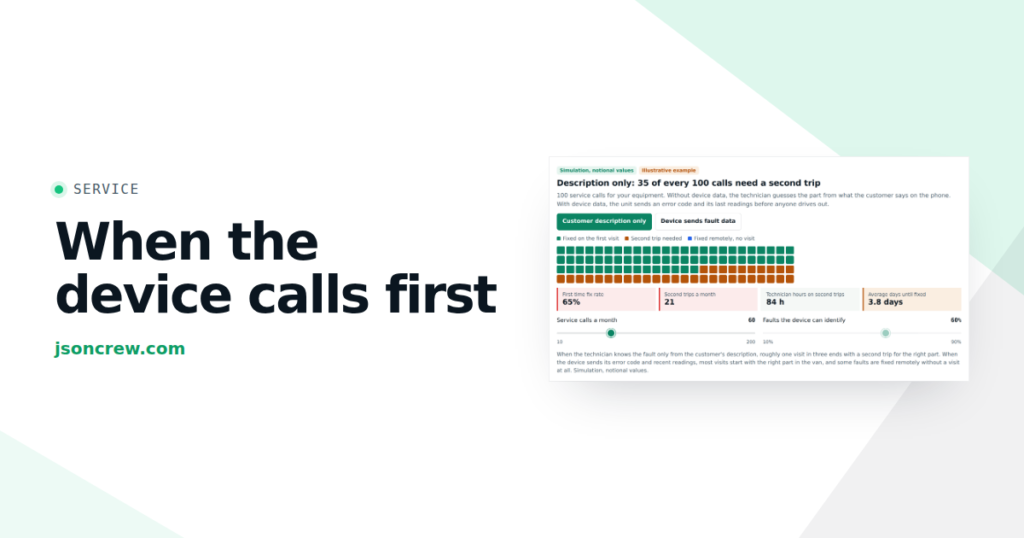
No one without the app. When the customer finally remembers, they type the brand and the word „service” into Google and call up the first result. Sometimes it's your partner. Often not. With the app, the reminder comes from you, with your logo and an appointment at your service center, just like a key on the dashboard. Set the sliders and see how many reviews stay on your network.
Without an application, the review is sold by the person who first answers the phone from your customer
1,000 heat pumps of your brand, second year after installation. Use the sliders to set how customers behave.
Overview in your service network
Review elsewhere or not at all
Failures visible on your site before the customer calls
The values in the simulation are conventional. Notice the third stripe. Without an app, you find out about a failure when a customer calls. With the application, you see failures of connected devices earlier and you call the customer to ask whether the service technician can come tomorrow.
What data does the heat pump app collect and what do you get from it?
A mechanic with a diagnostic computer does not guess, he only reads what the car has written. The manufacturer with the application receives such readings from all its devices at once. Illustrative examples:
- Working in frost. You see how the models behave at minus fifteen: which ones work at the limit, and which ones turn on the heater more often than they should. This is knowledge for the development department and for advisors who select power. I write more about it in the text about predictive maintenance.
- Repeating error codes. If the same error appears in hundreds of devices from one batch, you know about it after a week, not after a season of complaints.
- Client settings. If a high bill is due to your settings and not your device, it will show up in your data. Often, one tip in the app is enough.
- Opinions at the right time. A request for an evaluation after a successful inspection or after a quiet month goes to a satisfied customer. Without the app, reviews are more likely to be written by those who are angry.
Why does an alarm in a heat pump application need hysteresis?
The fastest way to get a customer to uninstall an app is to wake them up at night for no reason.
Let's go back to the dashboard. The fuel reserve light in a good car comes on at a few liters, but goes out only when you fill up significantly more. If it came on and off at the same value, it would blink at every turn because the fuel in the tank was overflowing. Engineers call this difference between the ignition and extinguishment thresholds histerezą.
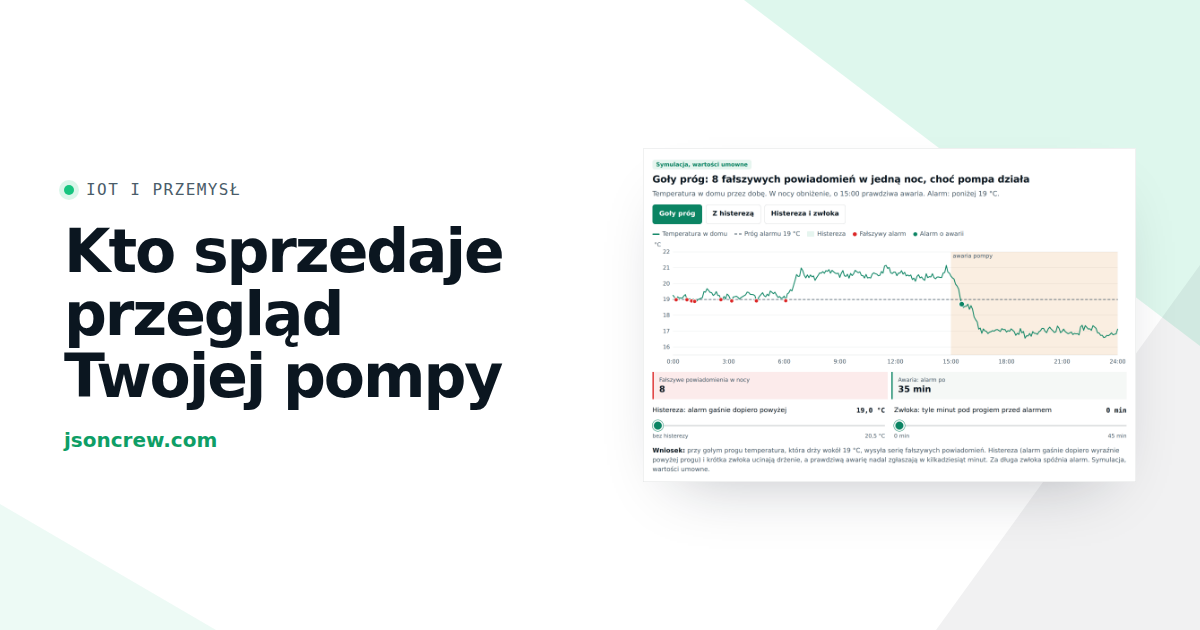
It's the same with the temperature at home. At night, when the heating is at a lower temperature, the reading fluctuates around the alarm threshold. The threshold itself, without hysteresis, turns this fluctuation into a series of notifications. See on the chart.
The threshold itself: 8 false notifications in one night, although the pump is working
Temperature at home 24 hours a day. At night there was a reduction, at 3 p.m. there was a real failure. Alarm: below 19 °C.
- Temperature at home
- Alarm threshold 19 °C
- Hysteresis
- False alarm
- Failure alarm
Two settings do the job here:
- Hysteresis: the alarm turns on below the threshold, but goes out only significantly above it, just like the reserve light. Minor reading fluctuations do not trigger further notifications.
- Delay: the temperature must be below the threshold for several to several minutes before the application sends an alarm. The short squeeze doesn't count.
But don't go overboard. Set the delay to 45 minutes and see how much later you find out about the real failure. It's like a reserve light that comes on only when the car is parked on the side of the road. An overly cautious alarm is as harmful as a nervous alarm, only later.
These settings determine whether the application will give the customer peace of mind or irritate him. The thresholds are set with controller people, using data from real devices.
Remote corrections instead of service trips
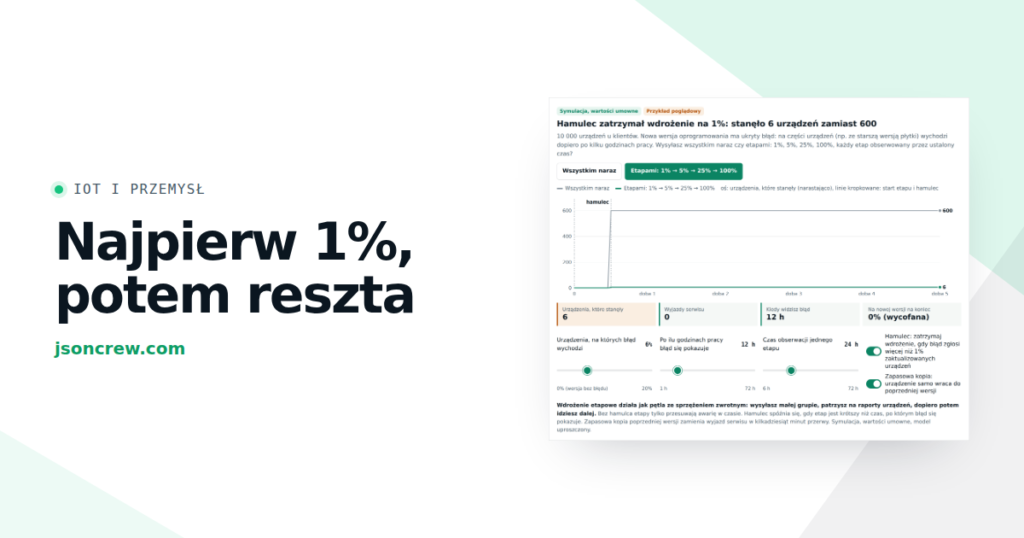
Some new cars receive software corrections at night, at home, without visiting a workshop. The heat pump controller also has software. When you find an error, you can send a service to each device or a correction via the Internet. The latter is called remote updating (in the industry: OTA, from English over the air).
Fix distributed by the service: 90% of devices after 270 days
The same driver software fix: service trips versus remote shipping in stages (first 1% of devices, then 10%, 50% and the rest).
- Service trips
- Remotely, in stages
The stages are important. The patch does not go to everyone at once, but first to 1% of devices, then to 10%, to half and finally to the rest. If something goes wrong, the error will affect a small group, not all customers in January. I describe how to plan such stages and what the controller must be able to do in the text about OTA device updates.
What does it look like at the controller manufacturer: KG Elektronik
KG Elektronik is a Polish manufacturer of controllers for gas boilers, on the market for 25 years. We built the APP Smart Control application for them. The numbers below are from implementation description, as of April 2026.
At the beginning, the customer controlled the boiler from a panel in the boiler room and learned about the failure when it got cold in the house.
Three layers were created:
- mobile app for iOS and Android (one code, two stores) for home owners and building managers: temperature, schedule, phone alarms,
- cloud, which connects each controller to the WiFi module and sends a notification when the temperature deviates from the norm,
- panel for the KG team: view of all devices, remote diagnostics and preparation for remote driver software updates.
Result: approx 12,000 connected devices, above 1,000 downloads on Google Play and 3 months from the start of the project to publication in stores. Grzegorz from KG Elektronik told us in April 2026: „Only this month are we starting to feel that the customer is finally coming back to the store calling our WiFi controller.” The prices of drivers have not changed. The application has ceased to be an addition and has become an argument for purchasing the device itself.
In the same industry, we also work with the Recuperation Center, but before the purchase: the customer selects the recuperator there, and the offer is created automatically in JSON Hub.
Where to start if you are a producer
Before you order the application, answer four questions. You can check each one in a week.
- How many of your devices can connect to the internet? This determines whether you start with the app or the WiFi module.
- Who reminds you about the inspection today? Count how many pumps sold two years ago were serviced in your network. This is your starting point.
- How long does it take to get from an error to the quality department? From the first error code on your device to the moment someone knows about it. This is your dead time.
- How much does a software patch cost you today? If the answer is „we go to every client”, then in practice you don't make any corrections, you just wait for a new model.
When it doesn't work. An application is not the best first step if there are few devices (several hundred), the equipment does not yet connect to the Internet, or decisions in the company take longer than three months. Then you can achieve a similar effect more cheaply using the browser panel for the website or the device selection configurator. An application for several dozen customers is an expensive sensor that will not show much.
Frequently Asked Questions
Does a heat pump application have to be created from scratch?
Not always. Often, the controller is already sending data, but no one is collecting it. Then you first write down what the device can convey, and only then design the screens.
How long does it take to build such an application?
In the case of KG Elektronik, three months passed from the start of the project to publication on Google Play and App Store: mobile application, cloud and panel for the manufacturer's team. With different equipment, the deadline may be different, so we start with a workshop on what the controller can do.
Will the application replace the service network?
NO. Thanks to the application, the customer enters your network, and the service technician arrives with knowledge of what happened to the device. Inspections and repairs are still performed by people.
What about customers who don't connect their pump to the app?
The part will never connect. Therefore, connecting the pump to your customer account should be part of the installation: the installer does this before he leaves. The more connected devices, the more you see.
Is device data safe?
This has to be designed at the start. In APP Smart Control, each device has a separate certificate, and the client logs in via an account in the application, so taking over one controller does not give access to the others.
Where is your company blocking out?
The application is one tool from the post-sale stage. The test will show where your company loses the most: with inquiries, offers or after the sale.
Are you thinking about an application for your device or your own panel for a website? Application cost estimator in a few minutes it will show you how much it actually costs and how long it takes before you talk to anyone.
Where is your company blocking out?
Eight sentences about how your company responds to results. Next to each of them, indicate how often you do this. At the end, you will see what kind of regulator your company is today, what it lacks and where to start.
None of the eight sentences fit your business. This is a good sign: your decision loop is calm. Check it quarterly, because rocking usually begins when the company is growing or the market is changing.
I will send you 10 questions to list one process, with hints for your result
Sent
CEO of Ideo Solutions AS
Case study: Smart Control App
See the manufacturer's ready-made application
Implementation description APP Smart Control for KG Elektronik shows the entire path: from the panel in the boiler room to about 12,000 devices connected to the application. You can find more about what we build on our websites IoT applications and mobile applications.
How to Cite This Article: Jędrzej Siewierski, „A heat pump application with your brand: who makes money on the review when you don't have it”, JSON Crew, jsoncrew.com, 2026.