 Jędrzej Siewierski
Author: Jędrzej Siewierski, CEO and co-founder of JSON Crew.
About 1,600 people enter the term „sales funnel” into Google every month. Most of the results describe the online store: advertising, visit, basket, purchase. The manufacturer's funnel has seven stages and narrows elsewhere, usually only after inquiry, at quotation.
I'll show you these seven stages, where the funnel is most likely to get stuck, and one number to measure at each stage.
In short:
- The sales funnel is the customer's journey from the first contact to the signed contract, divided into stages. At each stage, some cases are dropped, and each case waits for a while.
- In a B2B manufacturing company, the funnel has seven stages: collecting inquiries, building trust, qualifying, identifying needs, offering, closing and what happens after the sale.
- The funnel gets blocked in two ways: it leaks (at this stage most things are dropped) or it gets clogged (things wait there the longest). For manufacturers, both problems often lie in the same place: pricing.
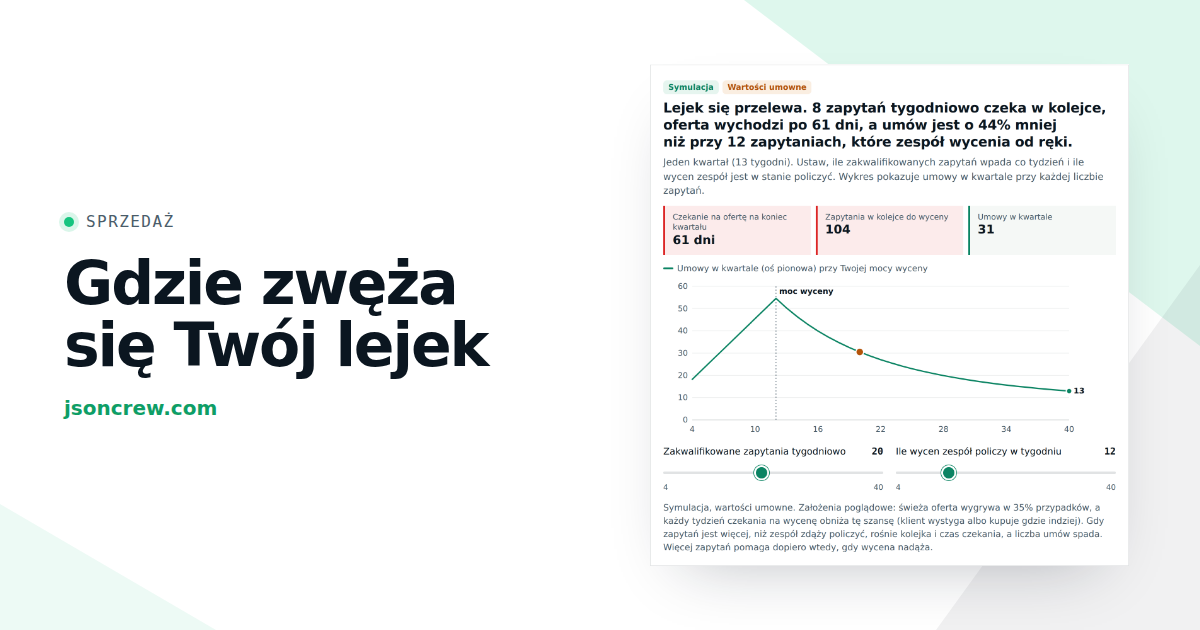
- More queries only help if the tightest spot can keep up. Adding inquiries to a clogged quote can reduce sales.
Oil Funnel: The neck determines the rate
You pour oil into the engine through a funnel. The canister is full, so you pour it quickly. After a few seconds, the oil goes under the edge of the funnel and drips down the engine. A fuller canister won't change anything. How much oil enters the engine in a minute depends on the neck.
Sales work the same way. Contacts and inquiries go to the top, signed contracts come to the bottom. There are places along the way where things fall off and places where they wait. The pace of the whole is set by the narrowest of them.
What is a sales funnel?
A sales funnel (also known as a sales funnel) is a model of the customer's journey from the first contact to the contract, divided into stages. For each stage, you know two numbers: what proportion of cases progress and how many days the case waits there. A sales pipeline is something else: a list of specific, open cases for today, each with a company, value, stage and next step. The funnel tells you how the process works. Pipeline shows what's in it today.
At the manufacturer, before „yes” is said, the matter goes through a salesperson, often a technologist or a person calculating quotes, sometimes a visit to the customer and several people on his side. That's why most steps come after the query, not before it.
Stages of the sales funnel in a B2B manufacturing company
I use the same seven steps as ours B2B sales process map. For each one, I provide what to measure and how long it takes to see the effect of the change.
| Stage | What's going on at the manufacturer | What are you measuring? | When you see the effect |
|---|---|---|---|
| 1. Collecting inquiries | telephones, form, fairs, distributors | inquiries from companies from your profile per week | advertising: days, content: months |
| 2. Building trust | the client reads, watches the projects, compares | how many people come back and how many ask to talk | months |
| 3. Qualification | Does the client fit: parameters, budget, deadline | time until first contact | hours |
| 4. Identification of needs | conversation, drawings, visit to the client | conversations ending with the next step with a date | weeks |
| 5. Offering | calculation, technologist, offer | time from conversation to sent offer | immediately |
| 6. Closure | acceptance, contract, advance payment | days from „yes” to signature and payment | days |
| 7. After sales and growth | service, parts, subsequent orders | repeat purchases and referrals | months and years |
1. Collecting inquiries. A common mistake is to count everything, including spam and companies that will never buy your product. Only count inquiries from companies on your profile.
2. Building trust. B2B buyers rarely call right away. First, it checks whether you've done something similar before. At Blachodach, which makes roofs, facades and fences, the salesperson has a gallery of completed projects in the pricing tool. The customer looks at ready-made roofs and fences before asking about their own.
3. Qualification. You check whether the query matches: parameters, budget, deadline. For manufacturers, this stage consumes a lot of salespeople's time because each inquiry asks the same questions about dimensions and variants. Blachodach has an internal tool for salespeople for this purpose. The salesperson goes through the selection of a roof, facade or fence with the customer, the price is calculated immediately, and the customer receives an offer in PDF with a link for acceptance. The same questions are not asked anew with each inquiry.
4. Identification of needs. Conversation, drawings, sometimes a visit to the client. This is where a big job is won or lost. The funnel gets clogged when all the knowledge is in one person's head: that person gets sick and the matter stops.
5. Offering. The most common neck from the manufacturer. The valuation can be calculated by one or two people, often a technologist who also has other responsibilities. Each new query gets queued to the same hands.
6. Closure. The client said yes, and then you wait weeks for a signature and a down payment. They are hindered by formalities: a contract written from scratch, acceptance on the client's side, and manually issued invoices.
7. After sales and growth. For a manufacturer of machinery and equipment, sales do not end with delivery. There is service, parts, subsequent orders and recommendations. If your devices send data, you can also see what happens to the customer after the sale. More about this in the text about predictive maintenance.
Now put it into numbers using an illustrative example. Tap any stage and change two numbers: how many cases are moving forward and how many days the case is waiting there.
Where does the sales funnel get blocked most often?
The funnel locks in two ways and each repairs differently.
Leak This is the stage where most things get lost, as if the funnel had a hole in it. The transitions between stages multiply: 50% times 60% times 35% and so on. Therefore, a 10 percentage point improvement makes the most difference where the transition is lowest. When you increase the transition from 35% to 45%, there will be over a quarter more contracts. When from 80% to 90%, only one eighth.
Jam this is the stage where things wait the longest, like a clogged cervix. It is not always visible in the number of contracts, but it lengthens the entire sales cycle. The longer the cycle, the later you see the effect of the decision and the easier it is for the customer to buy elsewhere along the way.
For manufacturers, the hole and the plug are often in the same place: in the offering. Illustrative example: the offer goes out after three weeks, and the customer already has two others during that time.
Why more inquiries may result in fewer deals
Return to the oil funnel. When you pour faster than the neck allows, some of the oil ends up on the engine, not in it.
In the company it looks like this. The management board sees too few contracts, so it spends money on advertising. There are more and more inquiries, but people counting valuations have the same number of hours as before. There is a queue and offers come out later and later. A customer who waits three weeks for a price will have time to talk to another company or postpone the purchase. The company pays for more inquiries and signs fewer contracts.
Check it out for yourself. Set how many qualified inquiries are received per week and how many quotes the team will be able to count.
The number of contracts increases as long as there are as many inquiries as the team can quote. Then it falls. We wrote the same conclusion on our map at the stage offering: first widen the cervix, i.e. shorten the valuation time, and only then pour it faster.
Sales funnel as a loop: sensor, delay, congestion
In the text about managing processes in the company I described how to look at every process as a loop: there is a goal, a measurement, the difference between them and a decision. A sales funnel consists of several such loops, one per stage. I ask four questions with each one, and the answers can be seen in the same funnel with the oil.
- What are you measuring? When pouring oil, you look at the level in the funnel, not how much is left in the canister. In sales, the number of inquiries is tempting because it is easy to increase it. When it becomes an end in itself, it stops telling the truth (I write about this in the text about almost Goodhart).
- How long does it take to see the effect? The oil flows into the engine with a delay, so you check the level on the dipstick after a while, not immediately. The effect of change is visible after hours in qualifications, after days in closure, and in building trust after months.
- Where is the congestion? There is one neck and it sets the pace. Touch-ups in other places usually just add more before the neck.
- How strongly should you react? One change at a time, then wait for the effect to wear off. Doubling your budget after one bad week is like tilting a canister upright because the oil is flowing too slowly.
What to measure at each stage of the B2B sales funnel?
All you need is one number per stage, which you see every month without having to search through boxes and sheets. Check which ones you have today.
Start with the stages where the effect of change is visible most quickly: qualification, offering and closure. There you will be able to check in a few weeks whether the fix works. Measure stages that take months to produce results (confidence, growth) immediately, but evaluate them quarterly.
When you have numbers from several months, you can calculate the forecast from the funnel: the value of each open case times the chance of winning at its stage. I described it step by step in the text about sales forecasting.
Sales pipeline in CRM: a funnel that counts on its own
Everything above can be done in a spreadsheet. But someone has to remember to fill in the sheet, and the numbers copied by hand quickly stop matching. It's better if the funnel counts the system in which salespeople work anyway.
In our CRM JSON Hub at each stage, the funnel shows the sum and value weighted by the chance of winning, and next to it you can see won and lost cases. You can run several sales processes, for example machines and parts separately. A case without any movement for 14 days gets a red marker, and the „No next step” list shows contacts for whom no one has planned a next move. This is how you can see a traffic jam without looking for it.
In the offering stage, JSON Hub has an offering module. The offer is sent to the client as a link, not as a PDF. You see when and how many times the customer opened it, and the customer can change the parameters, see the new price and click „I accept the offer”.
When the jugular is the quote itself, CRM is not enough. Then it helps configurator for a customer or a salesperson, digital bidding and integration with ERP, if prices and availability are in the production system. Repetitive steps between stages, such as inquiry assignment or offer reminder, take over automation. The text will tell you where to start levels of bidding automation and about this, what is CPQ (a program that helps you select a product, calculate the price and prepare an offer).
What to do on Monday
- Draw your funnel. Seven stages, each with the number of cases from the last three months. If you don't have any number, that's your answer.
- Count the time at each stage. Take the last 20 won cases and check the dates: inquiry, first contact, conversation, offer, acceptance, signature. The longest section is your traffic jam.
- Find the leak. This is the stage with the lowest transition. There, 10 improvement points will give you the most contracts.
- Before you add any questions, check the neck. How many quotes per week can the team count and how many days does the customer wait for the offer today?
When it doesn't work
- Several large contracts a year. With such a small number of cases, transition percentages are random. Handle each case separately, by name, with the date of the next step.
- Sales through distributors. Part of the funnel happens at the distributor and you don't see it. Then measure what you see: inquiries submitted to distributors and orders from them.
- Tenders. The deadline and criteria are set by the ordering party. The funnel will help you assess which tenders to participate in, but it will not shorten the procedure.
Frequently Asked Questions
What are the stages of the sales funnel in a manufacturing company?
Seven: collecting inquiries, building trust, qualifying, identifying needs, offering, closing and the post-sale stage (service, parts, subsequent orders, referrals). Most of them are after an inquiry, which is why the manufacturer's funnel is different from the online store's funnel.
What is the difference between a sales funnel and a sales pipeline?
A sales funnel is a process model: stages, transitions between them and time. The sales pipeline is a list of specific open cases in these stages today. The funnel helps find the blockage, the pipeline shows which issue to deal with now.
At what stage should you start improving your funnel?
From congestion, i.e. from the stage at which most cases are dropped or cases wait the longest. Manufacturers often offer this. If you don't know where the bottleneck is, check the dates at each stage in your last 20 case wins.
Do more inquiries always increase sales?
NO. When pricing or qualifications can't keep up, new inquiries wait in the queue, offers come out later and some customers buy elsewhere. First, check if the narrowest place in the funnel has room.
How many stages should a funnel in CRM have?
As many as there are real decisions in the process, usually five to seven. Each stage must have a clear transition condition, for example „offer sent” and not „we are talking”. Otherwise, salespeople will move things by feel.
Check where your funnel narrows
„Where is your company stuck?” Test will go through the same seven stages with you and show you at which stage your sales slow down the most. Takes a few minutes.
Where is your company blocking out?
Eight sentences about how your company responds to results. Next to each of them, indicate how often you do this. At the end, you will see what kind of regulator your company is today, what it lacks and where to start.
None of the eight sentences fit your business. This is a good sign: your decision loop is calm. Check it quarterly, because rocking usually begins when the company is growing or the market is changing.
I will send you 10 questions to list one process, with hints for your result
Sent
CEO of Ideo Solutions AS
How to Cite This Article: Jędrzej Siewierski, „Sales funnel in a manufacturing company: 7 stages, where it gets stuck and what to measure”, JSON Crew, jsoncrew.com, 2026.