
TL;DR · 30 SECONDS
- Realistic price range for the product configurator in 2026: Basic: 35,000–60,000 PLN; Extended: 87,000–150,000 PLN; Advanced: 175,000–300,000 PLN. Annual maintenance: ~20% of the project value.
- The price depends on 7 factors: complexity of the product and rules, 3D module (+30-80k), integration with ERP/CRM/PIM (4-15k per system), infrastructure, security (~10% of the project), number of platforms (+40-80k for mobile) and post-implementation maintenance.
- ROI per team size (expanded ~120k): 1 salesperson – 4–8 years, not worth it. 3 salespeople – 14 months to 2.5 years. 5 salespeople – 7–19 months. 10 salespeople – 4–10 months.
- When you SHOULD NOT invest: less than 5 offers per month, average offer value below PLN 15-20k, 90% of repeat sales without configuration, no salesperson actively selling.
Price of the product configurator in 2026, the investment ranges from PLN 35,000 (simple MVP, one product, several variants, static price list) to PLN 300,000 (advanced, hundreds of parameters, ERP+CRM integration, dedicated infrastructure). Most manufacturing companies land in the range of PLN 35,000–90,000. PLN for MVP, one product type, several parameters, offer generation.
You're calling a software house. You describe your product, explain that salespeople are losing two days on every quote, and that customers are going to the competition. You ask: how much does a configurator cost? The answer: „It depends.” Three calls, zero answers. This article is the answer you didn't get.

Realistic ranges from our pricing matrix, three ROI models, and an honest answer to the question: when a configurator isn't worth it.
|
You already know you want a configurator? Fill out the form and we will contact you on the next business day. |
Fill out the form |
How much will a product configurator cost in 2026? Three levels of complexity
Check if the configurator makes sense on your end
Survey 15 questions (3 min). After filling it out, we'll both know if there's anything to talk about.
Fill out the checklist →We have been building product configurators for manufacturing companies since 2024. Below is a matrix of our valuations – real rates, real hours, real projects. In other words: not „from,” not „to,” not „it depends.”.
SIMPLE
One product, multiple variations, static price list, CMS, minimal integration
PLN 35,000 – PLN 60,000
Annual maintenance: PLN 6–12k
EXPANDED
Several product lines, parameters + options, marketplace or CRM integration, advanced rules
PLN 87,000 – PLN 150,000
Annual maintenance: ~18k PLN
ADVANCED
Hundreds of variations, dynamic exclusion rules, ERP and CRM integration, dedicated infrastructure
PLN 175,000 – PLN 300,000
Annual maintenance: 18k+ PLN
So where does a typical project land? Most manufacturing companies start with simple or the lower limit of the expanded, one product type, several parameters, price list and offer generation. As a result, this is the MVP for PLN 35,000 – PLN 90,000. Furthermore, the expansion (additional lines, ERP integration, 3D module) is phase 2, a separate budget.
When someone offers you a configurator for 20-25 thousand, you most likely get a WordPress plugin or a simple low-code form. For a very simple product (several variants, static price list), this may be enough. But WordPress has its limits: rigid architecture, performance problems with higher traffic, lack of flexibility when pricing rules become more complicated. However, in six months, when you add a second product line or need integration with ERP, you will start from scratch because the WP plugin will not handle it. It's worth knowing this in advance.
What factors influence the price of a product configurator? 7 factors
1. Product and rule complexity
First and foremost, a furniture configurator with three color options is not the same as an agricultural machinery configurator with hundreds of parameters and interdependencies. Akpil projects (agricultural machinery) we have hundreds of parameters per machine type, variants, accessories and exclusion rules, this is the advanced level.
Approximately:
- Below are 10 parameters (e.g., color, size, material), a simple configurator
- 10–100 parameters with options and accessories, comprehensive
- 100+ parameters with dependencies, exclusions, and dynamic pricing, advanced
3D Module (Visualization)
3D ModuleThree.js—we wrote about it in a separate post) is not present in the simple configurator. In the advanced one, it's an option, and in the expert one, it's a full module. Consequently, the cost difference is PLN 30,000–80,000. If your product doesn't require a visual representation (because the customer buys based on the specifications), don't pay for 3D rendering.
3. ERP / CRM / PIM Integration
Every integration with an existing system is 4,000–15,000 PLN additional. For example, SAP, Comarch, Subiekt, Salesforce, and Pipedrive—each has a different API (or none at all). If you don’t have a CRM yet or your current one doesn’t support automated quoting, we build configurators with native integration with JSON Hub (Our CRM platform + digital quoting in one). This brings the integration cost to zero, as the configurator and CRM share the same backend.
4. Infrastructure and hosting
As for the infrastructure: the basic configurator runs on shared hosting (a few hundred PLN per year), while the advanced version requires a dedicated environment (AWS / Azure), costing 1,500–5,000 PLN per month.
5.Security
Fixed overhead ~10% project value. Specifically: penetration testing, code auditing, data encryption, identity management.
6. Number of platforms
By default, web is the standard. However, the mobile version (Flutter / React Native) is PLN 40,000–80,000. Start with web, add platforms after validation.
7. Post-Implementation Maintenance
The configurator isn't a one-time purchase; it's a dynamic system that grows alongside your product. The approximate annual maintenance cost is ~20% project values. What's included in this:
- Infrastructure, hosting, SSL, uptime monitoring, backups
- Bug fixes and patches, corrections submitted by sales representatives and customers
- New product variants, add a line, change the parameters, and the configurator updates
- Price list updates, synchronization with your PIM/ERP system, or manual updates
- Maintaining integration. The APIs of external systems are changing, so integration requires adjustments
- Minor UX improvementsOnce it's implemented, you can see where customers get stuck and make improvements
We determine the specific scope of maintenance on a case-by-case basis after implementation; it depends on how often your product and pricing change.
Three return on investment models
How much does this one question cost? The second, equally important one: When does it return? There are three models. None of them work alone, but together they form a complete picture.
Time savings (measurable, scales with team)
MODEL 1 - MEASURABLE
Merchant time saving
B2B Sales Representative in Poland: ~9,800 PLN gross/month, employer cost 14–18k/month, hourly rate 80–130 PLN. Time saved per quote: 30–60 minutes.
| Band | Savings / year | Break-even enhanced (~120k) |
| 1 salesperson | PLN 15,000–35,000 | 4–8 years old, not worth it |
| 3 salespeople | 45,000–105,000 PLN | 14 months–2.5 years. OK |
| 5 salespeople | 75,000–175,000 PLN | 7–19 months, good |
| 10 salespeople | PLN 150,000–350,000 | 4–10 months, a hit |
Application A team of 5+ salespeople, each handling 10+ offers. Model 1 alone justifies the configurator.
How does this fit together (chart)
The more merchants, the faster the configurator pays for itself. Green zone = full payback in one year.
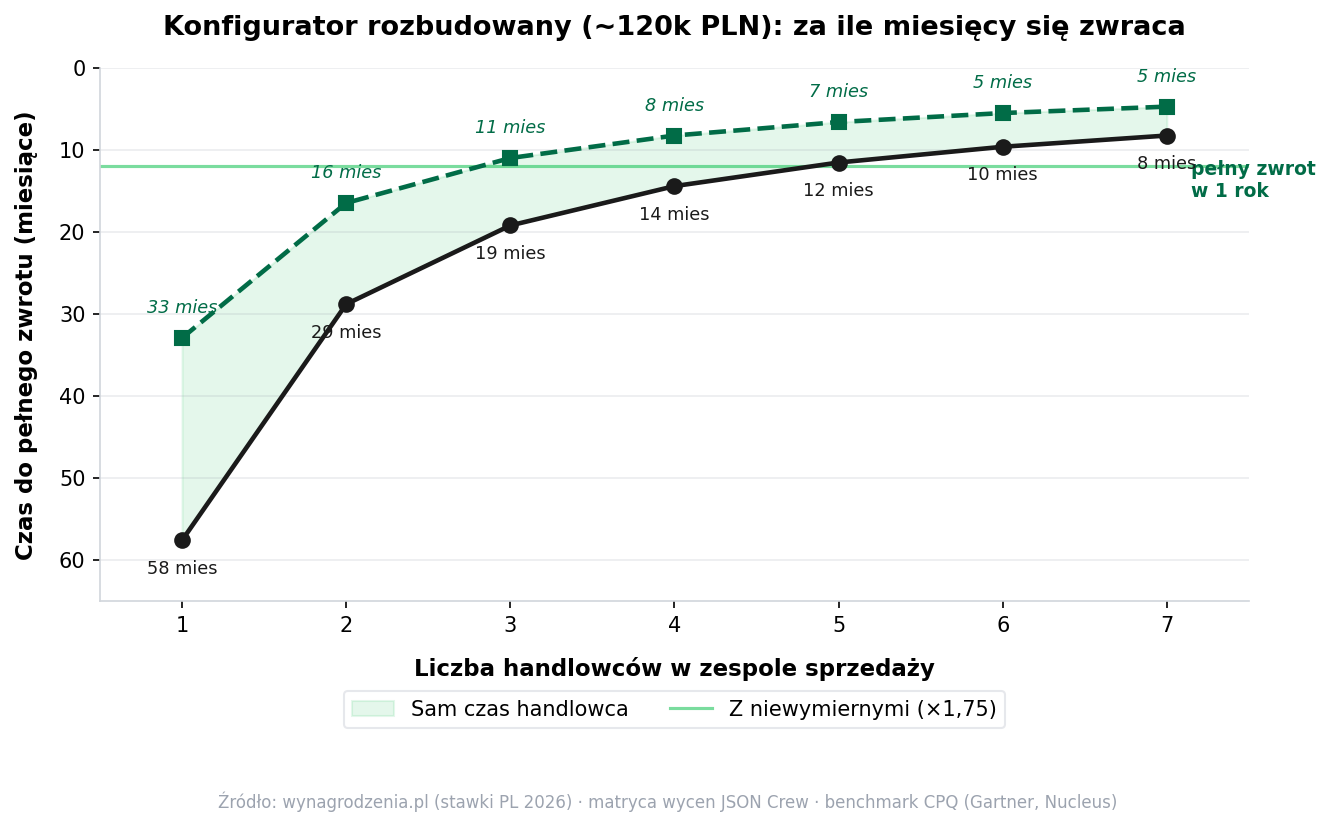
Black line (profit considering only traders' time): full return in ~12 months with 5 traders.
Green dashed (including intangible aspects): full return in ~12 months with just 3 salespeople. The larger the team, the faster.
MODEL 2 - MARKET BENCHMARK
Win rate increase
Benchmarks Gartner i Nucleus Research indicate +10–20 percentage points in win rate after CPQ/configurator implementation:
- The client receives the price on the screen, not in the weekly email
- A conversation with a salesperson is about conditions, not fundamentals.
- There's no "ghost effect"—you know who set it up and where they left off
Bill: 10 offers/month × 100k PLN × +10pp win-rate = +100k additional revenue/month. With a margin of 20–25% → ~$250,000–$300,000 in profit per year.
Advanced configurator (120k) ÷ 250k profit/year = break-even in 5–6 months.
MODEL 3 · IMMEASURABLE BUT REAL
Engagement, retargeting, data
A client setting up a product spends time on the website. 3–8 minutes (vs. ~30 seconds per PDF). This remarketing window (hot lead), profile for CRM (what was configured, which variant stalled), and data for product iteration (what's missing from the offer).
You won't paste these three things into an ROI spreadsheet, but each is observable two months after implementation.
The configurator is addressed through changes to the sales process, not through stoppers.
When a configurator is NOT worth the investment
Less than 5 offers per month, the scale is too small to display even a simple configurator
• Average offer value below 15,000–20,000 PLN, a small profit per deal
• 90% repeat sales No configuration, so there's no point in automating it
• Lack of an actively selling salespersonThe configurator supports, but does not replace, the sales process
In short, if you fall into one of these four categories, you don’t need to use a configurator. Just reach out, and we’ll recommend a simpler tool (a calculator, a dynamic form, or a ready-made SaaS CPQ solution).
Custom configurator vs. ready-made template: which one to choose
A configurator is a tool before contacting a salesperson...the customer configures the product themselves, sees the price, and submits an inquiry. This isn't Configure-Price-Quote, which comes into play during the quoting stage after speaking with a sales representative. These are two different tools at two different stages of the sales funnel.
The comparison therefore focuses on how to build a configurator: custom vs. off-the-shelf solution:
| Custom (JSON Crew) | Ready configurator (SaaS) | WP Plugin / low-code | |
| Launch price | 35,000–90,000 PLN (MVP) | 500–2,000 PLN/month/user | 200–500 PLN/month |
| Process alignment | 100% for your product | 70–80%, the rest is a workaround | 50%, generic interface |
| ERP Integration | Full (API, custom) | Limited partner list | No or webhook |
| 3D Visualization | Three.js, full customization | Addon (expensive) | None |
| Implementation time | Typically 8–12 weeks. | 2–4 months for setup | 1–2 weeks |
| Code ownership | Yours forever | Subscription (SaaS) | Subscription |
| Scalability | Unlimited (Your code) | Vendor dependent | Limited (WordPress) |
How do we do this in JSON Crew
Since 2024, we have implemented three configurators: Akpil (agricultural machinery) with hundreds of parameters per machine type, Hunting rifle with the choice of model, stock, wood, caliber, and accessories, plus one project from the construction industry. Ten manufacturing companies use JSON Hub.
- Fixed Price MVP, clear scope, clear price, no change requests during the project
- Bi-weekly sprints, and after each one, you see a working version. Typical MVP: 8–12 weeks, depending on complexity
- Time and Materials only in Phase 2, when the product reaches users
- Stack Next.js + Three.js + Nest.js
Questions we hear in interviews
„60k is too much.”
Offer chaos costs a company with 10 salespeople ~180,000 PLN annually (lost deals + time for manual valuations + fixes + follow-up). As a result, a $60k MVP pays for itself in 3 months through Model 2 alone (win-rate). The question isn't „Can you afford a configurator.” The question is „Can you afford another year without one.”.
„We already have a CRM.”
CRM manages relationships, while the configurator manages configuration and pricing. The question is: does your CRM automatically generate a quote based on what the customer has selected? In most cases, the answer is „no.” That's why we built JSON Hub, a platform that combines a product configurator, CRM, and digital quoting all in one place. The customer configures the product, the system generates a quote, and the sales rep sees the lead with full context. No more switching between Pipedrive, Excel, and email. If you already have a CRM (Pipedrive, HubSpot, Livespace), the configurator integrates with it. If you don’t have one— JSON Hub It replaces three tools with one.
“We have too many parameters: it’s impossible.”
Akpil has hundreds of parameters. Knieja has a model, stock, wood, caliber, accessories. Nevertheless, both operate within one system. A sensible MVP is one product type, followed by extensions.
„What if it doesn't work?”
We work in two-week sprints, and after each one, you see a working feature—not just a slide. What’s more, the scope is defined on paper before a single line of code is written. If you don’t see value after the first few sprints, we don’t proceed with any more. We don’t promise magic dates; we promise that after every sprint, you’ll know exactly where you stand.
„Another used car dealership priced it cheaper.”
What do you get for this price? How many hours? Who is the architect? What's the stack? Do they have a case study with a configurator, or are they building their first? „To be determined later” = change requests for an additional fee.
That's why it's worth considering. We've seen more than one project where a client chose a cheaper option, and after a few months, they returned to the market looking for someone to bring it to a usable state. The cost of repairs? As a result, it's usually two to three times the original budget. We don't take on such projects. If we’re dealing with an unfinished system from another vendor, we’ll honestly assess whether it can be salvaged. But if we need to build from scratch, we’ll build from scratch—we won’t just patch our code onto someone else’s, because that ends up being more expensive for both parties.
Frequently Asked Questions About the Price of the Configurator
How much will a product configurator cost in 2026?
In 2026, a product configurator costs between 35,000 PLN for a simple MVP (one product, several variants, static pricing) and 300,000 PLN for an advanced system (hundreds of parameters, dynamic exclusion rules, integration with ERP and CRM, dedicated infrastructure). Most manufacturing companies fall within the PLN 35,000–90,000 range for an MVP. An expanded configurator (several product lines, parameters plus options, integration with a marketplace or CRM) costs PLN 87,000–150,000, with annual maintenance at ~PLN 18,000.
What factors affect the price of the configurator?
The price of the configurator is influenced by 7 factors: 1) the complexity of the product and its rules (fewer than 10 parameters is simple; 100+ with dependencies is advanced), 2) the Three.js 3D module (+30,000–80,000 PLN), 3) integration with ERP/CRM/PIM (4,000–15,000 PLN per system), 4) infrastructure (shared hosting vs. AWS/Azure 1,500–5,000 PLN/month), 5) security ~10% of project value (penetration testing, audit, encryption), 6) number of platforms (standard web, mobile Flutter/React Native +40,000–80,000 PLN), 7) post-implementation maintenance ~20% of value annually.
Is a car configurator that costs 35,000 PLN of good quality?
A configurator for 35,000 PLN is the bare minimum for a simple MVP: one product, a few variants, a static price list, a CMS, and minimal integration. For a very simple product, that’s enough. On the other hand, a 20,000–25,000 PLN offer is most likely a WordPress plugin or low-code solution, featuring a rigid architecture, performance issues, and a lack of flexibility when dealing with more complex pricing rules. When you add a second product line in six months or need ERP integration, you’ll have to start from scratch. A sensible custom MVP starts at 35,000 PLN.
How long does it take to implement the configurator?
Implementation of a custom product configurator typically takes 8–12 weeks from the initial brief to go-live, depending on complexity. We work in two-week sprints; after each sprint, you see a working feature, not just a slide. Phase 1 is the MVP (one product type, basic parameters, quote generation). Phase 2 (expansion to additional product lines, ERP integration, 3D module) involves a separate budget and separate implementation. For comparison: a ready-made SaaS configurator takes 2–4 months to configure, a WP plugin takes 1–2 weeks but comes with significant architectural limitations.
What is the ROI of the configurator?
The ROI of a configurator depends on the size of the sales team. For an extensive configurator (~120,000 PLN): 1 salesperson equals a 4–8-year payback period (not worth it), 3 salespeople equals 14 months to 2.5 years (OK), 5 salespeople equals 7–19 months (good), 10 salespeople equals 4–10 months (a hit). The three return models add up: sales rep time savings (15,000–350,000 PLN/year depending on scale), win-rate increase of +10–20 percentage points according to Gartner i Nucleus Research, plus data for retargeting and product iteration. The full 5-dimensional ROI model: ROI from a configurator: how to realistically calculate return on investment.
When should you NOT implement a configurator?
There are four situations in which it is not worth implementing a configurator: 1) fewer than 5 deals per month—the scale is too small to justify even a simple configurator; 2) average deal value below 15,000–20,000 PLN—marginal profit per deal; 3) 90% of sales are repeat business without configuration; there is no point in automating this, 4) no sales representative actively selling; a configurator supports the sales process, it does not replace it. In such cases, lighter tools are better: a calculator, a dynamic form, a ready-made CPQ SaaS solution, or simply a well-organized PDF price list.
What to do if you're considering a configurator
Option 1 · check yourself
Is your company ready for a configurator?
15 questions, 10 minutes. Answer honestly, and you’ll see whether implementation makes sense right now or whether you need to get your basics in order first.
Option 2 · Chat with us
Schedule a diagnostic call
30 minutes, free. Come with two numbers: how many offers per month and the average offer value. We'll tell you which bracket your project would fall into. Without a pitch deck.
P.S. If you’re reading this article because you’ve just been told “it depends” by a third software development company, we understand your frustration. That’s why we’re publishing our pricing matrix, realistic price ranges, and an honest assessment of “when it’s not worth it.” Price transparency isn’t a weakness. It’s a filter that attracts the clients we want to work with.
About the author
Jędrzej SiewierskiCEO and co-founder JSON CrewSince 2024, he has been building product configurators for B2B companies (manufacturers of agricultural machinery, hunting weapons, modular homes, and IoT electronics) as well as JSON Hub, his own SaaS platform that integrates CRM, automated quoting, and project management. Co-author of a digital sales transformation methodology: shortening the path from interest to purchase through a configurator + automated quoting + CRM. Stack: Next.js, Three.js, Nest.js, React Native. Contact: contact@jsoncrew.com · LinkedIn.
See the configurators in action — 5 working demos
Instead of just reading about the configurators, click and try them out for yourself—no login or registration required. JSON Crew Showroom has 5 working demos designed for various industries:
- 3D Weapon Configurator — GLB model in the browser, accessories (red dot sight, magazines), body finish (Cerakote/carbon fiber/camouflage). A benchmark for firearms and accessories manufacturers.
- 3D Car Configurator — body paint, wheels, spoilers, and trim packages. The UX standard used by BMW, Audi, and Škoda serves as a benchmark for automotive dealers and manufacturers.
- Modular Home Configurator — building structure, transportation, systems, automated PDF pricing. Mechanical engineering for B2C and B2B modular home manufacturers.
- Metal Garage Configurator — Step-by-step selection of design, size, and gate. Implementation takes approximately 4 weeks. Demand for this product in the Polish market has increased by 160% year-over-year.
- Configurator cost estimator — Cost estimates in PLN for your business in 3 minutes. EASY/MID/HARD + 3-year TCO + ROI calculation.