 Jędrzej Siewierski
Author: Jędrzej Siewierski, CEO and co-founder of JSON Crew.
In 2016, the American bank Wells Fargo paid $185 million in fines. Employees, who were held accountable for sales targets and rewarded for meeting them, opened over two million accounts and cards that customers may never have agreed to. The number of products sold increased, and it ended with a fine.
It has a name: Goodhart's Law. When an indicator becomes a target, it stops measuring well. You don't have to run a bank to have the same mechanism. All it takes is one number on the dashboard and a bonus that depends on it.
In short:
- Goodhart's Law states that an indicator to which you attach a reward begins to grow faster than the thing it was supposed to measure. The number increases, but the result does not.
- This is not a problem of dishonest people. People do what you pay them to do.
- An indicator is harder to manipulate when it has two components: result and quality (closed tickets and reopened tickets, forms and opportunities accepted by sales representatives). In addition, there should be regular checks of a small sample.
- You fix the measurement first. A doctor who treats a radiator reading is treating a healthy child.
Thermometer by the radiator
Do you remember the thermometer trick from your childhood? You don't want to go to a test, so when your mom leaves the room, you put the thermometer against the radiator. One hundred and one point five. You're staying home.
The thermometer works flawlessly. But from the moment its reading determines whether or not to go to school, it stops saying anything about fever. It only tells you how close it was to the radiator.
Mom can forbid measuring, but then she won't know anything. She can yell, but then the child will only hide the trick better. She can also do what wise parents do:
- place your hand on your forehead,
- check whether the child has eaten breakfast with appetite,
- Occasionally take your temperature yourself, on your own.,
- and to decide to stay at home after a discussion, not just after reading the information.
Remember these four moves. They will soon return as four ways to improve KPIs in your company.
Goodhart's Law: What is it?
Definition. Goodhart's Law is the observation that when an indicator becomes a target against which someone is held accountable, people start to improve the indicator itself rather than the thing it was supposed to measure. The indicator then ceases to measure well.
The name comes from the British economist Charles Goodhart. In 1975, while writing about the UK's monetary policy, he observed that any pattern in the data begins to break down when someone starts using it for control purposes.
The short version that everyone quotes today was formulated in 1997 by anthropologist Marilyn Strathern: when a measure becomes a target, it ceases to be a good measure. American psychologist Donald Campbell had a similar thought in the 1970s. It's the same thermometer by the radiator, only on the scale of a country and a university.
KPIs: What are they, and why can every performance indicator be manipulated?
KPI (key performance indicator) is a key performance indicator: a number by which you assess whether a department or process is heading in the right direction. For example, the number of bids, the win rate, the response time to an inquiry, the margin.
Measurement alone does not trigger Goodhart's Law. It is triggered by pressure: a bonus, a ranking, a public table at a meeting, the threat of dismissal. That's when people look for the cheapest way to get a better number, and that rarely leads through better work. It usually leads through the radiator. At Wells Fargo, the U.S. Consumer Financial Protection Bureau (CFPB) explicitly stated that employees opened accounts to meet sales targets and receive bonuses.
Three examples from companies (illustrative examples)
It's Examples for illustration: They do not describe specific companies, but the layout is typical.
Sales KPIs: number of calls
The head of sales sets a target: 60 calls per day per salesperson. After a month, everyone meets the target. The calls last 40 seconds each, the salespeople call easy contacts, and the difficult client, who needs to be spoken to for half an hour, is put off until next week. The number of calls increased, but the number of meetings did not. The number of calls itself isn't bad. It becomes a problem when it's the only factor that determines the bonus.
KPIs in Marketing: Forms Instead of Opportunities
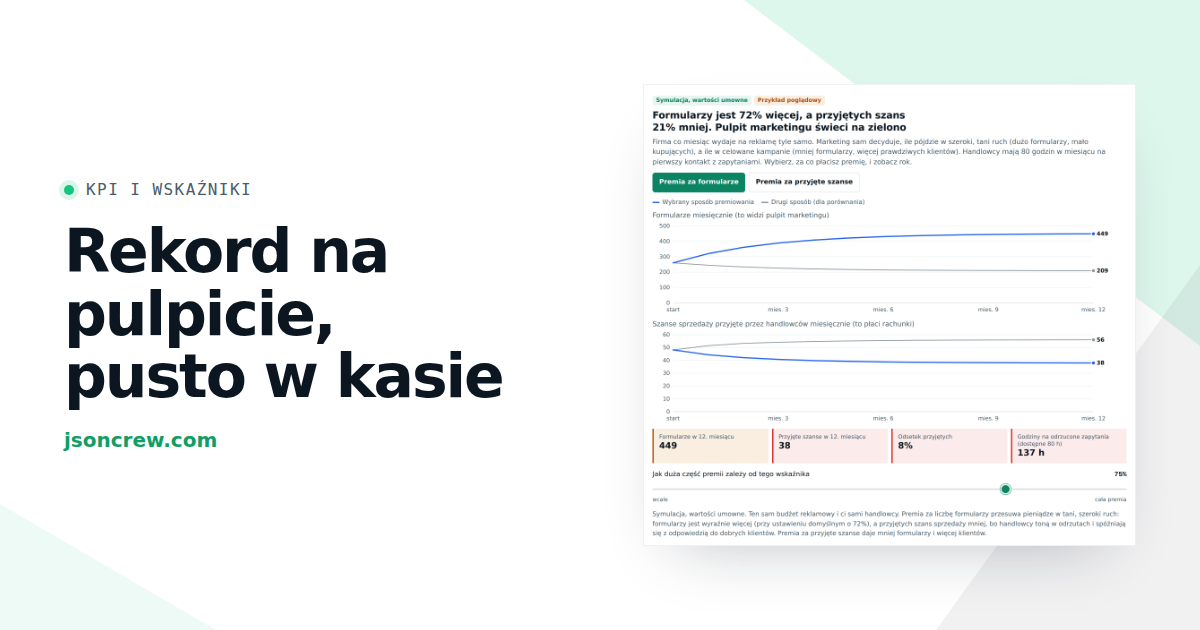
Marketing is evaluated based on the number of forms. The easiest way to increase it is through broad, inexpensive traffic, a free guide in exchange for an email address, or a contest. Salespeople receive a pile of inquiries from people without a budget and without a need. They call everyone because they don't know which inquiries are genuine. A real customer from Tuesday gets a response on Friday, when they're already talking to someone else.
See for yourself: the same budget, the same salespeople – you only change what marketing gets rewarded for.
With the default setting (75% of the bonus depends on the indicator), the bonus for forms results in 72% more forms and 21% fewer accepted opportunities after one year. Rejected inquiries take up 137 hours per month for sales representatives, and they only have 80 hours available for them. The bonus for accepted opportunities results in 20% fewer forms and 16% more opportunities. The values are arbitrary, but the mechanism is real.
Service KPIs: Closed tickets
The service manager receives a bonus based on the number of closed tickets. There are more tickets than the team can resolve, so some of them are closed „on their word”: restart, „please monitor”, status closed. The dashboard shows the record, and the customer comes back after two weeks with the same problem. The worst part is that management doesn't see the real reason: the service department is short of staff or parts. The thermometer is lying next to the radiator, so no one knows that the patient is really sick.
How to choose an indicator that cannot be easily manipulated?
There is no indicator that cannot be manipulated. However, it is possible to set the measurement so that manipulation no longer pays off. The four moves of the mother help with this.
1. Pair of index fingers: hand on forehead
Andrew Grove, long-time head of Intel, in his book The The High Output Management (1983) advised pairing indicators: one measures the effect, the other measures the side effect. His examples are down-to-earth: the number of invoices processed paired with the number of errors found during an audit. In the company, it looks like this:
| Result Indicator | Steam: quality index |
|---|---|
| 'Forms Count:' | percentage of inquiries accepted by salespeople as a real opportunity |
| number of phones | Number of scheduled meetings and their progress |
| closed service requests | repeated reports of the same issue within 30 days |
| number of offers sent | percentage of offers viewed and accepted by the customer |
| merchant revenue | margin and interest on late payments |
The pair only works when both indicators count towards the bonus or rating. A quality indicator that no one looks at is like a hand that no one puts to their forehead.
2. An indicator closer to money: appetite at breakfast
You can't heat your appetite by the radiator. It's similar with indicators: the closer the indicator is to the money, the more difficult it is to bend it. Everyone will fill out the form. A sales opportunity is accepted by a salesperson who will waste time if he accepts just anything. The offer is accepted by the client. However, the transfer comes too late to control it, so you look for an indicator as close to the money as possible, which appears quickly enough to react. For marketing, it is usually an accepted sales opportunity, for sales, an offer accepted by the customer.
3. Sample check: Mom measures it herself
Once a month, you take 10 random cases and check them manually. You call 10 customers with closed tickets and ask if it's working. You read 10 random forms. You listen to 5 random sales calls. It's not about checking everyone, but about making sure everyone knows that their case could be included in the sample. In the process, you find out why the numbers have changed.
See what the pair and the sample are doing on the site from the example above.
Without safeguards, after a year, the dashboard shows 236 closed tickets per month, of which 180 are actually resolved, and 39 are reopened. With the pair and the sample, the dashboard shows 181. Fewer, but accurate. And suddenly, you can see that the queue is growing by about 20 tickets per month because the service department is understaffed. This is a decision for the management board, not for the service manager.
4. Don't tie your entire bonus to a single number
A wise mom doesn't decide on a school based solely on a thermometer reading. The larger the portion of compensation you tie to a single indicator, the stronger Goodhart's Law comes into play. In the first simulation, move the slider to „not at all”: no one manipulates the indicator, but neither does anyone have any reason to improve it. It's like a ban on measurement: peace of mind, but no knowledge. A reasonable arrangement lies in the middle: part of the bonus for the result, part for quality, and the assessment after discussing what the sample showed.
Through the lens of the Tuned Company: measurement comes first
In the pillar of this series, I described the company as a control system: You have a goal, you measure the result, you calculate the difference and you react. I call this approach the Tuned Company. In this approach, the KPI is the thermometer, and you fix the thermometer before anything else. The sequence is as follows:
- Measurement: Opportunities taken, not forms; margin, not just revenue.
- Delay: After what period of time can the effect of the decision be seen?
- Bottleneck: where there's a traffic jam anyway.
- How to Respond how much and how often you correct your course.
Why take the temperature first? Because a doctor who treats a temperature of 38.5 degrees Celsius (101.3 degrees Fahrenheit) taken near a radiator is treating a healthy child. The more carefully the doctor selects the medication, the more accurately they will hit the wrong target. A thermometer by a radiator doesn't need a better doctor, just a different measurement location.
There is one difference between a thermometer and a KPI. A thermometer doesn't know that someone is looking at it. People know that they are being measured, and it is up to them what the number will show. That's why a pair of indicators and a sample are mandatory in a company, not just welcome.
Where Goodhart's Law Hits Sales: The Qualification Stage
On ours sales map Goodhart's Law has the strongest impact at the juncture of two stages. At the stage Collect the temptation to use „more forms” arises. At the qualification stage, it becomes clear how many of them are real opportunities. If each of these stages has a separate bonus, you have a ready-made recipe for a green marketing dashboard and a red company result.
To measure an opportunity accepted by a salesperson, you need to record it: who accepted it, when, and if they rejected it, why. In a spreadsheet, this quickly becomes disorganized, which is why CRM – a system for managing clients and conversations with them – is used for this purpose. In our JSON Hub Each inquiry has the next step recorded, and you send the offer as a link. You can see that the customer opened it, how many times they returned to it, and whether they clicked „Accept.” This indicator is closer to money than "offer sent" and is harder to manipulate because it's the customer who clicks, not the salesperson. First, however, determine what constitutes an opportunity, because otherwise the tool will only measure the wrong thing faster.
When it doesn't work
A pair of indicators easily grows into twenty, which no one looks at. One performance indicator and one quality indicator per department, plus a sample, are sufficient. The second mistake is a quality indicator that is defined by the same person who is held accountable for it. In that case, the thermometer simply ends up on a different radiator. The definition of „opportunity taken” is determined jointly by Marketing and Sales, and is changed by the Management Board.
What to do on Monday: four questions
Take the list of KPIs that your company's bonuses depend on and ask the following for each one:
- What is the most cost-effective way to improve this figure without improving the company's performance? If the answer comes to your mind in 10 seconds, it has also come to your people's minds.
- What is the side effect when this number increases? This is a candidate for an indicator for the pair.
- Who, apart from the person being assessed, confirms the result? For example, a salesperson who seizes an opportunity or a customer who accepts an offer. If no one, you have a thermometer without a hand on your forehead.
- When was the last time someone manually checked 10 random cases? If never, start this month.
Frequently Asked Questions
What is Goodhart's Law in simple terms?
When an indicator becomes a target for which someone is held accountable, people start to improve the indicator itself instead of what it was supposed to measure. The number increases, but reality does not. The name comes from economist Charles Goodhart (1975), and the most frequently cited formulation from Marilyn Strathern (1997).
Does this mean that KPIs are a bad idea?
No. Without indicators, you manage by intuition. Goodhart's Law only states that an indicator changes its meaning when under the pressure of bonuses. Therefore, KPIs need a pair (result and quality), proximity to money and regular checks of a small sample.
Which marketing KPIs are harder to manipulate?
Sales opportunities accepted by salespeople, the cost of one accepted opportunity, and the time from the form to the first call. The number of forms can remain on the dashboard, but it shouldn't be the sole determining factor for the bonus.
Which sales KPIs are worth pairing?
The number of offers with the percentage of offers accepted by the client. Revenue with margin. The number of phone calls with the number of scheduled meetings. One indicator tells us „how much” and the other „whether it made sense.”.
Find out where your business is stuck
The „Where is your company getting stuck?” test will show whether your problem lies in measurement, delay, bottleneck or response. It takes a few minutes.
Where is your company blocking out?
Eight sentences about how your company responds to results. Next to each of them, indicate how often you do this. At the end, you will see what kind of regulator your company is today, what it lacks and where to start.
None of the eight sentences fit your business. This is a good sign: your decision loop is calm. Check it quarterly, because rocking usually begins when the company is growing or the market is changing.
I will send you 10 questions to list one process, with hints for your result
Sent
CEO of Ideo Solutions AS
Next article in the series
What's next: key results without the rollercoaster ride
Key Results in OKRs have the same problem as KPIs, and you also need to know how strongly to react when they turn red. I describe this in article in this series on OKRs.
How to Cite This Article: Jędrzej Siewierski, „Goodhart's Law: Why Your KPIs Show a Record, But It's Not in the Cash Register,” JSON Crew, jsoncrew.com, 2026.