 Maciej Ramus

A customer fills in the contact form: a plot with a 25-meter frontage, a sliding gate with a motor, a pedestrian gate, a utility pillar for the gas and electricity meters, horizontal pickets in anthracite. They ask for a fence quote. The sales rep replies that the price will follow a site survey, because “every fence is different”. The survey is in a week, the offer three days after that, and in the meantime the customer has already received two other prices from companies that answered faster.
This article is for fence, gate and pedestrian gate manufacturers, and for installation companies considering a configurator on their website or in a sales panel. We show what an online fence quote is made of, which rules a configurator has to know so it does not sell a gate that will not open, and why a “per running meter” price can be off from reality by as much as 10-20%. All figures come from our 3D gate and fence configurator in the showroom.
Why a price per running meter does not work for fences
Most fence price lists start with a rate per running meter of panel. That is a good measure for the fence itself, but on a typical plot frontage more than half of the total is made up of items that do not depend on length: the gate, the pedestrian gate, the motor, the utility pillar and the lighting. When a customer asks “how much per meter” and the sales rep multiplies the plot length by a single rate, the result is random.
See what happens to the same set (horizontal pickets 150 cm, 4 m gate with a motor, 100 cm pedestrian gate, utility pillar with cabinets, two lamps) when we change only the frontage length:
| Frontage length | Gate selected by the configurator | Estimated price | Price per meter of frontage |
|---|---|---|---|
| 18 m | double swing, because a sliding gate has no room to run back | 24 200 zł | 1 344 zł |
| 20 m | sliding, running back to the left, pedestrian gate moved to the other side | 27 720 zł | 1 386 zł |
| 22 m | sliding, running back to the right | 29 236 zł | 1 329 zł |
| 25 m | sliding, running back to the right | 31 640 zł | 1 266 zł |
| 30 m | sliding, running back to the right | 35 560 zł | 1 185 zł |
The price per meter varies by 17%, and a 20 m frontage costs more per meter than an 18 m one. The reason is not the panels but the gate: at 18 meters a sliding gate does not fit together with its run-back, so the configurator replaces it with a cheaper double swing gate. No per-running-meter price list will capture this, because the price depends on the plot layout, not just the length.
What a quote for a 25 m fence is made of
This is the quote for the default configuration in the demo: 25 m frontage, 150 cm height, horizontal pickets on a 25 cm smooth base, 4 m cantilever sliding gate with a motor, 100 cm pedestrian gate, utility pillar with cabinets for gas, the meter and mail, two lamps on posts. Prices are sample gross prices including installation.
| Item | How it is calculated | Amount |
|---|---|---|
| Panel infill | 21.7 m² × 520 zł | 11 284 zł |
| Base | 18.1 running m × 90 zł | 1 629 zł |
| Side fence with installation | 5 running m × 230 zł | 1 150 zł |
| Frontage line installation (posts, foundations) | 18.1 running m × 70 zł | 1 267 zł |
| Gate with installation | 2 900 zł + 4 running m × 1 100 zł | 7 300 zł |
| Pedestrian gate with installation | 1 pc. | 1 450 zł |
| Utility pillar | 1 pc. | 3 900 zł |
| Gate motor, photocells, warning light | 1 pc. | 2 900 zł |
| Lamps on posts | 2 × 380 zł | 760 zł |
| Total | 31 640 zł |
Note two things. First, of the 25 meters of frontage only 18.1 m is the panel line. The rest is taken up by the gate (4 m), the pedestrian gate (1 m), the utility pillar (1.6 m) and the gate posts. Second, the gate, pedestrian gate, motor, utility pillar and lamps add up to 16 310 zł, or 52% of the total. A configurator that calculates the price per meter is therefore wrong mainly in the half of the quote where the customer makes the most decisions.
Each item has a different unit: infill is calculated per m², the base and installation per running meter of the line, the gate from a base rate plus a meter of width, and the pedestrian gate and motor per piece. It is the same problem we described for the matrix price list and formula for roller blinds: a good quote is a few simple formulas connected by rules, not a single rate.
Rules a fence configurator has to know
A quote is the result of construction rules and regulations. If the configurator does not know them, it will let the customer order a sliding gate that hits the pedestrian gate, or a pedestrian gate that opens onto the sidewalk. Below are the rules our demo runs on, together with the values we adopted in it (legal status as of 24.10.2026):
| Rule | Value in the demo | What the configurator does |
|---|---|---|
| Cantilever sliding gate run-back | leaf 1.43 × clear gate width, run-back with a 25 cm margin (5.97 m for a 4 m gate) | checks whether the run-back zone fits on the plot on the selected side |
| Telescopic gate run-back | approx. 0.85 × clear width + 25 cm (3.65 m for a 4 m gate) | suggests it when a standard sliding gate does not fit |
| Run-back zone | no pedestrian gate or utility pillar may stand in it | moves the pedestrian gate and pillar to the other side of the gate or changes the run-back direction |
| Single swing gate | leaf up to 4.0 m, from 3.0 m a 140 × 140 mm hinge post | switches to a double swing gate for wider openings |
| Opening direction of the gate and pedestrian gate | into the plot (§ 42 sec. 1 of the 2002 Technical Conditions) | does not offer leaves opening onto the street and reserves space for the leaves behind the gate |
| Minimum width | gate 2.4 m, pedestrian gate 0.9 m clear width (§ 43) | blocks narrower variants |
| Sharp tops | allowed only from a height of 1.8 m (§ 41 sec. 2) | mounts the 3D panel with spikes facing down and finishes the bars with balls |
| Formalities | fence up to 2.2 m without a permit or building notification (art. 29 sec. 2 item 20 of the Construction Law) | shows a note in the summary |
| Post spacing | pickets and bars 2.0 m, 3D panel, slats and sheet metal 2.5 m | divides the line into panels of equal width |
| 3D panel height | only 103, 123 or 153 cm | matches the fence height to the nearest panel and explains why |
The rules on opening direction and gate width come from the 2002 Technical Conditions (WT 2002), which according to the demo may be applied transitionally until 20.03.2028 (art. 102b of the Construction Law). When we implement a configurator for a specific company, we keep this table of regulations in one place, so a change in the law means changing one value instead of going through the entire code.
Calculator: fence quote with the gate run-back rule
Below is a simplified version of the demo logic. Change the frontage length, the entrance position or the gate width and see when the configurator changes the run-back direction or picks a telescopic or double swing gate. With every change you get the message the customer sees in the real configurator.
Calculator: fence quote with a gate, pedestrian gate and utility pillar
A simplified version of the rules and price list from the gate and fence configurator in our showroom: smooth 25 cm base, 5 running m of side fence included, sample gross prices including installation. The entrance is measured from the left corner of the plot to the center of the gate. The full configurator knows more variants, e.g. a narrower gate or a clinker brick base.
| Item | Quantity | Amount |
|---|---|---|
| Total | PLN 0 | |
What the configurator does when there is no room for the run-back
The simplest reaction to a conflict is the message “This configuration is not possible”. The customer then closes the page. It is better for the configurator to find the smallest change that solves the problem on its own and say what it changed. In our demo the order is:
- run-back to the other side,
- pedestrian gate and utility pillar on the other side of the gate,
- narrower pedestrian gate (100 instead of 120 cm),
- narrower gate,
- telescopic or double swing gate,
- only as a last resort, removing the utility pillar or the pedestrian gate.
The choice the customer made last stays untouched. If they have just selected a 5 m gate, the configurator will not narrow it back to 4 m, but will look for another solution. Using the table above as an example: at 22 m the 4 m gate runs back to the right, because there is 6.5 m of free frontage there. At 20 m there is 4.5 m left on the right, so the gate runs back to the left and the pedestrian gate with the pillar moves to the right. At 18 m there is 2.5 m on the right, which is not enough for the pedestrian gate with the pillar or for the run-back of a telescopic gate, so the configurator picks a double swing gate and says: “On this frontage a sliding gate has no run-back, so we chose a double swing gate”.
For the company this is not cosmetics. Each of these cases is a conversation that a sales rep has today over the phone or, worse, an installer has on site once the gate has already been produced.
Surcharges calculated as a difference, not from the price list
In the configurator the customer sees next to each option how much the price will change. These surcharges are not fixed price list items but the difference between two full quotes. This is what they look like for the 25 m configuration from the table above:
| Change | Price difference |
|---|---|
| 3D panel instead of pickets | −9 970 zł |
| Steel bars with balls | −7 222 zł |
| Solid sheet metal | −1 429 zł |
| Louvres | +1 856 zł |
| Laser-cut perforated sheet metal | +3 081 zł |
| Aluminum palisade | +9 238 zł |
| Wrought iron with ornament | +30 441 zł |
| Split-face block base | +8 321 zł |
| Gabion | +7 522 zł |
| Clinker brick | +14 279 zł |
| Telescopic gate instead of cantilever | +2 190 zł |
| Double swing gate | −1 900 zł |
| Multimedia post instead of utility pillar | +4 608 zł |
| No utility pillar | −2 656 zł |
| No pedestrian gate | −978 zł |
| No motor | −2 520 zł |
The pedestrian gate costs 1 450 zł in the price list, but dropping it lowers the price by only 978 zł, because a panel with a base and installation takes its place. The utility pillar costs 3 900 zł, yet removing it saves 2 656 zł, because the freed 1.6 m of frontage also has to be fenced. The pattern changes not only the panels but also the price of the gate and pedestrian gate, which are made in the same pattern: bars have a factor of 330/520 relative to pickets, wrought iron 1300/520. If the sales rep calculates surcharges manually from the price list, they get it wrong with every such change, and usually to the company’s disadvantage.
Bill of materials: what production and installation receive
The same logic that calculates the price breaks the fence down into components. For the 25 m frontage from the table, the configurator lists in the summary:
- panels: 5 × 1.67 m and 5 × 1.80 m (the line is divided into equal panels on both sides of the gate, not into full 2 m panels and one leftover),
- posts: 10 posts 80 × 80 mm in the line, 2 gate posts 100 × 100 mm, 1 pedestrian gate post 60 × 60 mm,
- base: 10 boards 250 × 25 × 5 cm,
- gate: leaf 5.72 m, run-back to the right,
- formalities: fence up to 2.2 m without a building notification, a driveway from a municipal road requires the road authority’s consent.
This is a ready list for the production order and for ordering posts and boards from the supplier. In many companies it is still created manually today, after the site survey, in Excel. If the configurator is connected to a Customer Relationship Management, the form inquiry reaches the sales rep together with this list, the price and a link to the 3D configuration the customer set up themselves.
Try it in the demo
All the rules from this article work in the 3D configurator: you can change the frontage length, gate type, pattern and base, open the gate and pedestrian gate and see how the price and the bill of materials change.
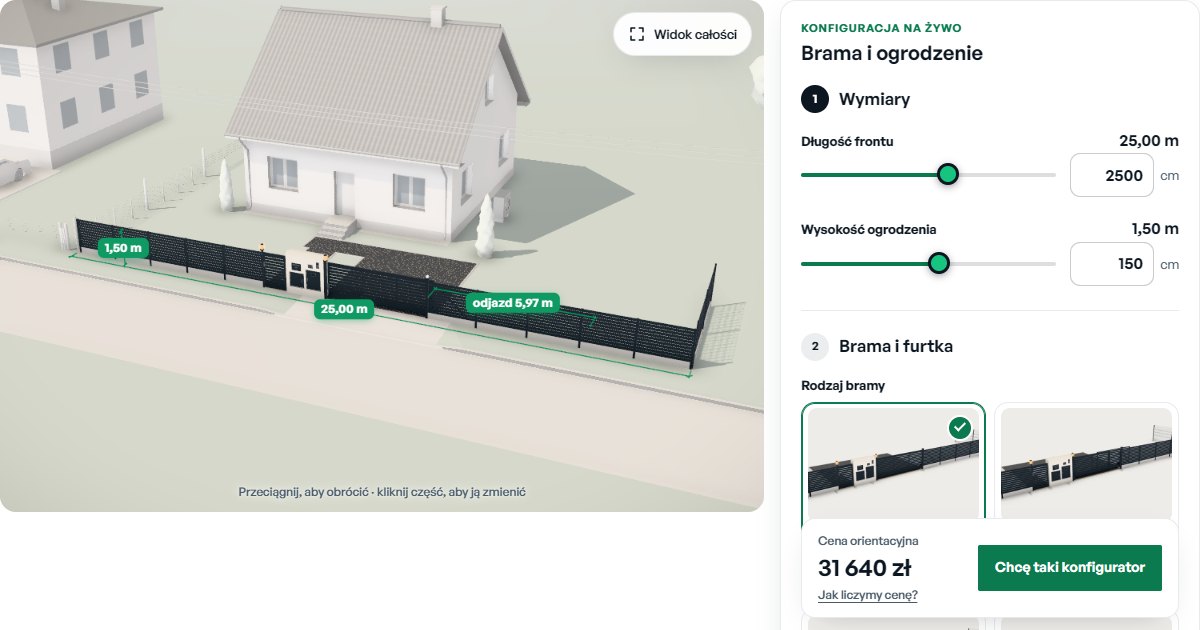
Click to launch the configurator right here in the article. Prefer full screen?
Open the 3D gate and fence configurator in the showroom →
6 mistakes in online fence quoting
- A single rate per running meter. The gate, pedestrian gate and automation are more than half of the price and do not depend on length.
- No run-back rule. The customer picks a sliding gate on a narrow plot, and the problem surfaces during installation.
- Surcharges taken from the price list. Dropping a pedestrian gate or utility pillar does not subtract its full price, because a panel takes its place.
- Pattern calculated only for the panels. A gate and pedestrian gate in a more expensive pattern cost more, yet there is often one gate price list for all patterns.
- A configurator that says “no”. Instead of blocking a choice, it is better to suggest the smallest change and explain why it was made.
- Price without a bill of materials. If the quote does not break down the panels and posts, someone still has to do it manually before production.
Frequently Asked Questions
Can a fence be quoted online without a site survey?
An estimated price, yes. All you need is the frontage length, entrance position, height, gate and pedestrian gate type, pattern and base. From this the configurator calculates the panels, posts, gate and extras accurately enough for the customer to decide. The site survey remains to confirm dimensions and ground conditions before production.
How much space does a sliding gate need?
A cantilever gate has a leaf longer than the clear entrance width, because its rear section counterbalances the gate on the roller carriages. In our demo the leaf is 1.43 times the gate width and the run-back has a 25 cm margin, so a 4 m gate needs 5.97 m of free fence to the side. A telescopic gate needs approx. 0.85 of the width plus 25 cm, i.e. 3.65 m for a 4 m gate.
What does the configurator do when the gate does not fit?
It looks for the smallest change: it switches the run-back direction, moves the pedestrian gate and utility pillar to the other side of the gate, narrows the pedestrian gate or the gate, or suggests a telescopic or double swing gate. It describes each change to the customer in a short message, so they know why the configuration looks different from what they chose.
Can a fence configurator use our price list?
Yes. Prices in the demo are samples. In an implementation the configurator calculates from the company’s price list: rates per m² of infill, per meter of base and installation, prices of gates, pedestrian gates and automation, broken down by pattern and color. The price list can later be changed in the admin panel without a developer.
Does a fence require a building notification?
According to the regulations adopted in the demo (legal status as of 24.10.2026), a fence up to 2.2 m high requires neither a building permit nor a building notification. A separate matter is a driveway from a public road, which requires the road authority’s consent. Before building, it is worth checking the local zoning plan.
Next step
If you manufacture or install fences and gates, and quoting every inquiry takes a phone call, a site survey and Excel, send us your price list and two or three typical offers. We will tell you which rules can be built into a configurator, what the bill of materials for production would look like and how much work the first version takes. Working examples, including the 3D gate and fence configurator, 3D carport configurator and 3D louvered pergola configurator, can be found in JSON Crew showroom.
Get in touch or see what a configurator implementation looks like, from the first conversation to a working MVP.
Read also
- From customer dimensions to CNC-ready panels: panel cutting in a wardrobe configurator
- Matrix price list vs formula: how to price a roller blind, insect screen or venetian blind in a configurator
- How much does a configurator cost? Realistic price ranges and what influences the price
- ROI from the configurator: how to realistically calculate the return on investment
- Quotation Chaos in a Manufacturing Company: 7 Signs and How to Spot It