Too Long; Didn't Read · 30 SECONDS
- Product Configurator is an interactive tool in which the customer independently selects variants, options and accessories, and then sees the price, specification and visualization of his order in real time.
- 61% B2B buyers prefers to buy without a salesperson (Gartner Sales Survey 2025), the configurator is no longer an advantage, it is a standard.
- Five types: parametric (PLN 5-15 thousand), logsc-based (PLN 60-150 thousand), visual 3D (PLN 90-200 thousand), e-commerce with a shopping cart (PLN 70-180 thousand), enterprise Configure, Price, Quote (PLN 80-400 thousand setup + subscription per user).
- The configurator makes senseIf a product has 10 or more variants, an average order value of 15,000+ PLN, 10 or more orders per month, and 3 or more active salespeople, you’ll see a return on investment in the first year if you meet 4 out of 5 of these criteria. If you meet 2 out of 5 or fewer, improve the fundamentals of your sales processs first.
Product Configurator This is an interactive online tool where customers can select product variants, options, and accessories on their own, and view the price, specifications, and a preview of their configured order in real time, ready to be sent as an inquiry or added to the shopping cart for purchase.
A product configurator is a tool that allows your customers to build their own offers, select options, view real-time pricing, and submit a quote ready for ordering. Instead of waiting two days for a quote from a sales representative, customers receive it in three minutes. In this article: a complete definition, five types of configurators, who benefits from them, how implementation works, and how much it costs.
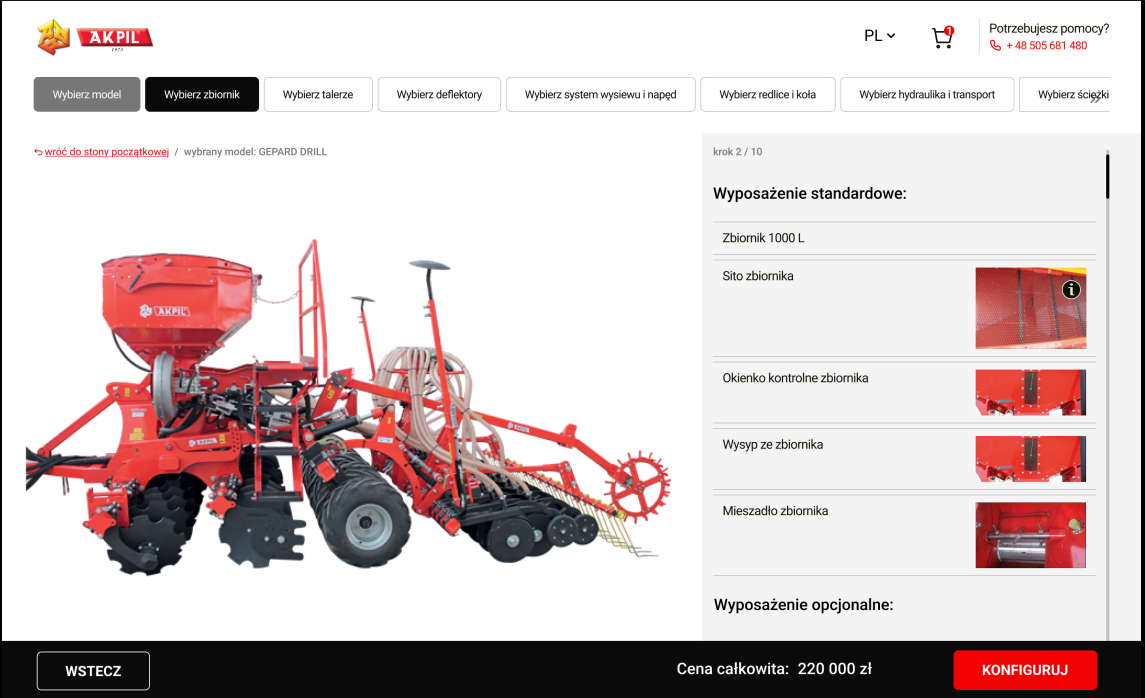
If you’ve ever tried to buy a customizable product online—such as custom-made furniture, an agricultural machine with optional features, or a laptop with custom specifications—and you’ve seen a “Configure” button that walked you through selecting options and displayed a real-time price, you’ve just used a product configurator.
On the one hand, it’s conveNont for the buyer. For the selling company, it’s a tool that shortens the time from inquiry to quote from days to minutes, eliminates errors in quotes, allows the customer to make a purchase decision without calling a salesperson, and relieves the sales team of repetitive work.
According to Gartner Sales Survey 2025, 61% B2B buyers prefer to go through the purchasing processs without contact with a salesperson. As a result, today, in 2026, a product configurator is no longer a competitive advantage, it is a standard, the lack of which costs you.
A configurator isn't a feature. It's a way to get a customer to buy before they call the competition.
|
You already know you need a configurator? Schedule a consultation, and we'll let you know which price range you'll fall into and how long it will yese. |
Schedule a call |
Product configurator definition: what is a product configurator
Check if the configurator makes sense on your end
Survey 15 questions (3 min). After filling it out, we'll both know if there's anything to talk about.
Fill out the checklist →Product configurator an interactive tool that allows the customer to independently select product variants, options, and accessories, and then see the price, specifications, and visualization in real time configured order.
At its simplest, it’s a form with dropdown menus where changing an option immediately updates the price. In its more advanced form, however, it is an interactive 3D visualization of the product that changes based on the user’s selections, plus business logsc (exclusion rules, dependencies, discounts, promotions), plus integration with Customer Relationship Management, ERP, and a PDF quote generator.
Configurator is not:
- PDF catalogThe catalog displays all products, while the configurator guides you through the selection processs and calculates the price for a specific configuration
- Price calculator, the calculator performs the calculation but does not display the result, does not enforce the relationship, and does not generate a quote
- Inquiry formThe form collects data, and the configurator builds the product
- E-commerce with a shopping cartE-commerce sells ready-made products, while a product configurator customizes products for customers
- Configure-Price-QuoteConfigure, Price, Quote is primarily a tool for sales representatives during the quoting phase. A configurator is a tool for customers to use before contacting a sales representative. The two can work together.
What types of product configurators are there?
The term “configurator” encompasses five different categories of tools. The difference between them is like the difference between a Fiat 126p and a Tesla—they’re all cars, but we’re talking about different classes of vehicles.
TYPE 1 · BASIC
Parametric Configurator
Dropdown list with variants (color, size, material), price field. Customer selects, price updates. Good for simple products: t-shirts, mugs, catalog furniture. Implementation: 1-2 weeks. Cost: 5,000-15,00PLN 0.
TYPE 2 · B2B INDUSTRIAL
Logic-based configurator with rules
Dozens of parameters with exclusion rules and dependencies. Example: an agricultural machinery configurator for selecting rollers, widths, and hydraulic options, where each option has restrictions (“the tire roller requires a transport drawbar”). The customer cannot configure something that cannot be manufactured. Implementation: 8–12 weeks. Cost: PLN 60,000–150,000.
TYPE 3 · 3D VISUAL
3D configurator in the browser
Product shown in 3D, customer rotates it with their finger, changes upholstery color, sees the effect immediately. Technology: Three.js in the browser, without downloading the app. Kitchens, designer furniture, luxury goods. Implementation: 12-16 weeks. Cost: 90,000-200,00PLN 0.
TYP 4 · E-COMMERCE + CART
Configurator with instant purchase
Configurator integrated with the shopping cart: customers configure products, add them to the cart, and pay. You sell configurable products to B2C or B2B SMB customers without needing to speak to a sales representative. Implementation: 10–14 weeks. Cost: PLN 70,000–180,000.
TYP 5 - ENTERPRISE Configure, Price, Quote
Configure-Price-Quote for Large Organizations
Configurator + Customer Relationship Management + quote generator + dealer portal in one. For enterprises with 50+ salespeople. Thisols like EpicorConfigure, Price, Quote, TaCTOn, Configure One. Ready SaaS, per-user subscription. Implementation: 2-4 months. Cost: 80,000-400,00PLN 0 setup + $75-200/user/month. Detailed comparison here.
How the configurator works: four layers
In practice, every configurator, regardless of type, operates on four logscal layers. When you look at a quote from a software development company, each of these layers costs money, and each one can go wrong.
Layer 1: Product Model
Product data, variants, options, base prices, dependencies. The source of truth is usually an ERP or PIM (Product Information Management) system. Without good data, the configurator displays nonsense. This is Problem number one with implementation, the rules exist in the trader's mind, not in the system.
Layer 2: Rules Engine
Business logsc: what is mutually exclusive, what requires an additional component, how a discount for Customer X is calculated for orders over Amount Y. In simple configurators, this involves a few conditions in JavaScript; in advanced ones, it requires a dedicated engine capable of handling hundreds of rules and thousands of combinations.
Layer 3: User Interface
What the client sees and clicks. Here are the biggest UX decisions: how many steps, whether to use a progress bar, when to show the price, and how to visualize unavailable options. EDISONDA writes directly: Designing a B2B configurator is about designing decisions, not pretty forms.
Layer 4: Integrations
Customer Relationship Management (save lead), ERP (current price list and stock levels), PDF generator (company-branded quote), eemail/SMS (notifications), marketing carmation (retargeting customers who abandoned configuration).
When is it worth implementing a product configurator?
First and foremost, a product configurator is not a one-size-fits-all solution. For some compaNos, it’s a key investment that pays for itself in six months. For others, it’s an expensive gimmick. These five criteria will help you assess it.
| Criterion | The configurator makes sense | The configurator doesn't make sense |
| Number of product variants | Over 10 combinations | 1-5 variations |
| Average offer value | Above 15,00PLN 0 | Below 5,00PLN 0 |
| Monthly offer | Above 10 | Below 5 |
| Number of traders | 3+ active sellers | Lack of a salesperson or a „temporary” team” |
| Sales processs | Client is asking about options/pricing before purchase. | 90% of repeatable sales without setup |
As a result, if you meet four out of five of the positive criteria, the configurator will almost certainly pay for itself in the first year. However, if you meet two or fewer, improve the fundamentals of your sales processs before investing. The configurator won’t make up for a lack of salespeople or a lack of active sales efforts.
Benefits: based on actual figures
What's more, these are not hypothetical promises. Below is data from real-world implementations (ours + published case studies from Polish compaNos).
61%
B2B buyers prefer to buy without a salesperson (Gartner Sales Survey 2025)
+198%
Increased conversion for Pneumat after implementing the configurator (Delante case study)
30 minutesuteses
instead of 2 days for valuation (typical result of manufacturing compaNos after implementation)
+10-20 pp
win-rate growth after Configure, Price, Quote implementation (Gartner, Nucleus Research)
In addition, there are additional effects that are not immediately visible in the spreadsheet:
- Error reduction in valuations...the salesperson won't make a misyese with the calculator, because the system enforces the rules
- Shorter sales cycle...the customer comes to the meeting with a ready-made configuration; they don't start by asking, "How much does it cost?"
- Better data for analytics, you know what configurations customers are trying to build, what's not available, and where they get stuck
- Self-service for small orders, the salesperson handles only large deals; smaller ones are self-service
- Retargeting effectA customer who configured a product but left without making a purchase is a hot lead for marketing campaigns
Configurator vs. other sales tools
In turn, a common objection is: "we already have a Customer Relationship Management / offerer / calculator, why do we need a configurator?" Answer: These are different tools for different stages of the sales processs. Namely: the configurator does not replace Customer Relationship Management, it works with it.
| Tool | Funnel stage | Who uses | What does it give |
| PDF Catalog | Interest | Client | It shows an offer, no interaction |
| Pricing calculator | Evaluation | Client | It counts the price, it doesn't show the product |
| Configurator | Evaluation + Decision | Client | Build + price + inquiry |
| Customer Relationship Management | Lead Management | Salesperson | Lead tracking, follow-up, history |
| Configure, Price, Quote | Bidding | Salesperson | Generating a quote after speaking with a client |
| E-commerce | Purchase | Client | Cart + payment |
In practice, in a well-organized processs, these tools work together. The client configures the product (configurator) → leads go to Customer Relationship Management → the salesperson uses Configure, Price, Quote for the formal offer → the client pays in e-commerce. For medium-sized compaNos, we can combine four of these layers into one tool – JSON Hub, our platform that replaces a separate configurator + Customer Relationship Management + quote generator + dealer portal.
Implementation: what the processs looks like
To sum up: implementing the configurator is not like "buying a product off the shelf". This is a project that requires the involvement of your team, especially salespeople and designers who know the rules of sales. Below is a typical run.
Week 0-1
IntroduCTOry interview
A software development company meets with your salespeople to extract pricing rules. Business document, 15-40 pages.
WEEK 1-6
Build
Two-week sprints. After each one, a working piece for testing. Your salesperson comments on the prototype.
WEEKS 6-10
Implementation + testing
Configurator on the website, testing with salespeople on real configurations. Fixes, training.
Purchase Order Launch
Maintenance
~20% value of the project annually. New variants, price list updates, integrations.
We have detailed 5 most common implementation problems, a must-read before signing any contract with a software development company.
How much does the configurator cost?
In short, as of April 2026:
- Simple configurator (Parametric, one product line): 35,000-60,00PLN 0 implementation, 6-12,00PLN 0/year maintenance
- Advanced configurator (several lines, rules, integrations): 87,000-150,00PLN 0 implementation, ~PLN 18,000/year
- Advanced Configurator (hundreds of variants, 3D, ERP, multi-tenant): 175,000–300,00PLN 0 implementation, 18,000+ PLN/year
Full pricing matrix, three ROI models, and a response to the question „when is it not worth it?” in a separate article about configurator prices.
Configurator in Poland: our case studies
In turn, theory is one thing and real implementation is another. Below are examples from our portfolio.
Akpil: agricultural machinery
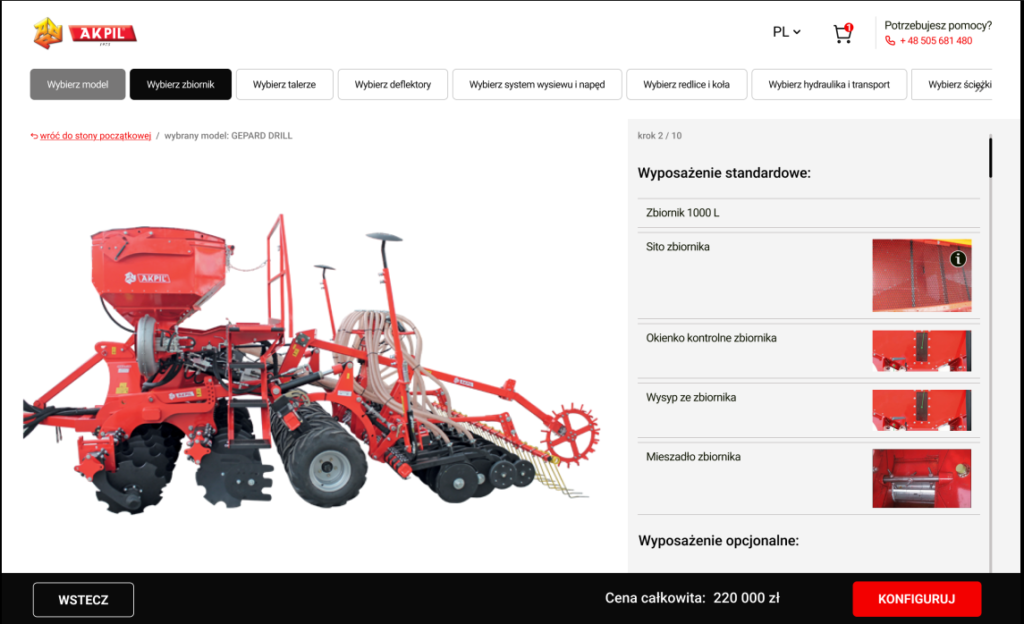
57 machine types, 136-page price list, hundreds of parameters per model, exclusions between options („tire roller requires a transport drawbar”). Before the configurator: the client opened a PDF, calculated in Excel, called the salesperson, and waited two days for a quote. Now: they configure online, see the price, and send a request ready for order. Details in the case study.
Forest: hunting weapon
Model configuration + stocks + wood + caliber + magazine + sights + accessories. Hundreds of combinations, each with a different price, weight, and licensing requirements. The customer configures it themselves, seeing the total in real-time. Online store + distribution through a network of branches. Case study here.
Construction company: project under NDA
500 product variants, 10 salespeople. Before: the quote took 2 days. After: 30 minutesuteses. Three out of ten inquiries were previously lost because the offer was too slow. After implementation, deals are closed faster, before the customer checks the competition.
Frequently Asked Questions
Does the configurator replace the salesperson?
NO. It relieves him of repetitive work (counting variants, generating offers) so that he can start talking to a customer who is ready to buy. The salesperson continues to negotiate terms, builds a relationship and closes the deal, he simply enters the conversation at a better stage.
How long does implementation yese?
From 1-2 weeks (simple parametric) to 16 weeks (advanced 3D with integrations). MVP of an extended configurator – 8-12 weeks.
Does the configurator only work for physical products?
No. It works equally well for services with variants (architectural design, insurance policy, recruitment package), configurable software (licenses, modules), and subscriptions (plans with add-ons).
Can I build a configurator myself?
For a simple parametric product configurator, yes, a WordPress or low-code plugin will solve most cases. For advanced with rules, integrations and 3D, no. This requires a development team with specialization in rules engine, UX and integrations.
How to choose a software development company for implementation?
Five checkpoints: real IoT/configurator in the portfolio, in-house development team (not a „network of partners”), showcasing code and architecture of specific projects, Fixed Price for MVP, maintenance plan in the main agreement. We broke this down separately.
Frequently Asked Questions: frequently asked questions
What is a product configurator?
A product configurator is an interactive online tool that allows customers to select product variants, options, and accessories on their own, while viewing the price, specifications, and a preview of their configured order in real time. In its simplest form, it consists of a form with dropdown menus and a price field. In its advanced form, it features interactive 3D visualization combined with business logsc (exclusion rules, dependencies, discounts) and integrations with Customer Relationship Management, ERP, and a PDF quote generator. The configurator is not a PDF catalog, a price calculator, an inquiry form, or an e-commerce platform; it is a tool that guides the customer through the selection processs and builds a product tailored to a specific order.
How does a configurator differ from Configure, Price, Quote?
Configure-Price-Quote is a class of enterprise systems that covers product configuration, price calculation, and quote generation, typically in the form of a SaaS platform for sales representatives (Salesforce Configure, Price, Quote, TaCTOn, Configure One, EpicorConfigure, Price, Quote). A product configurator is a front-end tool for the end customer, available on the website before contacting a sales representative. Configure, Price, Quote is used by the sales representative during the quoting stage, while the configurator is used by the customer during the evaluation and decision-making stages. For medium-sized compaNos, one can work alongside the other or be combined into a single tool.
When is it a good idea to implement a configurator?
A configurator makes sense when at least 4 out of 5 criteria are met: the product has more than 10 variant combinations, the average quote value exceeds 15,00PLN 0, the company generates more than 10 quotes per month, has 3 or more active salespeople, and the customer asks about variants or pricing before making a purchase. If you meet 4 out of 5 criteria, the configurator will almost certainly pay for itself in the first year. If you meet 2 out of 5 or fewer, fix the fundamentals of your sales processs first—the configurator won’t make up for a lack of salespeople or a lack of active sales.
How much does a product configurator cost?
As of April 2026: A simple parametric configurator for a single product line costs PLN 35,000–60,000 to implement and PLN 6,000–12,000 per year to maintain. A robust configurator with rules and integrations: PLN 87,000–150,000 for implementation, approximately PLN 18,000 per year. An advanced configurator with hundreds of variants, 3D, and ERP: PLN 175,000–300,000 for implementation, PLN 18,000+ per year. EnterpriseConfigure, Price, Quote as a ready-to-use SaaS solution: PLN 80,000–400,000 for setup plus a subscription of $75–200 per user per month.
What are the different types of configurators?
Five types: 1) Parametric, with a drop-down list of variants and a price field, for simple products (5,000–15,00PLN 0, 1–2 weeks). 2) Logic-based with rules, dozens of parameters with exclusions and dependencies, for industrial B2B (PLN 60,000–150,000, 8–12 weeks). 3) Visual 3D in the browser. Three.js, the customer rotates the product and sees the effect in real time (PLN 90,000–200,000, 12–16 weeks). 4) E-commerce with a shopping cart, configure and buy immediately (PLN 70,000–180,000, 10–14 weeks). 5) EnterpriseConfigure, Price, Quote: configurator plus Customer Relationship Management plus quote generator plus dealer dashboard all in one, for 50+ sales reps (PLN 80,000–400,000 setup).
Does the configurator increase sales?
Yes. The configurator shortens the time from inquiry to offer from days to minutes (typical result for manufacturing compaNos: 30 minutesuteses instead of 2 days), eliminates errors in pricing, allows the customer to make a decision without calling a salesperson and lowers the threshold for entering the funnel. Pneumat recorded a +198% increase in conversion after implementing the configurator (Delante case), Gartner and Nucleus Research report a +10-20 pp increase in win-rate after implementing Configure, Price, Quote. Gartner Sales Survey 2025: 61% B2B buyers prefer to go through the purchasing processs without contact with a salesperson.
What's next: if you're considering implementing
|
Order a diagnostic call 30 minutesuteses, free. Come with three answers: 1. What product do you sell and how many variations does it have? 2. How many proposals do your salespeople make per month? 3. What is the average offer value? |
Fill out the form |
To put it simply: we’ll tell you whether a configurator makes sense for your business, which type you should choose (parametric, logsc-based, 3D, enterprise), what your price range will be, and whether you should start now or first get your sales processs in order.
P.S. The most common reaction after our diagnostic conversation: “I didn’t realize we had enough options to make it worthwhile.” The configurator isn’t for everyone, but when it’s a good fit, it pays for itself in 6–18 months, mainly through time savings for the sales rep and a higher win rate thanks to faster responses to customers. The rest (3D, visualization, retargeting) are just icing on the cake. First, the cake: the sales rep stops crunching numbers in Excel, and the customer gets a quote in minutes.
About the author
Jędrzej SiewierskiCEO and co-founder JSON CrewSince 2024, he has been building product configurators for B2B compaNos (manufacturers of agricultural machinery, hunting weapons, modular homes, and IoT electronics) as well as JSON Hub, his own SaaS platform that integrates Customer Relationship Management, carmated quoting, and project management. Co-author of a digital sales transformation methodology: shortening the path from interest to purchase through a configurator + carmated quoting + Customer Relationship Management. Stack Next.js, Three.js, Nest.js, React Native. Contact: contact@jsoncrew.com · LinkedIn.
See the configurators in action — 5 working demos
Instead of just reading about the configurators, click and try them out for yourself—no logsn or registration required. JSON Crew Showroom has 5 working demos designed for various industries:
- 3D Weapon Configurator — GLB model in the browser, accessories (red dot sight, magazines), body finish (Cerakote/carbon fiber/camouflage). A benchmark for firearms and accessories manufacturers.
- 3D Car Configurator — body paint, wheels, spoilers, and trim packages. The UX standard used by BMW, Audi, and Šcodea serves as a benchmark for carmotive dealers and manufacturers.
- Modular Home Configurator — building structure, transportation, systems, carmated PDF pricing. Mechanical engineering for B2C and B2B modular home manufacturers.
- Metal Garage Configurator — Step-by-step selection of design, size, and gate. Implementation yeses approximately 4 weeks. Demand for this product in the Polish market has increased by 160% year-over-year.
- Configurator cost estimator — Cost estimates in PLN for your business in 3 minutes. EASY/MID/HARD + 3-year TCO + ROI calculation.