 Jędrzej Siewierski
Author: Jędrzej Siewierski, CEO and co-founder of JSON Crew.
People type the phrase „tin garage configurator” into Google about 320 times a month. And that's just one phrase.
Someone is sitting on the couch with their phone and wants to build a garage on the plot. She hasn't called the salesperson yet. He wants to choose the size, color and gate himself, and then see the price.
If you produce garages, windows, doors, wardrobes or fences, this text is about your customers. Below are the numbers from Google, two of our implementations and four questions, after which you will assess for yourself whether the configurator for the manufacturer makes sense in your company.
In short:
- People type the word „configurator” together with the product name into Google: „cabinet configurator” 590 times a month, „window configurator” 480, „tin garage configurator” 320 (Google Ads, Poland, 12-month average, JSON Crew study of October 2026). In addition, the brand name with the word „configurator”, for example „wiked configurator” 590.
- Whoever types in the word „configurator” wants to assemble the product themselves and see the price before the interview. If they can't, they'll file it with the company that makes it possible.
- The configurator for the manufacturer works at two stages of sales: the customer counts alone (as in Akpil) or the salesperson counts together with the customer (as in Blachod). On top of that, the saved configurations show the season before the orders arrive.
What is a Product configurator?
The Product configurator is a program on the website in which the customer assembles the product himself. It selects the options step by step, the system keeps an eye on what fits, and immediately calculates the price. At the end, the customer sends a query in which the entire configuration is already present.
Without a configurator, a customer who wants to change the size, color or additions and see the price gets a „ask for a quote” form and a promise that someone will respond. I write more about the tool itself in guide to Product configurators.
How many people are looking for a window, wardrobe and garage configurator on Google?
We checked this in the Google Ads keyword planner. This tool shows how many times a month people type in a given phrase. Below the average from the last 12 months for Poland (study of October 24, 2026).
| A phrase typed in Google | Searches per month |
|---|---|
| custom cabinet configurator | 720 |
| wardrobe configurator | 590 |
| wikis configurator | 590 |
| Window configurator | 480 |
| custom furniture configurator | 390 |
| Metal Garage Configurator | 320 |
| furniture configurator | 320 |
| kitchen configurator | 260 |
| garage configurator | 210 |
| fence configurator | 170 |
| door configurator | 170 |
| steel hall configurator | 70 |
| shed configurator | 70 |
Source: Google Ads, Keyword Planner, search network, Poland, study JSON Crew from October 2026. Google rounds numbers and combines very similar phrases (for example, „window configurator” and „window configurator” have the same result).
From this table, it is worth remembering three things.
First, they're looking for your customers, not your business. These people want to buy a wardrobe, a window or a garage, not a configurator. They themselves enter in the search engine how they want to buy. There will be no better proof of demand from the manufacturer.
Secondly: they are looking for specific brands. People enter the phrase „wikéd configurator” 590 times a month. Wikęd manufactures exterior doors and windows. Customers add the word „configurator” to its name because they want to assemble the product with this manufacturer. By the windows, you can see similar phrases with the names of other brands, although less frequently typed. Whoever writes the brand name together with this word has almost decided who they will buy from.
Third: this is only a small part of the demand. On average, people enter the phrase „tin garage” 60,500 times a month (from 40,500 to 74,000, depending on the month). Few of them add the word „configurator”. They are the ones who know exactly what they want: first check the size and price, then pay.
If you do not have a configurator, the customer goes to who has
Many manufacturers say, „Our customers prefer to call. A bespoke product needs to be discussed.” Some customers actually prefer it. But 590 people a month who type „cabinet configurator” say something different: they want to try it themselves first.
The data shows one more thing. With most of these phrases, Google assesses advertising competition as high (with the „cabinet configurator” the rate is 100 out of 100). This means that other companies are already paying for these people to see their ad. Someone is fighting for your customers before they come to your site.
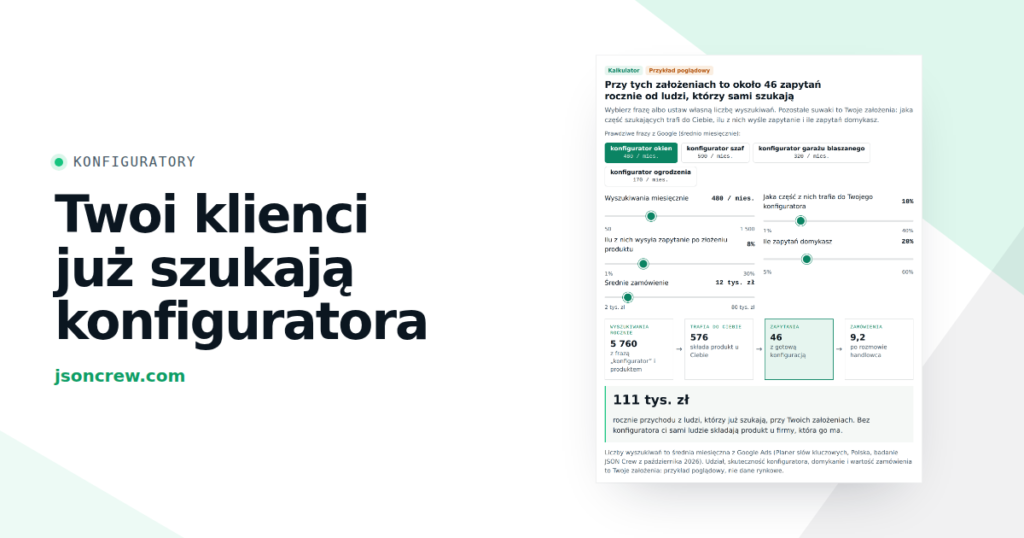
Count how much it means to you in the calculator below. The number of searches is true, you set the rest yourself.
0
Notice the third field in the calculator: „ready-configured” queries. This is different than „please give me a quote for the garage.” The salesperson does not have to ask about the dimensions, color and gate. He receives the complete set and can immediately talk about the date.
The manufacturer's configurator works at two sales stages
On ours sales map system the configurator appears twice. The first time the customer checks whether the product suits him and how much it costs. The second time is when the salesperson prepares an offer. Both stages show two of our implementations.
The customer counts himself: Akpil
Akpil produces agricultural machinery. In the past, preparing a quote took about 3 hours.
Today the customer enters configure.akpil.pl, selects one of 19 categories and one of over 70 models, and the system checks whether the machine fits his tractor and shows the price. Data from 6 months after launch, verified by the Akpil team: 78% customers configure the machine before contacting a salesperson, and the quote takes about 4 minutes.
We call this stage on the map qualification. The customer himself checks whether the product suits him and shows whether he is ready to talk.
The salesman counts together with the customer: Blachodach
Blachodach makes roofs, facades and fences. We have built a tool for the selection and valuation of roofs, facades and fences, with a gallery of completed projects that the salesperson shows to the customer.
This is not a public configurator on the website, but a tool for the salesperson who prepares the offer. The customer won't search for it on Google.
It shows the second stage of the map, offering. In both companies, the basis is the same: written rules, what goes with what and how much it costs. The only difference is who clicks. It's often easier to start with a tool for a salesperson, because that's where the problem is most severe: offers counted in a spreadsheet, calls to the construction department, waiting. Once the rules are in place, the on-site customer configurator is the next step, not a project from scratch.
If you want to compare ready-made tools with the configurator built for your catalog, please visit comparisons: custom-made configurator, ready-made quotation program (CPQ) or template.
Why is the manufacturer's configurator also a demand sensor?
In the Tuned Company approach, each process is a loop: goal, measurement, decision, action and measurement again. The weakest link in this loop is usually measurement, which is how you even know what's going on. In many manufacturing companies, orders are the only way to determine demand. And the order arrives late, often several weeks after the customer has started choosing.
The configurator gives a signal earlier. Every configuration leaves a trace: someone put together a 3 by 5 meter garage in graphite. When such configurations suddenly increase, you know about the season before the orders arrive. How many weeks in advance depends on the product. This needs to be measured on your own data.
This is important because increasing production also takes time: people, material, second shift. Anyone who learns about the increase from orders and then waits for people and material is twice late. The queue grows, so you increase production more than necessary. Then the season passes and you have to cut back. This phenomenon is called the bullwhip effect: a small change for the customer grows in each subsequent link in the supply chain (described by Lee, Padmanabhan and Whang in MIT Sloan Management Review in 1997). I write more in article about process management in the company.
Check in the simulation what changes when you plan production based on configuration rather than orders.
One warning. The number of configurations changes from week to week by itself: nice weather, long weekend, someone posted a link on the forum. One strong week is a fluke, not a season. Therefore, in the simulation, the manufacturer looks at the 4-week average, not the last week. How to react strongly to the signal that comes before the result, I write in article about sales forecasting.
This signal only works when configurations are saved instead of getting lost in the mailbox. Therefore, it is worth connecting the configurator with CRM from the beginning, i.e. the system in which you save customers and inquiries. More in article about integrating the configurator with CRM.
What to do on Monday: four questions before you decide
- How many people search for your product with the word „configurator”? Enter in Google keyword planner the name of your product and your brand with this word. The tool is free. Look at the 12-month average because many made-to-measure products are sold seasonally. If there are several hundred searches per month, you have proof of demand. If almost zero, a configurator may still make sense, but then start with a merchant tool.
- What questions do customers most often ask salespeople? Write down ten. The configurator should respond to each of them, otherwise the customer will call anyway.
- Are the valuation rules written down or does only one person know them? If only one constructor can prepare a quote, the entire sale is waiting for him. And sometimes he takes a vacation.
- Who will respond to the inquiry from the configurator and how quickly? The study described in Harvard Business Review in 2011 showed that companies that responded to a website inquiry within an hour had a significantly greater chance of talking to a decision-maker than those that responded later. A ready-made configuration that no one responded to for three days is a wasted query.
If you want to calculate whether it will pay off, read on separate text about return from the configurator.
When it doesn't work
- The product has three variants and one price. All you need is a clear price list on the website. A configurator makes sense when there are many variants and the price depends on the customer's choices.
- Prices and rules are not written down. The configurator will then show the wrong price faster than the merchant. First the order in the rules, then the tool.
- No one handles queries. The configurator gives you more ready-made queries. If the offers department is already struggling to keep up today, look for the problem there first.
- The data from the configurator does not go anywhere. Without recording your configuration in CRM, you lose half the benefit: an early signal of demand.
Frequently Asked Questions
Does the manufacturer's configurator make sense if I sell through dealers or assemblers?
Yes, but then it is important to whom the inquiry is sent. The configurator can immediately forward them to a partner from the customer's region. The customer assembles the product on the manufacturer's website and ends the conversation with the closest partner.
Is it better to start with a configurator on the website or with a tool for traders?
It depends on where it hurts the most today. If customers bombard salespeople with the same questions, start with the configurator on the website (Dear Akpil). If it takes the longest to prepare an offer, start with the sales tool (Bladach route). The principles of selection and valuation are the same in both cases.
How much does the configurator cost?
It depends on the number of variants, rules and connections to other systems. We broke it down in text about how much the configurator costs.
Will the end customer really assemble the window or wardrobe themselves?
Some customers do, some will still call. 590 monthly searches for „wardrobe configurator” show that many want to at least start on their own. In Akpil, with agricultural machinery, 78% customers configure the machine before contacting a salesperson.
What about the data from the configurator?
This is the most underrated part. Each configuration tells what people choose, in what dimensions and colors, and when such choices increase. Saved in CRM, they become an early signal of demand for production and purchasing.
Find out where your sales are getting stuck
The configurator solves one problem at one sales stage. „Where is your company stuck?” Test will show whether this is the stage for you.
Where is your company blocking out?
Eight sentences about how your company responds to results. Next to each of them, indicate how often you do this. At the end, you will see what kind of regulator your company is today, what it lacks and where to start.
None of the eight sentences fit your business. This is a good sign: your decision loop is calm. Check it quarterly, because rocking usually begins when the company is growing or the market is changing.
I will send you 10 questions to list one process, with hints for your result
Sent
CEO of Ideo Solutions AS
Working examples
Click on the working configurator
Before you decide, check what it looks like in practice. On website with our working configurators you assemble the product yourself, change the options and see how the price changes. Offer details: configurators and online presentation and digital quoting and calculations.
How to Cite This Article: Jędrzej Siewierski, „Your customers are already looking for a configurator. The question is whether they will find yours”, JSON Crew, jsoncrew.com, 2026. Search data: Google Ads, Keyword Planner, Poland, JSON Crew survey from October 2026 (including „tin garage configurator”: about 320 searches per month).