Akpil. 8 salespeople. 150 enquiries a week. 60% are the same questions.
Akpil. 8 salespeople. 150 enquiries a week. 60% are the same questions.
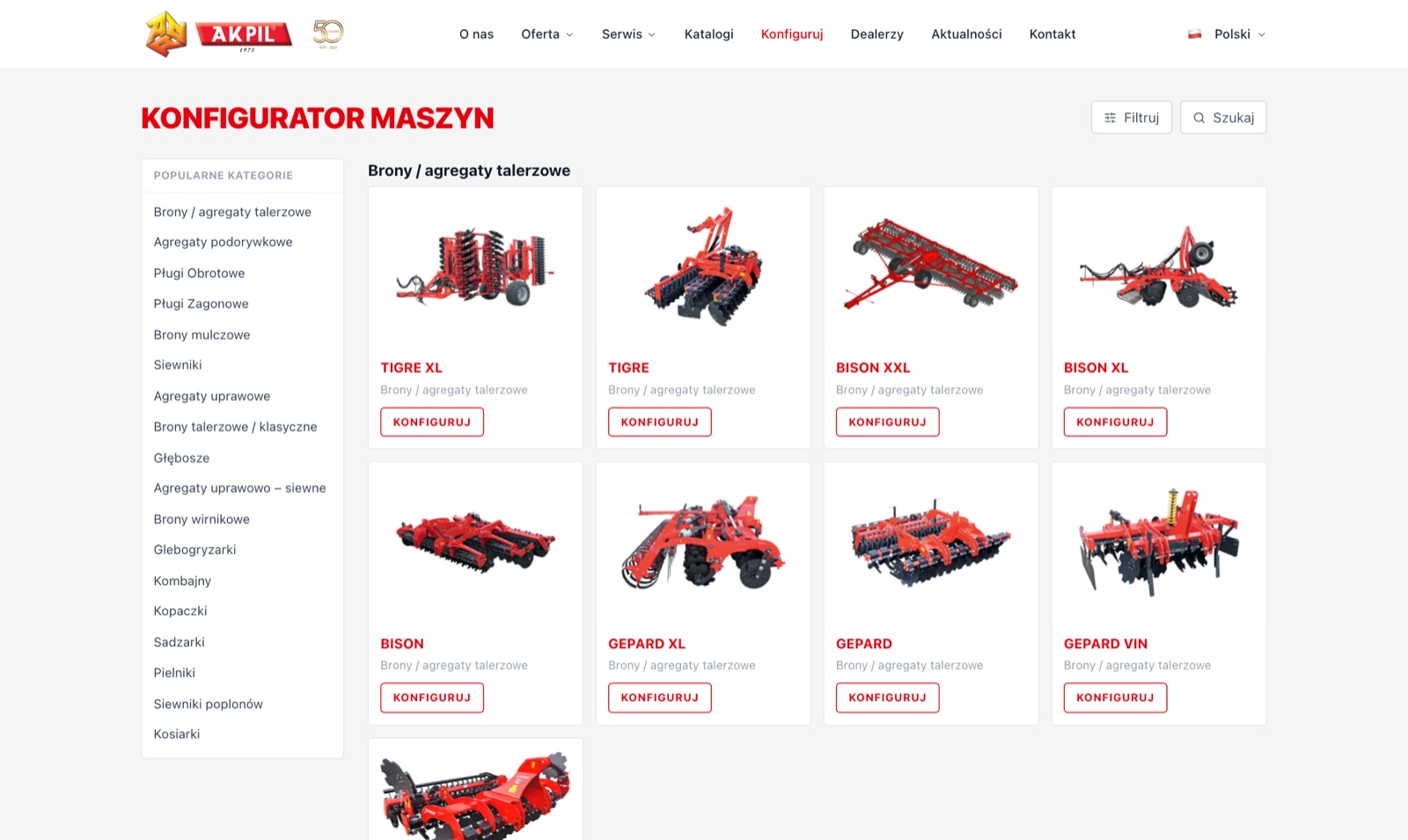
What we did in 8 weeks and what it looks like live. Configurator: configure.akpil.pl
 Open the configurator
View the machine in 3D
Grab and rotate — a 3D visualization of the product, just like in the Akpil configurator.
The customer calls. He asks about size, parameters, compatibility with the tractor, price, availability. The salesman translates. Next client - same questions. Yes, dozens of times a week.
How it works with Akpil
The customer goes to configure.akpil.pl, selects a category (harrows, cultivators, plows, seeders, subsoilers—19 categories) and a model (TIGRE, BISON, SCORPIO, MAXIMUS—over 70 models). Configures the variant. The system checks compatibility with the tractor and displays specifications, price, and availability. The customer downloads a PDF quote.
When he finally calls, he gets straight to the point: “I’ve configured the SCORPIO H—it fits my tractor. When can I pick it up?” The sales representative discusses the schedule and delivery, not the specifications.
Before and after implementation at Akpil
Before
- Over 150 inquiries per week for 8 sales representatives
- 60% of the questions are the same (specifications, compatibility, price, availability)
- Estimated time: 3 hours (Excel + phone call to the warehouse)
- Salespeople spend 40% of their time answering repetitive questions
After implementation
- 70% fewer inquiries about basic questions
- Estimation time: 4 minutes (the customer does it themselves; the sales representative receives a ready-made configuration)
- Trader's time for basic questions: 40% → 10%
- 78% of customers configure their orders before contacting a sales representative
- The salesperson discusses financing, the deadline, and delivery. They do not explain the specifications.
Data from the 6 months following go-live, verified by the Akpil team.
Behind the scenes: what does “Akpil configurator” actually mean?
The configurator is not a database-driven interface—it is an engine for rules, integrations, and quoting. Off-the-shelf SaaS tools cannot handle this level of complexity (dozens of variants × technical parameters × tractor compatibility).
- Compatibility Rules Engine (IF/THEN logic). Example: “IF tractor power < 60 HP AND working width > 3 m THEN warning.” The rules are edited by the Akpil team without contacting the developer.
- Dealer network: The lead is automatically routed to the distributor in the customer's region.
- Discount system: codes by dealer and by campaign.
- PDF Quote Generator: document number, expiration date, specifications, price, sales representative.
- Multilingualism: ready for export.
Implementation: 8 weeks, fixed price.
Thursday, 2:00 p.m. Agricultural fair.
Akpil, the salesman, is at his booth. The phone rings every four minutes: a generator, a plow, a harrow—same specs, same compatibility. Business cards to call back, a laptop with tabs open.
After implementation: same trade show, same salesperson, but the phone rings less often, and every call is business-related. “I’ve configured the BISON XL—it’s in stock. When can I pick it up?” The rest of the customers configure their units themselves at the booth, using a tablet.
Agricultural machinery configurator: how to design it to take the load off sales reps
This guide is for agricultural machinery manufacturers and distributors considering a configurator on their website. It answers where to start the project, which elements determine whether the tool will actually reduce the number of phone calls, and how to measure the impact after launch.
An agricultural machinery configurator isn't a prettier version of the catalog. A catalog is for browsing; a configurator is for making a decision: the customer should be able to check on their own whether the machine fits their tractor, what its specs are, how much it costs, and when it will be available. If the tool doesn't answer these questions, the sales rep's phone will ring anyway.
Start with a list of questions customers ask
The best input isn’t the catalog but the sales reps’ notes. In the Akpil implementation described above, 60% of inquiries were the same questions, repeated by customers dozens of times a week:
- What machine size is right for my field and crop?
- Does the machine fit my tractor, considering power and the hitch system?
- What are the technical specifications: depth, working width, number of sections?
- How much does it cost?
- When is it available?
Each of these questions should be answered in the configurator. It's a simple test of project scope: if any of them is left unanswered, that's exactly the one that will generate phone calls after launch.
A compatibility rules engine instead of knowledge in a sales rep's head
With agricultural machinery, compatibility is the hardest part. The same harrow may fit one tractor and be too heavy for another. That’s why the heart of the configurator is an if-then rules engine, for example: if the tractor’s power is below 60 HP and the working width exceeds 3 m, show a warning.
The key is who maintains these rules. At Akpil, the manufacturer's team edits them in the panel on its own, without involving a developer. With a catalog spanning 19 categories and more than 70 models, that's a prerequisite for keeping the configurator from going stale after the first change to the product range.
3D machinery configurator: where visualization helps and where a photo is enough
3D visualization grabs attention, but it doesn't have to cover the entire catalog. At Akpil, 3D visualization was prepared for selected models, not for all of the more than 70. This approach lets you start with the models where customers compare variants most often and expand the library gradually.
A 3D machinery configurator also works well beyond the website. At agricultural trade shows, customers can configure a machine on a tablet at the booth, while the sales rep focuses on conversations with customers who have already chosen a variant. So when designing the interface, it’s worth accounting for a large touchscreen from the start, not just desktop and mobile.
Product configurator for a machinery manufacturer: product range, dealers, and ERP
The configurator ends with a quote, not just a summary of the selected options. In the implementation described, the generator creates a PDF document with a number, validity date, specifications, price, and the sales rep's details. The customer downloads it immediately, and the sales rep receives a ready configuration.
A manufacturer selling through a dealer network needs a few additional elements:
- automatic routing of the lead to the distributor in the customer’s region,
- a discount system with codes assigned to a dealer or campaign,
- ERP integration, so that price and availability come from a single source,
- multiple languages, if exports are planned.
Without ERP integration, the configurator quickly starts showing outdated stock levels and prices, and then customers call again to confirm them.
Off-the-shelf SaaS tool or a configurator built around your catalog
There are good SaaS configurators on the market, such as Tacton, ThreeKit, or Configure One. They work best for catalogs with standardized logic, where a product is described by a few dimensions, a color, and a material. A solution built for a specific catalog is usually chosen when:
- the rules require industry-specific compatibility logic, such as matching a machine to a tractor,
- ownership of code and data matters more than a per-user subscription,
- ERP integration requires a custom data flow.
Akpil met all three conditions. With a dealer network, paying a subscription for each partner would have been more expensive in the long run than a custom solution. On the other hand, if the catalog is small and pricing is simple, a spreadsheet may be perfectly sufficient.
How to measure whether the configurator works
It’s worth defining metrics before launch so you have a baseline. At Akpil, data from six months after launch, verified by the client’s team, looked like this:
| Metric | Before | After implementation |
|---|---|---|
| Quote preparation time | 3 hours | 4 minutes |
| Sales rep time spent on repetitive questions | 40% | 10% |
| Inquiries about basic questions | 150+ per week across 8 sales reps, 60% repetitive | 70% fewer |
| Customers configuring before contacting sales | no configurator | 78% |
The last metric is the most telling. When most customers arrive with a finished configuration, the conversation with the sales rep is about financing, timing, and delivery, not whether the machine is a fit. A configurator doesn't replace the salesperson; it qualifies the customer before they reach them.
The most common mistakes when designing an agricultural machinery configurator
Most problems with configurators don't stem from technology, but from assumptions made at the start. A few of them come up especially often:
- Designing from the catalog side instead of from the customer’s questions. The result is a nice-looking presentation that doesn’t say whether the machine fits the tractor.
- Compatibility rules hard-coded. Every change to the product range then requires a developer, and the configurator quickly stops reflecting reality.
- No price or availability. The customer finishes the configuration and still has to call to find out the two most important pieces of information.
- Leaving out dealers. If a lead isn't automatically routed to the regional partner, some inquiries get lost between headquarters and the sales network.
A well-designed agricultural machinery configurator reverses the order: first answers to customer questions and rules, then the look.
How long implementation takes and what it depends on
At Akpil, the project took 8 weeks: audit and workshop, data model with catalog and rules, interface with 3D visualization, rules engine with admin panel, quoting with ERP integration, and finally launch and dealer training. The timeline depends mainly on the quality of product data and the number of compatibility rules, so it's worth spending the first week organizing the catalog and customer questions.
We describe the scope of such projects on the page online configurators and presentations, and you’ll find working examples in the JSON Crew showroom, and we write about generating quotes from the configurator in digital quoting and calculations.
The three objections we hear most often
“We already have a catalog. Customers can view the products.”
The catalog is for browsing. The configurator is for making decisions. Question: Can customers check for themselves whether a product fits, how much it costs, and when it’s available—without having to call? Akpil added the configurator alongside the catalog, not in place of it.
“It won’t work for us; the products are too complicated.”
That's what Akpil thought at first. The key: the IF/THEN rule engine handles the logic instead of the salesperson. Your team edits the rules without having to contact a developer.
"Customers prefer to talk to a salesperson."
Customers want to discuss pricing, financing, and delivery dates—not whether the machine is the right fit. The website can answer those questions. The configurator doesn’t replace a sales representative—it qualifies the customer before the sales representative gets involved.
Do these problems sound familiar?
Please check the boxes that apply to your business. Everything is anonymous; we won't share this information with anyone.
0 out of 5Your scenario: how much money are you letting slip through your fingers?
Akpil saves approximately 150,000 PLN per year in sales staff time. Check your scenario.
You're losing 211,200 PLN annually on recurring questions.
The configurator (49,000–89,000 PLN) pays for itself in 5 months.
8 weeks, to be exact
- Week 1. Audit + workshop. Mapping of the Akpil catalog (19 categories, 70+ models). Identification of 60% of the queries and their grouping. Decision: which rules engine to use, and how to integrate it with the ERP.
- Weeks 2–3. Data model: product catalog, configuration options, compatibility rules, dealer network, discount system.
- Weeks 4–5. Configurator interface with 3D visualization for select models. Tractor compatibility logic.
- Week 6. The IF/THEN rule engine and rule management panel for the Akpil team.
- Week 7. PDF quote generator, quote system with automatic numbering, integration with the Akpil ERP system.
- Week 8 Go-live + dealer training. Onboarding the first distributors to the configurator. Conversion tracking + feedback loop.
Week 1: They smile right away
The first week is an audit: mapping your catalog, questions, and process. If, by the end of the week, we see that the configurator won’t help of all peopleLet’s be honest. We’re putting the project on hold. No penalties, no blackmail, no “let’s at least finish the MVP.” Your time is worth more than our invoices for an unused implementation.
This has happened before with companies that had too small a product catalog or too simple a pricing process. A configurator is a tool that offers flexibility. If Excel is sufficient, Excel is the best choice.
Your next step
Three paths, each different. Choose according to your level of discernment.
Frequently Asked Questions About Implementation at Akpil
How much does a configurator cost for a company similar to Akpil?
Configurator with a rules engine and ERP integration (like Akpil’s): starting at 89,000 PLN (one-time fee). For smaller catalogs without ERP integration: starting at 49,000 PLN. Check it out estimator for your script.
How long does the implementation take?
At Akpil: 8 weeks from kickoff to go-live. Standard timeline: Week 1 – audit; Weeks 2–3 – data model; Weeks 4–5 – interface + 3D visualization; Week 6 – rules engine; Week 7 – quoting + ERP integration; Week 8 – production deployment + training.
Does the configurator replace the salesperson?
No. Configurator qualifies the customer before the sales representative. At Akpil, 78% of customers configure their product options before the first contact; the sales representative discusses financing, timing, and delivery instead of explaining the product specifications. The time the sales representative spends on basic questions has dropped from 40% to 10%.
Why not a SaaS-based configurator (Tacton, ThreeKit, Configure One)?
Tacton, ThreeKit, and Configure One are good tools for catalogs with standardized logic (e.g., furniture with 5 dimensions, color, and material). Custom (as with Akpil) is chosen when: the rules engine requires industry-specific compatibility logic, ownership of the code and data is a priority over per-user subscriptions, and ERP integration requires a non-standard workflow. Akpil needed agricultural logic and a dashboard where the team could edit the rules themselves. Cheaper in the long term than a per-dealer subscription.
What are the most common questions from Akpil customers?
Five common questions: 1) What size is right for my field/crop? 2) Is the machine compatible with my tractor (horsepower, mounting system)? 3) What are the technical specifications (depth, working width, number of sections)? 4) How much does it cost? 5) When is it available? The configurator answers all 5 questions without needing to contact a sales representative.
Are my products too complicated?
That’s what Akpil thought. The key is the IF/THEN rule engine, which handles the logic instead of the salesperson. The rules are edited by the team, without needing to contact a developer. If your catalog has 30+ variants and compatibility logic, a configurator is possible.
Implementation guide — what to do if you have a similar problem
Akpil is no exception—it is a typical manufacturer with a customizable catalog. If you recognize your team in this description (salespeople spending their days crunching numbers, customers asking about the same specs for weeks on end), here’s the way forward:
- Product configurators — details on the scope, phases, and pricing (49,000–89,000 PLN) for the MVP
- 3D Weapon Configurator Demo — an analogue of a technical product with many variants
- 3D car configurator demo - UX pattern for products with 5+ configuration areas
- Cost Estimator — PLN range for your company in 3 minutes (EASY/MID/HARD)
- Ranking of 27 configuration tools 2026 - custom vs SaaS vs template comparison
- How much does the 2026 configurator cost — full cost breakdown + ROI calc
- Integration of the configurator with the CRM — how to turn leads into closed offers
- Schedule a 30-minute meeting — free discovery, no obligations
Check before we talk
Services associated with this deployment. Take a look at the offer, see how we approach similar problems in other customers.
View Case Studies
Three implementations from our portfolio. Specific numbers, processes rebuilt at real customers.


Did you like this article?
If after reading this you feel your company also has processes worth rebuilding, book a free call. Together we will check where sales are really leaking and what makes sense to implement first.
Schedule a call