 Jędrzej Siewierski
Author: Jędrzej Siewierski, CEO and co-founder of JSON Crew.
The excavator is being returned from a month-long rental. The customer says that it was operated „normally, for eight hours a day.” You look at the worn-out bucket teeth and have a different opinion, but you have no way to prove it.
Most conversations about monitoring construction machinery end with the question „where is my machine?”. It's a good question, but it brings in the least amount of money. This article is about what else machine data reveals and who benefits from it.
In short:
- Monitoring construction and agricultural machinery is more than just an anti-theft GPS tracker. The most money is in engine hours (i.e., the machine's mileage), fault codes, and operating methods.
- Based on this data, the rental company settles the rental based on the meter reading instead of „on trust,” the dealer schedules maintenance based on engine hours instead of the calendar, and the manufacturer considers the warranty based on facts.
- A ready-made tracker is a good, quick start, especially with a fleet that includes machines from several brands. A manufacturer's own application makes sense when the data from the machines is intended to support service, parts, warranty and subsequent sales under your brand.
The odometer that your machines don't show
Think of a car. It has an odometer, so you know when to get it serviced: every 15,000 kilometers, not „sometime in May.” The warranty states „5 years or x number of miles,” and no one argues because the mileage is visible on the odometer. After you return the car, the car rental company simply looks at the odometer and adds any miles over the limit.
Now imagine that only the driver can see the odometer. You, who sold, service or rent out the car, find out everything over the phone. Or not at all. This is how many companies in the machinery industry operate today: the machine has an hour meter and electronics that know about faults, but this data stays in the cab.
What is construction machinery monitoring, and how does it differ from a GPS tracker?
Machine monitoring (definition). Machine monitoring involves the remote collection of data from an operating machine: its location, operating hours (engine hours), operating conditions (load, idle time, fuel consumption), and any issues it may be experiencing (fault codes, temperatures, pressures). The data is sent to a panel that is visible to the owner, rental company, service center or manufacturer.
Anyone who types „GPS tracking for construction machinery” into a search engine usually has theft in mind. And rightly so, because a GPS tracker answers one question: where is the machine located? This is useful when an excavator is left overnight on an unguarded construction site. But the location of the vehicle alone won't tell you when to have it serviced. For this, you need a counter.
Full monitoring of construction machinery now includes a counter and information about faults. Location protects assets. You make money on engine hours and fault codes.
One word worth knowing: engine hour (abbreviated as mth). This refers to an hour of the machine's engine operation. In an excavator, loader or tractor, it serves the same purpose as mileage in a car: it is used to calculate inspections, wear and tear, and often the warranty.
Monitoring of construction machinery in a rental company: billing based on meter readings, not on verbal agreements
At a car rental, no one asks after you return the car: „Approximately how far did you drive?” They look at the odometer.
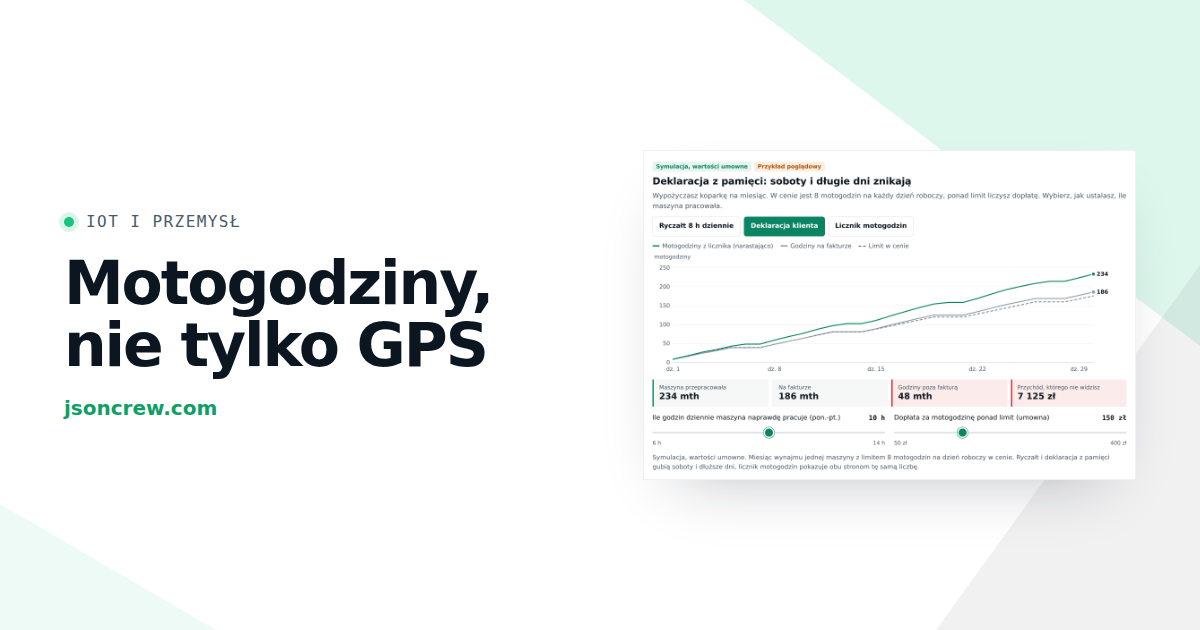
In machinery rental companies, it is often the other way around (illustrative example). The contract states that eight engine hours per working day are included in the price, and the settlement is based on a flat rate or on what the customer remembers. Nobody is cheating anybody. People simply remember round numbers. The Saturday when the excavator „only finished the excavation” slips from memory. The day when it worked for eleven hours is remembered as eight.
The simulation above shows what this does to the invoice. With a flat rate and a declaration, some of the working hours are not included on the invoice. With the meter, the invoice shows what the machine actually worked. And when it's within the limit, the customer can see that they're not paying for anything beyond the contract.
The second benefit: the meter puts an end to disputes. The customer and the rental company see the same number during the rental period, and not just when the vehicle is returned. And an argument at the time of return is often the last conversation with that customer.
Service based on engine hours, not on the calendar
An inspection every six months sounds reasonable. The only thing is that the excavator spends more time idle in winter, and in summer it operates on two shifts. The tractor has spring, harvest and long months of inactivity.
No one services a car „in May and November,” regardless of its mileage. An inspection is carried out after a certain number of kilometers. Machine manufacturers also usually specify inspection intervals in engine hours. The calendar is only an approximation for when you can't see the odometer.
In the simulation, the excavator goes for its scheduled inspection too late, because in the summer it accumulates operating hours faster than half a year passes. The tractor has its first inspection too early, even before the harvest. After the harvest, i.e., after the hardest work of the year, it operates for several weeks past the scheduled date.
For the dealer, it also involves workforce planning. When you see in the dashboard that thirty machines in the region are approaching their service date, you schedule appointments and order filters in advance. When you don't see this, you find out from phone calls, all at once, at the peak of the season.
How much does machine downtime cost on a construction site?
There is no single number. A day of downtime costs a company that pays its crew for waiting differently than it costs a farmer whose combine harvester has broken down during harvest. That's why, in the simulation below, you enter how much a day costs you.
What is more important is what downtime consists of. Usually, it's not the repair that takes the longest, but the waiting: until someone notices and calls, until the service technician arrives and checks what happened, until the part that was only ordered on-site arrives.
Monitoring removes the first two sections. The fault code is on the panel before anyone has a chance to call, so the part travels with the service technician. It's like a warning light on a car's dashboard: it comes on before the car breaks down on the side of the road. And if the data indicates a problem in advance (temperature rises, pressure drops, warnings increase), you replace the part during a scheduled stop, not in the middle of operations. I describe how to predict breakdowns based on data in text on predictive maintenance.
One caveat: the part still has to arrive. Monitoring won't shorten the journey from the warehouse, but it will shorten everything that happens before the order is placed. However, it will show you what breaks down most often, so you'll know which parts to keep in stock.
Warranty based on facts, parts on time
A warranty dispute without data is just one person's word against another's. The customer says that the machine was operating under light load. The service center sees signs of overloading. Neither party has any evidence.
A car warranty doesn't stir up such emotions because the mileage is visible on the odometer. In the case of machines, this role is fulfilled by monitoring data. The manufacturer can see how many operating hours the machine has worked, at what temperatures, for how long it has been under full load, and whether anyone has ignored the warnings. The warranty decision is then based on facts, not trust. And it works both ways: often, it is the data that protects the customer.
Based on the same data, parts sales are increasing (illustrative example). A dealer who sees the machine hours in their region knows whose bucket teeth, filters or blades will wear out in a month. He can call first before the customer orders from elsewhere. It ceases to be a place you call when there's a breakdown. It becomes a partner that calls before a breakdown occurs.
Monitoring agricultural machinery: the season doesn't wait
The monitoring of agricultural machinery differs from that of construction machinery in terms of the schedule. On a construction site, downtime means a contractual penalty. On a farm, downtime during harvest means grain that won't wait.
You can even see this in the search engine. In our study of Google Ads keywords (Poland, October 2025 – September 2026), searches for agricultural machinery monitoring have been increasing since February, peaking in March. Queries about construction machinery monitoring are most common from February to May. They have been declining significantly since June. People search before the season, when they are still planning.
For agricultural machinery manufacturers and dealers, the conclusion is practical. Plan pre-season inspections based on the previous year's engine hours, not the calendar. Keep a list of machines in the dashboard that will exceed the recommended operating hours during the harvest. It is worth having this conversation with the customer in March, not in July.
The manufacturer's own app or a ready-made tracker?
Ready-made trackers and monitoring platforms are a good, quick start. From day one, you can see where the machines are and how much they are working. For a fleet with machines from several brands, the ISO 15143-3 standard (also known as AEMP 2.0) is helpful. It describes a common format for basic data, such as location, operating hours and fuel consumption, so that a single system can read machines from different manufacturers. If your main goals are to protect your equipment and track operating hours, this is often sufficient.
A manufacturer's own app makes sense in a different situation. You are a manufacturer or a large dealer and you want machine data to feed into your service department, parts warehouse, warranty and sales. You want the customer to see your brand on their phone, not someone else's. Or your machine has its own controller (its built-in computer that knows the operating hours and faults), and its data needs to be translated into understandable messages.
| Situation | Ready-made tracker or platform | Manufacturer's own application |
|---|---|---|
| Main purpose | location, equipment protection, engine hours | service, parts, warranty, resale |
| Fleet | machines from many brands | Your machines, your controllers |
| Who is looking at the panel? | fleet owner, rental company | manufacturer, dealer, service provider, and end customer |
| Brand on the customer's phone | platform provider's brand | Your |
| Integrations with Other Systems | what the platform offers | Your Orders, Inventory, Service, CRM |
I discuss how to choose a contractor for such a system in A Guide to Choosing a Company for an IoT Dashboard. If you're tracking machine productivity at the plant rather than in the field, check out text about OEE.
Machine monitoring is the „Growth” phase”
In our sales process map, machine monitoring is the final stage, Growth: service, parts, and follow-up sales to customers who have already made a purchase. I explain why data from the machine is a better indicator than a phone call from a customer in article about process management in the company.
Where to Start on Monday
Before you buy anything, ask yourself these four questions:
- What basis do you use today to calculate rent and the security deposit? If you're working „on a per-job basis” or „on a flat-rate basis,” check the simulation above to see how many hours might not be included on your invoices.
- How does the service center know that the machine needs maintenance? From the calendar, the customer's phone, or the meter?
- How many days did the last outage last, and what caused it? Break it down into the service request, diagnosis, waiting for a part, and the repair. The repair is usually the shortest part of the process.
- Who should be able to view the data: just you, or also the dealer, the service center, and the customer? This question usually determines whether to choose a ready-made locator or to develop your own app.
When it doesn't work
- When an alert goes off over every little thing. After a week, people stop paying attention to it. Set the alert thresholds so that an alert means „do something,” not „something’s happening.”.
- When the data is there, but no one has changed the way they work, a dashboard without someone who checks the list of machines every morning before the inspection is just another tab in the browser.
- When the lease agreement doesn't mention the meter. The provision regarding billing based on operating hours must be included in the agreement, and the dashboard must be shown to the customer from day one—not just when a dispute arises.
- When you want to do everything at once. Start with the one thing that hurts the most: rental settlements, inspections, or downtime.
Frequently Asked Questions
How does construction equipment tracking differ from regular GPS?
GPS shows where the machine is located. Construction equipment monitoring tracks operating hours, operating conditions (load, idle time, fuel consumption), and fault codes. Location tracking protects the equipment from theft, and the other data enables rental billing, service planning, and warranty claims processing.
What are engine-hours?
A motor-hour is one hour of engine operation. In construction and agricultural machinery, it serves the same purpose as mileage in a car: it is used to determine maintenance schedules, parts wear, and often the warranty period.
Is it possible to monitor machines from different manufacturers in a single system?
That's often the case. The ISO 15143-3 standard (also known as AEMP 2.0) defines a common format for basic data such as location, operating hours, and fuel consumption. However, the scope of the data depends on the machine's make and model.
When is it more cost-effective for a machine manufacturer to develop its own app rather than use a ready-made tracking app?
When machine data is used to support service, the parts warehouse, warranty, and sales; when the customer is supposed to see the manufacturer’s brand; and when the machine controller requires its own operation. For a simple goal (the location and operating hours of machines from different brands), a ready-made solution is usually sufficient.
Find out where your business is stuck
Machine monitoring is just one source of data. Before you decide what to measure, determine at which stage of the sales process your company loses the most: during inquiries, during quotes, or after the sale.
Are you thinking about an application for your device or your own panel for a website? Application cost estimator in a few minutes it will show you how much it actually costs and how long it takes before you talk to anyone.
Where is your company blocking out?
Eight sentences about how your company responds to results. Next to each of them, indicate how often you do this. At the end, you will see what kind of regulator your company is today, what it lacks and where to start.
None of the eight sentences fit your business. This is a good sign: your decision loop is calm. Check it quarterly, because rocking usually begins when the company is growing or the market is changing.
I will send you 10 questions to list one process, with hints for your result
Sent
CEO of Ideo Solutions AS
Next article in the series
What happens next when the machine reports a malfunction on its own?
I'll explain how service and the warranty work in that situation in the next article in this series. If you'd rather ask about your machines right away, please email contact@jsoncrew.com. Details: IoT applications for manufacturers.
How to Cite This Article: Jędrzej Siewierski, „Monitoring Construction and Agricultural Machinery: What It Offers Manufacturers, Dealers, and Rental Companies (Beyond GPS),” JSON Crew, jsoncrew.com, 2026.