// section
Why the estimator starts at PLN 35,000, not “from 10k”
Short answer: because an app that costs 10,000 doesn’t exist—at least not one that would actually work for a real client. You can write the code—but no one will maintain it, no one will take responsibility for bugs, and no one will integrate the CRM with the invoicing system. That’s not an app; it’s a student project with an invoice.
Our most affordable service is system integration (middleware)—35,000 PLN. We connect two existing systems, map the data, and handle retries in case of a system crash. Below that is the „one developer, in the evenings, after hours” category—it might be cheaper, but you’ll end up coming back to us after six months asking us to save the project.
Web apps starting at 55,000 PLN. Mobile apps starting at 75,000 PLN. Multi-tenant SaaS starting at 150,000 PLN. These are the actual minimum thresholds at which we can take responsibility for production operations—including testing, deployment, documentation, and handover of the code.
How much does a mobile app cost, and what goes into that price
This guide is for companies that want to commission a mobile app for their customers, service teams, or sales reps and are asking how much a mobile app costs before they talk to a vendor. We break the price down into its components, show when a web app is enough, and suggest what to ask when comparing quotes.
A mobile app is usually three products, not one
Your customer sees an icon on their phone, but two more layers are working behind it. The first is the backend: the server, database, user authentication, notifications, and the API the app relies on. The second is the admin panel, where your team manages content, users, or orders.
A good example is APP Smart Control, built for KG Elektronik, a manufacturer of boiler controllers. The project included an app on Google Play, a web dashboard for facility managers, and an IoT backend for real-time telemetry. It took 3 months from brief to release on a fixed-price basis, and today the system handles 12,000 connected boilers. A quote that leaves out the backend or the dashboard is simply incomplete.
So when comparing quotes, check whether each vendor has priced all three layers. A low price for “the app” often covers only the phone interface, with the backend and admin panel to be ordered separately after the contract is signed.
Minimum thresholds for different project types
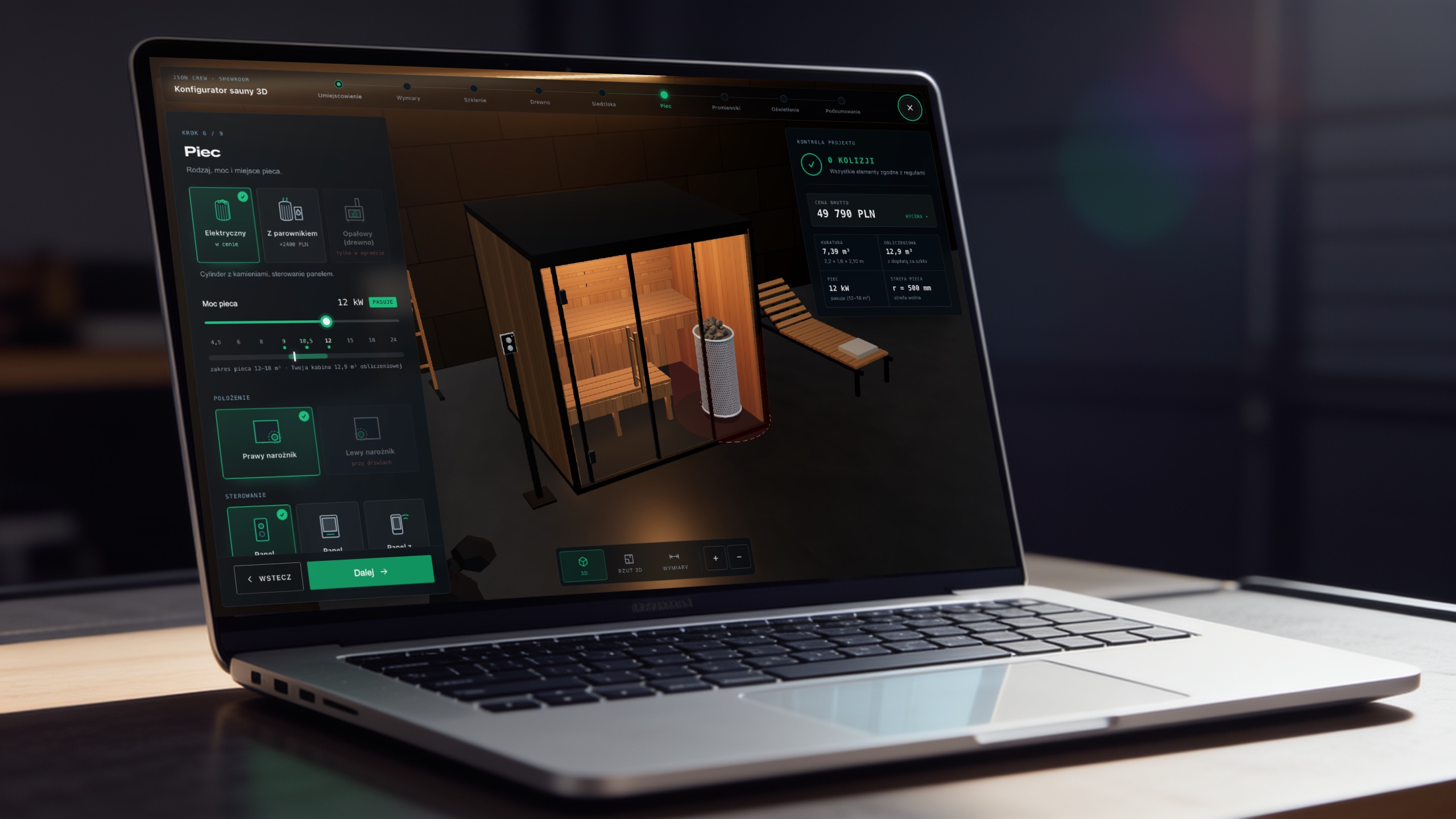
The estimator in the demo above distinguishes between several project types, because each has a different starting point. The amounts below are realistic minimums at which we take responsibility for production operation, including testing, deployment, documentation, and handover-ready code.
| Project type | From | When it's chosen |
|---|
| System integration (middleware) | 35,000 PLN | Two systems are already running; they need to be connected and the data flow monitored |
| Web app | PLN 55,000 | The tool is used mainly on a computer, in a browser |
| Mobile app | PLN 75,000 | The user needs a phone: notifications, field work, device control |
| Multi-tenant SaaS | 150,000 PLN | One system sold to many companies, each with its own data and accounts |
From these thresholds, the price grows with the number of screens, user roles, integrations, and offline requirements. The estimator shows a breakdown by component, so you can see which element drives the total up the most.
When a web app is enough instead of a mobile app
Not every “app” idea needs to end up in an app store. If users work at a desk, log in a few times a week, and don't need notifications, a web app opened in the browser will do the same job for less. You skip app store publishing, Apple and Google review, and separate update releases.
A mobile app has the edge when being on the customer's phone matters. That's the case for device control, failure alerts, field service technicians, or a loyalty program. For KG Elektronik, the point was exactly that: customers shouldn't have to go down to the boiler room, and they should learn about a problem on their phone before the house gets cold.
Combining both is often a good compromise. The mobile app serves end customers, while the web app serves your internal team or partners. Both use the same backend, so you don't pay twice for logic and data.
How much does a mobile app cost: what drives the price up the most
Two apps with a similar number of screens can be priced very differently. The difference usually comes from a few areas:
- Platforms. Android and iOS at the same time means more testing, two publishing processes, and two sets of app store guidelines.
- Integrations. Every connection to a CRM, ERP, payment system, or SMS gateway is a separate piece of work, and its timeline depends on the quality of the API on the other side.
- Devices and IoT. Communicating with a controller, sensor, or machine requires a protocol, handling of dropped connections, and testing on real hardware.
- Offline mode. Syncing data once the connection is back and resolving conflicts is one of the more labor-intensive features.
- Roles and permissions. The customer, service technician, administrator, and sales partner each see different data, and every role means separate flows to design and test.
Post-launch costs you need to plan for
A mobile app doesn’t end on launch day. Apple and Google release new OS versions every year and change their store requirements, so the app needs periodic updates even if you aren’t adding new features. On top of that come paid developer accounts in the stores, backend hosting, and error monitoring.
When comparing quotes, ask what happens after launch: who responds to outages, how updates are billed, and whether the code goes into your account. In our projects, the repository is handed over to the client, and the price includes technical documentation and a 2-week bug warranty after deployment. That is a benchmark worth applying to every quote, including those from competitors.
How to prepare for the call so the estimate is accurate
The estimator result is a preliminary quote. To turn it into a concrete proposal, prepare a few things:
- a description of the two or three most important scenarios, e.g. “a customer reports a fault and gets a service appointment,”
- a list of the systems the app needs to exchange data with, including whether they have an API,
- who the users will be and how many you expect at launch,
- a budget decision: your own funds, financing confirmed in writing, or financing still being planned.
The last point affects not the price but the start date. If the budget is confirmed, we move straight from discovery to the MVP scope and timeline. If not, it’s better to pick the conversation back up once the decision is made than to design an app that sits waiting for funding.
So the answer to how much a mobile app costs for your company depends on the MVP scope, not just the number of screens. It's better to start with a narrow version that solves one specific problem and expand it based on real usage data.
The scope of our projects is described on the pages mobile apps and IoT solutions, and the full project story for KG Elektronik is in APP Smart Control case study.
The amount was high. Is it possible to divide the project into phases?
Yes. We divide most projects into phases. Phase 1 is the MVP—basic functionality, a single platform, and limited integrations. The rest comes later, once the app is generating revenue and you know what’s actually needed. During the meeting, we'll show you exactly what we can remove from your setup without any cost to your business.
Why are you asking about a “confirmed budget”? Isn't it enough that I'm interested?
Because we talk to dozens of people every month who are „waiting for a grant” or „have been in talks with an investor for half a year.” It usually takes 9–18 months to reach an actual decision—if one is reached at all. We prefer to be upfront: come back with a written decision, and then we’ll get started. Your time is just as valuable as ours.
What exactly happens after sending a contact?
If you select „own funds” or “confirmed financing,” we'll redirect you to the calendar, where you can choose a time for a 30-minute call. Your information from the estimator is already loaded, so you don't have to repeat anything. If you're still waiting for a decision, you'll receive an email asking you to check back, plus two reminders each quarter. No pushy phone calls.
How do you differ from other software houses?
Three things: (1) we reject clients who do not have a budget - instead of bothering them with proposals and working „on credit”. (2) We provide the code and documentation - we do not bind you to a maintenance contract with us forever. (3) We show working productions - in the showroom you have 7 tools that we implement to real customers, clickable, without logging in. Most software houses show slides, we show the code in the browser.
How long does it take to implement an MVP?
Web app starting at 55k: typically 6–10 weeks from contract signing. Mobile app starting at 75k: 10–14 weeks (publication on the App Store / Google Play adds 2–4 weeks). Multi-tenant SaaS starting at 150k: 16–24 weeks. We set a specific schedule with milestones after the Discovery phase (a 5–10-day workshop)—without this, any promise of a deadline is just guesswork.
Can I see your working product before making a decision?
Yes—in the /showroom/ section, you’ll find 7 tools you can use without logging in: a 3D weapon configurator (WebGL), a 3D car configurator, a modular home configurator, a metal garage configurator, a gazebo configurator, the configurator’s cost estimator, and the app’s cost estimator itself. These are the same code templates that are in use with our clients—not demos, but production versions.