 Jędrzej Siewierski
By Jędrzej Siewierski, CEO and co-founder of JSON Crew.
Saturday, 7:15 a.m. A bakery owner calls your dealer: the unit you make stopped overnight, and the morning batch is ruined. The dealer’s technician drives an hour and a half, opens the panel, reads a code off the display and says the words everyone in service hates: “I need to order the part. I’ll be back Tuesday.”
Three weeks later a warranty claim lands on your desk. Under “description of fault” it says: stopped working.
(Illustrative example. The bakery and the timeline are made up.)
Nobody did a bad job. The technician came quickly and the part was in stock. But everyone learned about the fault in the worst possible order: the customer first, the technician second, you last. This article covers what field service management software does well, what it can’t see, and how data from your own equipment turns service and warranty from reacting into planning.
In short:
- Field service management software is good at scheduling, dispatching and work orders. But it usually starts when the customer calls, with the customer’s description as its first input.
- A manufacturer can do something a service contractor can’t: let the equipment report its own fault, with an error code and recent readings, before anyone picks up the phone. That’s remote diagnostics.
- Device data gives you three things: more jobs fixed on the first visit, warranty claims decided on evidence instead of guesswork, and a parts quote ready the moment the fault is known.
Why does the second trip happen?
In service, the share of jobs closed on the first visit is called the first-time fix rate. That one number hides three costs: technician hours spent driving back, parts shipped twice, and a customer who waited longer than necessary. A manufacturer that sells through dealers pays a fourth: the customer doesn’t remember which dealer came out twice. They remember the brand on the unit.
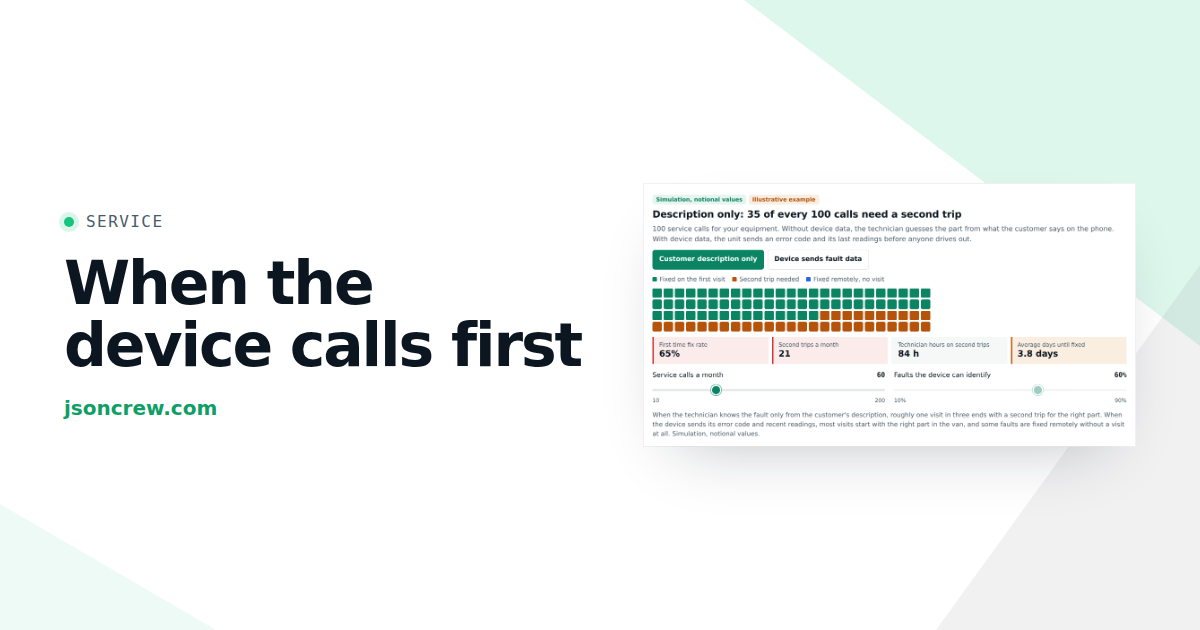
It usually isn’t the technician’s fault. Which part to bring is decided on the phone, from what the customer says: “It’s making a noise.” “The display shows something.” “It just stopped.” It’s like asking a mechanic to fix your car from your description of the noise, without plugging into the car’s computer. The technician packs parts for the most likely cause, and often enough it’s the wrong one.
Now change one thing. Before anyone drives out, the unit itself sends its error code and its last few hours of readings. Try it below.
The numbers are notional; the mechanism isn't. The more faults the device can identify, the fewer second trips you pay for, and some problems (a wrong setting, a stuck mode) get solved without a truck roll.
What does field service management software do well, and where does it start?
Field service management software (FSM) runs your service operation. It takes in the job, schedules it, assigns a technician, sends the work order to a phone app, tracks parts and closes the job with a report and an invoice. Established platforms such as Salesforce Field Service, Microsoft Dynamics 365 Field Service and IFS are very good at exactly that.
Notice where the process starts, though. A service job usually begins when someone calls or fills in a form, and everything the FSM tool does afterward (technician, route, time slot) is built on that first input. If it says “it just stopped,” the system schedules the visit perfectly, with the wrong part.
A service contractor who fixes every brand only knows what the customer tells them. You make the equipment. You can decide what it knows about itself and who it tells.
Remote diagnostics: a check engine light for your equipment
Back to the car. Since 1996, every new gasoline car sold in the United States has had a standard self-diagnosis system called OBD-II (the EU followed for gasoline cars in 2001). When the check engine light comes on, the mechanic plugs in a reader and sees a code that points to the cause. No guessing from your description of the noise.
Remote diagnostics is the same check engine light, except it shows up on your screen and nobody plugs anything in. When something goes wrong, the connected device sends what it knows to your dashboard: the error code, run hours, the temperatures, pressures or cycles before the fault, and its software version. A service call can then look like this:
- The unit raises an alert. The customer gets a notification on their phone, and your service team sees the same alert in its dashboard.
- Someone checks the data remotely before anyone drives out. A real failure, a setting, a power cut, a clogged filter?
- If it can be fixed remotely, it is. A setting changed, a mode reset, or the customer told which button to press.
- If it needs a visit, the job goes into your field service management tool with the diagnosis attached, and the technician leaves with the part the code points to.
Device data doesn't compete with FSM software. It moves the start of the job from “the customer called” to “the device noticed” and gives the FSM tool a better first input. KG Elektronik, a Polish maker of gas boiler controllers, already works this way: in the dashboard we built for them, KG's team sees its whole fleet of connected controllers and can diagnose units remotely (case study).
Warranty management software works on evidence, not guesswork
Back to the stopped working claim. Someone at your company has to decide: is this a defect you pay for, an installation error the installer should cover, or a unit that was never faulty? With a claim form and maybe a photo, it's mostly a judgment call. Be generous and you pay for faults you didn't cause. Be strict and you reject real defects and lose a dealer's goodwill.
Warranty management software organizes this: it collects claims, routes approvals, tracks parts returns and recovers costs from suppliers. Good tools make the process fast and consistent. But like FSM software, they can only judge what they're given.
A connected unit adds to the claim what your car's fault memory stores for the mechanic: run hours, whether it ran outside the temperatures you specify, which error codes appeared and when, and whether it was set up correctly. The claim arrives with evidence attached. Switch it on below.
You win twice. First, you pay real defects in days instead of weeks, without an argument, because the data shows the unit failed under normal use. That keeps dealers loyal. Second, every claim with a known cause tells your engineers something. When the same component keeps failing, you see it in a weekly report, not in next year's warranty cost review.
Who finds out first, and how late?
I look at companies as feedback loops, an approach I call The Tuned Company. One idea from that article matters here: dead time, the delay between something happening and someone being able to act on it.
In service and warranty, two things count: how you hear about a problem (today, a customer's call, a dealer's message, a claim form) and how long that news takes to reach someone who can decide. Through the dealer, a fault can take weeks to reach you and months to show up as a pattern. By then you have shipped more units with the same weak component.
A car without a check engine light doesn't break down less often. The driver just finds out on the side of the road. Companies work the same way: with a long delay, even good people make jumpy decisions because they react to old news. What helps is earlier news, and a device that reports its own faults delivers it.
From the right part to the next quote
If the device reports its model, serial number, configuration and software version with the fault, you know exactly which part fits. Not “the pump for that range,” but the pump for this unit, built in that year, with that option.
From there it's a short step to a parts quote. The dealer or the customer gets a list: the part the code points to, the seal kit that goes with it, the labor and the price. Once the unit is a few years old, the same data shows when an upgrade or a replacement makes sense, so your next sales conversation starts with facts.
A parts configurator for installed equipment is a Product configurator that works after the sale. Its rules answer one question: does this part fit this unit? More on this in our article on quoting software for manufacturers and our guide to Product configurators. On our map of the B2B sales process, this is the Growth stage: service, parts and repeat orders.
When this isn't worth it yet
If you have fewer than about 200 units in the field (our rule of thumb), if your equipment has no connectivity at all, or if a decision at your company takes longer than three months, a connected platform is probably not the first step. A simple web dashboard, better fault codes on the display or a parts configurator for your dealers can deliver much of the benefit for less. If faults are rare and simple, a good FSM tool may be all you need.
Better field service management starts with four questions
You don't need a platform to begin. Most answers are already in your service records.
- Which three faults cause most of your second trips? Group your last 100 return visits by cause.
- Can your equipment tell those three faults apart today? If it shows the same code for a failed sensor and a failed pump, start there, connected or not.
- How many days pass between a fault and the moment someone at your company knows about it? Count from the warranty claims: date of failure against date received.
- What would your warranty team want to see on every claim? Run hours, operating temperatures, error history? That list is the spec for your device data.
Frequently Asked Questions
What is field service management?
Field service management is how a company organizes work at the customer's site: taking in requests, scheduling and dispatching technicians, managing work orders and parts, and closing jobs with a report and an invoice. Field service management software runs that process in one system.
What is remote diagnostics?
A device sends information about its own condition (error codes, operating data, software version) over the internet, so the manufacturer or service team can identify a fault without being on site. Some problems are then fixed remotely, and the rest get a visit with the right part.
How does device data help with warranty claims?
A connected unit shows how long it ran, under what conditions and which faults it recorded. You pay real defects quickly and settle installation or operating errors on evidence.
How many devices do you need before this makes sense?
There's no single threshold. Our rule of thumb: below about 200 units in the field, or with no connectivity yet, a simple web dashboard or a parts configurator is often the cheaper first step.
Where is your company getting stuck?
Eight statements about how your company reacts to its numbers. For each one, pick how often it happens to you. At the end you'll see what kind of controller your company is today, what it's missing and where to start.
None of the eight statements applies to your company. Good sign: your decision loop is calm. Check it once a quarter, because the wobble usually starts when you grow or the market shifts.
I'll send you 10 questions to map one process, with tips for your result
✓ Sent
CEO of Ideo Solutions AS
Read next: catching failures before they happen
A device that reports its own faults is the first step. The next is spotting a failure on its way, from trends in the same data, and booking service before the unit stops. That's the subject of our guide to predictive maintenance for equipment manufacturers.
More about how we build this: IoT applications and mobile apps.
How to cite this article: Jędrzej Siewierski, “Field Service Management for Equipment Manufacturers: When the Device Calls Before the Customer Does,” JSON Crew, jsoncrew.com, 2026.
CEO of Ideo Solutions AS