 Jędrzej Siewierski
By Jędrzej Siewierski, CEO and co-founder of JSON Crew.
At Akpil, an agricultural machinery manufacturer, used to take three hours to prepare a quote. Now it takes four minutes.
Yet in most manufacturing companies, a quote with three hours of work still reaches the buyer days later. So where do the other days go? This article follows one quote through a typical company, shows what quote software and quote automation change, and helps you choose your next level of automation.
In short:
- A quote that takes three days often holds only a few hours of real work. The rest is waiting: in the estimator's queue, for engineering, for a discount approval.
- Good quote software shrinks the waiting, not just the typing. The biggest jump comes when the rules in one estimator's head move into a system.
- There are five levels of quote automation, from spreadsheets and emails to a configurator that your buyers use themselves. The useful question is which level comes next, not how to reach the top.
- Time-to-quote is dead time in your sales cycle. Shorten it before you push more leads in.
The roofer who calls back first
Think about the last time you needed a new roof. You called three contractors. One walked the job and emailed you a clear number the next morning. The second said, “We'll put something together for you.” The third you never heard from again.
Who got the job? Usually the first one, because their number came in while you were still ready to make a decision.
Your dealers and buyers behave in the same way. Often, the quote that wins is simply the first one they can say yes to.
Interest cools off quickly, and most companies are slow. A 2011 Harvard Business Review study of 2,241 US companies (Oldroyd, McElheran and Elkington, “The Short Life of Online Sales Leads”) found that only 37% responded to an online inquiry within an hour, and 23% never responded at all. That was a first reply, not a finished quote. A manufacturer still has to price the configuration, so hours easily turn into days.
Why does it take days to get a quote?
Walk one quote through your company and note two times for each step: work and waiting.
| Step (illustrative) | Work | Wait |
|---|---|---|
| The inquiry lands in a shared inbox | 2 minutes | until someone picks it up |
| The estimator finds the right price list and options | 30 to 60 minutes | in the estimator's queue |
| Engineering confirms that the combination can be built | 10 minutes | until the engineering team has a free moment |
| Quote document has been created | 30 to 60 minutes | |
| Discount approved | 2 minutes | until the manager returns |
| Quote has been sent and followed up | 5. |
The work adds up to a couple of hours. The waiting adds up to days. That is why a nicer template makes so little difference.
Go back to the roofing contractors. The first one could provide a quote the next morning because their schedule had an opening. With fifteen jobs already booked, your quote would have had to wait a week. Not because they work slower, but because you were in the queue.
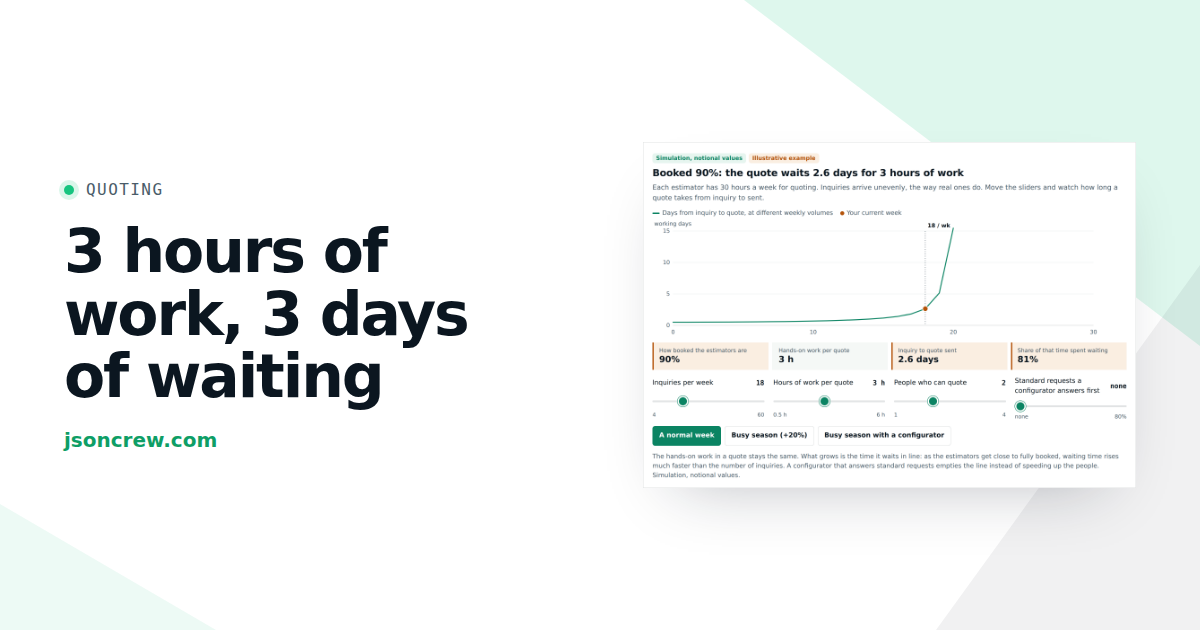
Your estimator is that roofer. Booked 60% of the time, they keep quotes coming in. At 90%, every new inquiry waits in line behind others. Don Reinertsen describes this in The Principles of Product Development Flow (2009): As a team gets close to being fully booked, the queue in front of it grows much faster than the workload.
Try it with your own numbers.
The hands-on time never changes. Only the waiting time does. When a configurator answers part of the standard requests before they reach the estimator, the queue gets shorter.
What does quoting software actually do, and what is CPQ?
Quote software (also called quoting or quotation software) keeps your prices, products and customers in one place and turns them into a clear quote document. It replaces the need to copy and paste.
Quote automation means steps happen without a person: the price is calculated, the document is built, the approval is routed, and the follow-up email goes out on day three. It replaces the waiting between people.
Configure, Price, Quote stands for configure, price, quote. A CPQ system knows which options can go together, prices the valid combination and produces the quote. The key word is “configure”: the system holds the rules, such as “the hydraulic kit only fits frames of 3 meters and up.” In most manufacturing companies those rules live in an old spreadsheet and in one senior estimator’s head. When that person is on vacation, quoting stalls. Getting the rules into a system everyone can use is the real job of quote automation. (More in What CPQ software is.)
The five levels of quote automation
Most companies are not choosing between “Excel” and “a full CPQ.” They are somewhere on a ladder, and the useful question is which rung comes next.
| Level | What it looks like | Where the rules apply | The buyer mostly waits for |
|---|---|---|---|
| 1. Spreadsheet and email | Every quote is built by hand from a price list and memory. | one estimator's head | the estimator |
| 2. Templates and a single price list | one current price list, a standard template, maybe e-signature | still one head | the estimator and the manager |
| 3. Quoting connected to your CRM | quotes from the customer record, routed approvals, reminders, open quotes you can count | still one head | engineering, to confirm the combination |
| 4. Rules-based configurator for reps (CPQ) | reps and dealers pick options, the system blocks what can’t be built and prices the rest | the system | almost nothing on standard products |
| 5. Configurator for buyers | the same rules on your website; the buyer configures at 9 p.m. and sends you a ready configuration | the system | nothing, for standard configurations |
At level 5, your rep’s first call is about delivery and financing. You are the roofer whose number is already in the inbox. (How these work: Product configurators for manufacturers.) AI can draft quote emails and summarize inquiries, and it works best on top of level 3 or 4, where prices and rules are clean.
Pick your level and see which steps are still done by hand.
You don’t have to climb to the top. If you sell five big custom projects a year, level 3 may be all you need. With a hundred similar inquiries a week, levels 4 and 5 start to make sense. Move up one level when the step that makes buyers wait is the one the next level automates.
Akpil: from 3 hours to 4 minutes
Before the configurator, a quote at Akpil took about three hours: a spreadsheet plus a phone call to the warehouse. Now buyers pick a model, configure the variant, and the system checks that the machine fits their tractor, then shows the price and creates the quote. The sales rep gets a ready configuration instead of a blank inquiry.
| Before | After (first 6 months, verified by the company’s team) | |
|---|---|---|
| Time to quote | 3 hours | 4 minutes |
| Buyers who configure before contacting sales | not possible | 78% |
The quote moved from one person’s queue to a system that is always available. Like the first roofer, the company now has room in the calendar.
At Centrum Rekuperacji, a ventilation company, choosing a heat recovery unit in a configurator creates the quote automatically in JSON Hub, our CRM and quoting system.
Through The Tuned Company lens: time-to-quote is dead time
In The Tuned Company, I look at a business as a loop: you set a target, measure, react, and measure again. Engineers call the gap between a move and its visible effect dead time. The days a buyer spends waiting for your number are exactly that. More in the article on feedback loops in business.
You see orders below target and react: more ads, a promotion, a new rep. But today’s orders come from inquiries you got weeks ago, and every day spent on a quote adds to that delay. Three things follow:
- You see the effect of your decisions late. A campaign started in March shows up in orders in May, and by then you have changed it twice. John Sterman at MIT showed in 1989 (the “beer game” experiments, Management Science) that managers consistently overreact when feedback arrives late.
- You measure the wrong thing. “Quotes sent this month” looks busy and tells you little. Time from inquiry to quote, and the share of quotes that turn into orders, tell you much more.
- You push into the bottleneck. If the estimator is already 90% booked, more leads mean a longer line and more lost deals, not more orders.
Here is the same sales loop with different quote delays. Only the delay changes.
The fix, in order: shorten the delay (faster quotes), watch a quicker signal (quotes accepted, not orders shipped), and only then decide how hard to push.
How to choose quote software for a manufacturing business
There are good off-the-shelf options. If your team already works in Salesforce, Salesforce CPQ is the natural place to start. Tacton is built specifically for configuring complex manufactured products. Threekit and Zakeke focus on visual product configuration for the web, including 3D. Many CRMs include solid quoting for levels 2 and 3. Our own, JSON Hub, is one of them: products and prices in a catalog, the quote sent as a link the buyer can open on a phone, adjust and accept with one click, and you see when it was opened. It is priced per company, from $119 net a month for up to five people, with a 30-day free trial.
A custom configurator makes sense when your rules are specific to your products, you want them on your website for buyers and dealers, and your own team should be able to edit them. That is the kind of project we build at JSON Crew. Either way, ask four questions before you buy:
- Who will maintain the rules and prices after launch, and how long does one change take?
- Can a dealer or a buyer use it, or only your inside team?
- Does the configuration reach your CRM and ERP without retyping?
- Can you see time-to-quote and quote-to-order from day one?
More on our approach to digital quoting and Product configurators. On our map of the B2B sales process, this is the Quoting stage.
What to do this week
- Measure time-to-quote. For your last 20 quotes, write down the date the inquiry came in and the date the quote went out.
- Split work from waiting. For three of those quotes, ask the estimator how many hours they actually spent. The difference is your queue.
- List the ten questions you answer every week (sizes, compatibility, lead times, standard prices). Each one is a candidate for a configurator.
- Write down the rules that live in one head. Sit with your senior estimator for an hour and record every “that option doesn’t work with that one.” Whatever tool you pick, this list is the most valuable input.
When quote automation won’t help much
If every order is engineered from scratch, a configurator covers only the standard part. If your price list is out of date or nobody agrees on discounts, fix that first, or automation will send wrong prices faster. And with a handful of inquiries a month, a good template and a CRM reminder may be enough.
Frequently Asked Questions
What is quote software?
Quote software keeps your products, prices and customers in one place and turns them into a consistent quote. Quote automation goes further: it calculates prices, routes approvals and sends follow-ups without someone moving each step by hand.
What is the difference between quote software and CPQ?
Quote software builds the document. CPQ (configure, price, quote) also knows which options go together and blocks combinations that can’t be built. For manufacturers with many options, that check is where most of the time and errors are.
How fast should a manufacturer send a quote?
There is no single number. If the quote reaches buyers after they have already talked to a competitor, it is too slow. For standard products, same day is realistic with a configurator.
Do I need a full CPQ system?
Not necessarily. Many manufacturers get most of the benefit from moving one level up, for example from spreadsheet quotes to quoting in the CRM.
Can buyers configure and get a price on our website?
Yes, if your rules can be written down. That is level 5: buyers configure the product themselves, see the price and send you a ready configuration.
Where is your company getting stuck?
Eight statements about how your company reacts to its numbers. For each one, pick how often it happens to you. At the end you'll see what kind of controller your company is today, what it's missing and where to start.
None of the eight statements applies to your company. Good sign: your decision loop is calm. Check it once a quarter, because the wobble usually starts when you grow or the market shifts.
I'll send you 10 questions to map one process, with tips for your result
✓ Sent
CEO of Ideo Solutions AS
30-minute call
Want to see where your quotes wait?
Email us at contact@jsoncrew.com and we’ll set up a 30-minute call about how your quotes get made today.
How to cite this article: Jędrzej Siewierski, “Quoting Software for Manufacturers: Why Your Quotes Take Days and How to Reduce the Time to Minutes,” JSON Crew, jsoncrew.com, 2026.
If you are at level 1 or 2 and want level 3 next week, try JSON Hub on your own: 30 days free, no card required.