 Jędrzej Siewierski
By Jędrzej Siewierski, CEO and co-founder of JSON Crew.
Thursday, 8:40 p.m. An installer sits at the kitchen table with two site visits from today. Both homeowners want a heat pump price before the weekend. The installer carries two brands. For the first, there’s a PDF price list from last spring, a compatibility table nobody fully remembers, and a distributor rep who answers email the next morning. For the second, there’s the manufacturer’s dealer portal: describe the house, get a matched system with every accessory, and send a branded quote in ten minutes.
Two quotes to write tonight. Which brand goes on both?
(Illustrative example. The installer and the brands are made up, but if you manufacture or distribute HVAC equipment, you know how this works.)
Most HVAC quoting software is built for the contractor. The rules that make a quote right (which unit, which indoor match, which accessories, what it costs this month) reside with you, the manufacturer. Whoever puts those rules in the installer's hands makes their brand the easy one to sell.
In short:
- People searching for „HVAC quoting software” are mostly contractors. This article is for the manufacturer or distributor whose equipment these quotes are for.
- Installers tend to quote the brand they can quote fastest, with the least risk of making a mistake. Every call to the distributor and every outdated PDF pushes them toward another brand.
- A manufacturer's selection and quoting tool offers what a contractor's software cannot: your sizing rules, matched combinations, cold-climate models, required accessories, current prices and stock.
- Quotes created in your own tool are your earliest signal of demand. Distributor orders tell you the same thing weeks later, and more emphatically than it really was.
Who is looking for HVAC quoting software?
Type „HVAC quoting software” or „HVAC estimating software” into Google, and the first page will be filled with contractor platforms and review sites. ServiceTitan, Jobber, Housecall Pro, Tradify, FieldInsight and others are built to run a contracting business: scheduling, dispatch, price books, quotes, invoices, and follow-ups. For a contractor, they're the right place to start.
This article is for the company behind the boxes on the truck. Your installers go looking for quoting software because quoting your product is slow. Their software can contain a price book. It can't know which of your units fits which house. That knowledge resides with your engineers, your technical sales staff, and a few spreadsheets.
What a contractor's estimating software doesn't know about your product
A price book is a list: item, cost, markup. That’s enough for a filter change or a service call. A heat pump quote needs rules. Before the quote is correct, the installer has to answer five questions:
- What size? The heating load depends on the house, the insulation, and the climate. In the US, the standard method is a Manual J load calculation; in the UK, a heat loss calculation under MCS.
- Which model is available in that size? In a cold climate, maybe only your cold-climate line qualifies.
- Which indoor unit goes with it? In the US, ratings apply to the matched system, not to the outdoor unit alone. AHRI lists certified combinations, each with its own reference number, and that certificate may be required when the homeowner applies for an efficiency rebate, incentive, or tax credit. (AHRI)
- What else needs to be shipped with it? Line sets, pads, controls, condensate pumps, backup heating, a cylinder.
- What does it cost today, and is it in stock?
None of these answers are in the installer's price book. They’re at your head office. So the installer calls the distributor and waits, quotes from memory and hopes, or quotes the brand where all of this is already done.
Some manufacturers already operate in this manner. In the UK, Mitsubishi Electric offers installers its Ecodan selection tool: it calculates the heat loss of a building, recommends a specific outdoor unit and cylinder, and generates reports for the job (Mitsubishi Electric, installation tools).
Here’s what „rules inside a tool” means. Describe a house the way an installer would after a site visit.
The installer didn't need a compatibility table or a phone call. Notice also what the tool won't do: guess. When the load is close to a unit's limit, or the house is too big for one standard system, it flags the job and hands it over to a person. Difficult cases are passed on to the engineering team with all the relevant input attached.
The installer quotes the brand that’s easiest to quote
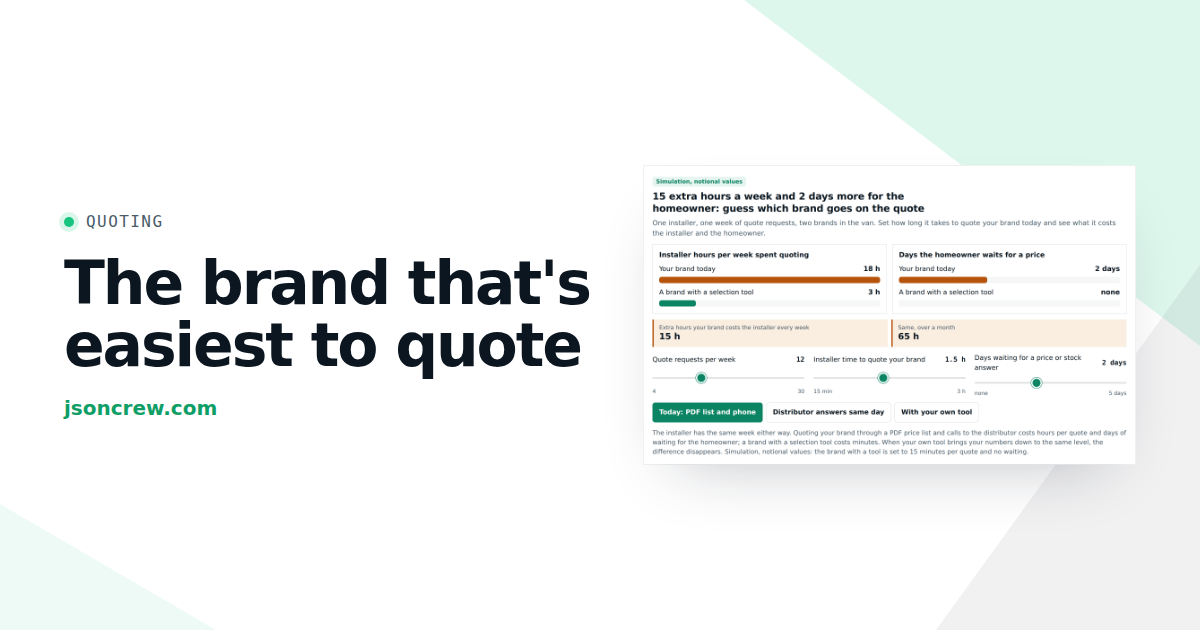
A homeowner waiting on two installers often goes with the one whose clear price arrives first. Installers know this, so they favor brands they can price quickly. If quoting your brand takes 90 minutes of looking things up and two days of waiting for the distributor, and another brand takes 15 minutes, you can guess what happens in a busy week.
Set the numbers for your brand.
Installers rarely say they stopped quoting a brand because it was a hassle. They say the other brand „has better availability” or „the customer preferred it.” The real reason is often the bar set by your brand above.
What should a manufacturer's HVAC quoting software contain?
When we design a selection and quoting tool, the screens are the easy part. The work lies in the six things behind them.
- Your selection rules, written down. Sizing inputs, model families, climate limits, „this indoor unit only with that outdoor unit,” „above this load, call engineering.” In most companies, these rules exist in the minds of two or three people. Writing them down pays off even without software.
- Matched combinations and their documentation. The tool should only produce valid combinations and attach what is required for the rebate or certification (in the US, the AHRI reference number of the matched system).
- Prices per channel. Installers see their net price; homeowners see the price the installer chooses to show.
- A quote that the installer is proud to send. The installer's logo, your product, and a clear list of what's included. Ideally, a web page that opens on a phone.
- A path for homeowners who start on your website. A simpler version of the same rules on your site, with the request routed to a certified installer nearby.
- Data that comes back to you. Every quote tells you the model, the size, the region, and whether it turned into an order. More on that below.
At Centrum Rekuperacji, a heat recovery ventilation company, the customer picks a unit in a configurator and the quote is created automatically in JSON Hub, our CRM and quoting system. Nobody retypes the configuration into a quote document.
Who maintains the rules matters as much as the rules themselves. Ask this of any tool you consider, ours included: when engineering changes a rule on Monday, do installers see it on Monday?
Through The Tuned Company lens: your quotes are your earliest sensor
In The Tuned Company, the way I look at a business as a set of feedback loops, I start with a thermostat. A thermostat is only as good as its sensor. Put the sensor next to a window and the house runs too hot or too cold, however clever the controller is. A business is the same: you steer by what you measure, and a late measurement means late steering. More in the article on feedback loops in business.
Most HVAC manufacturers steer production by distributor orders. That sensor sits far from the homeowner, like a thermostat in the next room. A cold snap changes demand this week, installers quote it next week, installs follow weeks later. Distributors then reorder for the new level and refill their safety stock at the same time, so the order reaches you late and bigger than the real change. Supply chain researchers call this the bullwhip effect; Lee, Padmanabhan and Whang described it in Sloan Management Review in 1997.
Quotes built in your own tool sit right next to the homeowner. Compare the two sensors.
What this gives you:
- You see the change weeks earlier. Quote volume by model and region shows what your distributors will order. You plan production on it instead of reacting to a spike that has already passed.
- You stop overreacting. If your quotes show demand rose by a third, not by double, you raise production by a third.
- You see what you lose. Too many lost quotes in one region, or for one size, point to price, stock or a competitor long before the quarterly numbers do.
On ours sales map system, all of this belongs to the Quoting stage.
Build, buy or extend
The right option depends on how specific your rules are. If your sales team already works in Salesforce, Salesforce CPQ (configure, price, quote: software that knows which options can go together and prices the valid result) is the natural place to look first. Tacton is built for configuring complex manufactured products, and Threekit and Zakeke are strong at visual 3D configuration on the web. A custom tool makes sense when your rules are specific to your range, one set of rules should serve installers, distributors and homeowners, and your own team should be able to change them. That’s the kind of project we build at JSON Crew (Product configurators, digital quoting). If your range fits a catalog and you mainly need quotes out of email and spreadsheets, a CRM with quoting built in may be enough: our JSON Hub sends the quote as a link that the installer or homeowner can open on a phone and accept, from $119 net per month for the entire company. More in quoting software for manufacturers and What CPQ software is.
Whichever way you go, check three things first: can an installer use it on a phone in a driveway without training, does the quote reach your CRM and distributor without retyping, and will you see quotes by model, region and outcome from the first week?
What to do this week
- Quote your own product. Ask a colleague to price a typical retrofit using only what installers get from you. Time it and count the phone calls.
- Ask three installers. Not „do you like our brand,” but „how long does it take you to quote us, and what do you have to ask our distributor?”
- Write down ten rules. Spend an hour with your most experienced technical salesperson and record every „that unit doesn’t work with that one” and „above this size, call us.” That list is the core of any tool.
When a manufacturer’s quoting tool won’t help much
If almost every job is engineered from scratch (large commercial systems, custom air handling), a tool can cover only the standard part, and your engineers stay involved. If installers already quote you quickly through a working distributor portal, improve that first. And if your price lists and compatibility tables disagree today, make them agree before anything else: a tool will only spread the wrong answer faster.
Frequently Asked Questions
What is HVAC quoting software?
HVAC quoting software helps a contractor turn a site visit into a priced quote: equipment, labor, accessories, options. A manufacturer’s quoting tool focuses on the equipment: the right unit, the matched indoor unit and accessories, at current prices.
What is the difference between HVAC quoting software and HVAC estimating software?
The terms overlap. „Estimating” often means calculating cost, materials and labor for a job, especially in commercial work. „Quoting” usually means producing the customer-facing price. Most tools do both.
Does a selection tool replace a Manual J or MCS heat loss calculation?
No. A good tool can make a first estimate and flag when a full calculation is needed, or take the result of one as an input. Sizing standards stay where they are.
Can homeowners use the same tool on our website?
Yes, in a simpler form. The same rules can show a homeowner a suitable system and a starting price, then route the request to a certified installer nearby. At Centrum Rekuperacji, the customer picks a heat recovery unit in a configurator and the quote is created automatically.
Where is your company getting stuck?
Eight statements about how your company reacts to its numbers. For each one, pick how often it happens to you. At the end you'll see what kind of controller your company is today, what it's missing and where to start.
None of the eight statements applies to your company. Good sign: your decision loop is calm. Check it once a quarter, because the wobble usually starts when you grow or the market shifts.
I'll send you 10 questions to map one process, with tips for your result
✓ Sent
CEO of Ideo Solutions AS
One question
Want to see how long it takes to quote your product?
How long does it take an installer to quote your unit today? Reply with minutes or hours to contact@jsoncrew.com, and we’ll write back with where we think the time goes.
How to cite this article: Jędrzej Siewierski, „HVAC Quoting Software: Why the Best Option for Your Installers Should Come From You,” JSON Crew, jsoncrew.com, 2026.